If you were to ask any crystal collector where their journey began, there is a very good chance they would point to a piece of quartz. It is the most abundant mineral on Earth’s surface, yet it manages to be one of the most diverse and captivating families of stones in existence. From the pale pink of a Rose Quartz heart to the deep, smoky mystery of a Morion point, quartz crystals seem to have a personality for everyone.
For beginners, the world of quartz can be both exciting and slightly confusing. You might see two stones that look completely different—one purple and one yellow—and be surprised to learn they are practically siblings. Understanding the different varieties of quartz crystals is like learning the members of a very large, very colorful family.
This guide is here to introduce you to the most beloved and common members of this mineral group. We will explore what makes each variety unique, where they get their stunning colors, and why they have been cherished for centuries. Whether you are looking to start a collection or simply curious about that shiny stone on your desk, you are in the right place.
Let’s dive into the sparkling world of quartz crystals and discover the varieties you are most likely to encounter.
What Makes Quartz So Special?
Before we meet the individual family members, it helps to understand what ties them all together. At its core, every single stone we will discuss today is made of the same two things: silicon and oxygen. This chemical composition (silicon dioxide) creates a hard, durable mineral that ranks a 7 on the Mohs scale of hardness.
This durability is one reason why quartz crystals are so popular. They aren’t fragile flowers; they can handle being worn as jewelry, carried in pockets, or displayed on sunny windowsills.
The “magic” of quartz variety comes from impurities. Pure quartz is perfectly clear and colorless. However, when nature adds a pinch of iron here, a dash of titanium there, or exposes the stone to natural radiation deep underground, the crystal transforms. These tiny changes create the rainbow of colors we know and love.
As you read through these varieties, remember that they share this same sturdy, crystalline heart, no matter how different they look on the outside.
The Essential Varieties: The “Big Three”
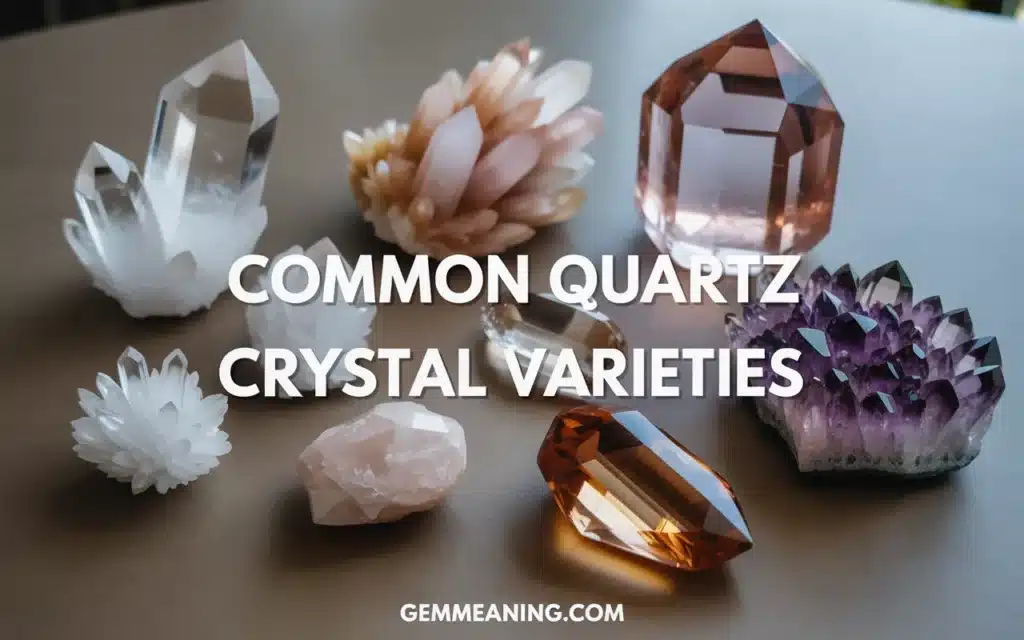
If you walk into any crystal shop in the USA, from a high-end boutique to a museum gift shop, you are guaranteed to find these three. They are the pillars of the crystal world and the perfect starting point for any collection.
1. Clear Quartz: The Master Healer
We have to start with the classic. Clear Quartz is exactly what it sounds like—transparent, colorless silicon dioxide. It is often called “Rock Crystal” to distinguish it from lead crystal glass.
What It Looks Like:
In its natural form, Clear Quartz often grows in six-sided prisms with a pointed termination. It can be icy clear, almost like frozen water, or it can have interesting mists, veils, and inclusions inside.
Why It’s Popular:
Clear Quartz is renowned for its versatility. In the metaphysical community, it is known as the “Master Healer” because it is believed to amplify energy and intention. It’s like a blank canvas; you can use it for almost any purpose. Its clarity and brilliance make it a stunning addition to any room, reflecting light and adding a sense of brightness to a space.
2. Amethyst: The Purple Beauty
Amethyst is arguably the most famous colored gemstone in the quartz family. It is the birthstone for February and has been associated with royalty for thousands of years because of its rich purple hue.
What It Looks Like:
Amethyst ranges from a barely-there lilac blush to a deep, dark royal purple. It often forms in geodes—hollow rocks lined with sparkling crystals. You might also see “chevron amethyst,” which has zigzag bands of white quartz and purple amethyst.
The Science of the Color:
That beautiful purple comes from trace amounts of iron within the crystal structure that have been irradiated by natural radiation in the surrounding rocks. It’s a fascinating example of how geology paints with chemistry.
Why It’s Popular:
Amethyst is widely loved for its calming energy. It is often suggested as a stone for sleep, relaxation, and stress relief. Its accessibility and stunning color make it a favorite for jewelry and home decor alike.
3. Rose Quartz: The Stone of Love
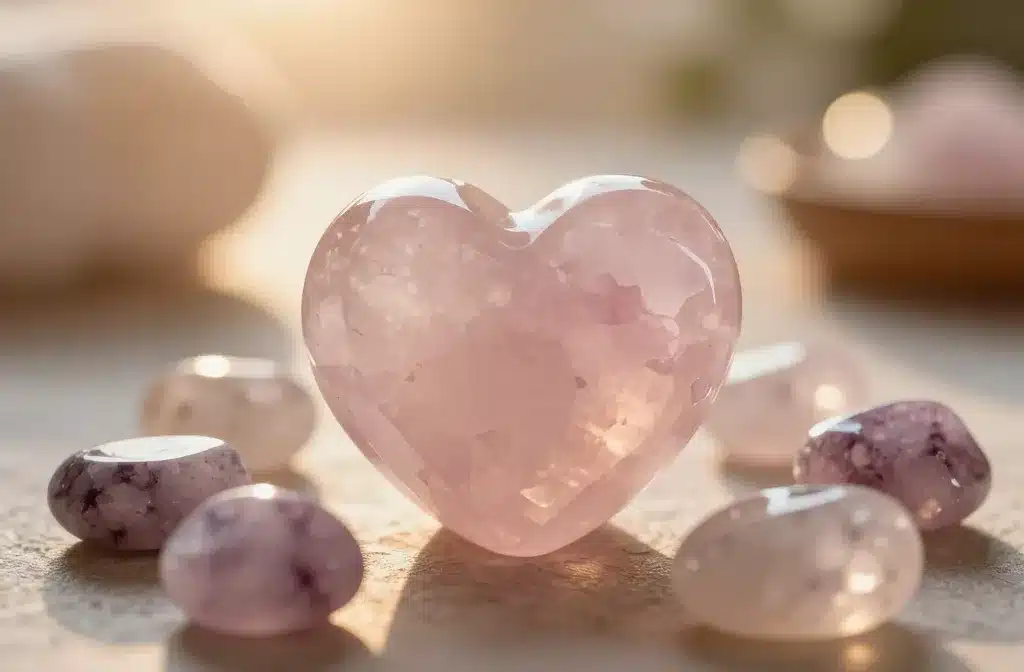
If Amethyst is the stone of calm, Rose Quartz is the stone of the heart. This variety is famous for its soft, gentle pink color and is a staple in collections around the world.
What It Looks Like:
Unlike Clear Quartz or Amethyst, Rose Quartz rarely forms distinct crystal points. It is usually found in massive chunks. It has a cloudy, translucent appearance and ranges from very pale, almost white-pink, to a deeper, rosy hue.
The Science of the Color:
The source of the pink color in Rose Quartz has been debated by scientists for a long time. Recent research suggests it is caused by microscopic fibrous inclusions of a mineral related to dumortierite within the quartz.
Why It’s Popular:
Rose Quartz is universally associated with love—romantic love, self-love, and friendship. Its gentle, nurturing vibe makes it a popular gift. It is soft, approachable, and undeniably pretty.
The Earthy and Grounding Varieties
Not all quartz crystals are bright and colorful. Some varieties carry the colors of the earth—browns, blacks, and yellows. These stones are often sought after for their grounding qualities and their sophisticated, moody aesthetics.
4. Smoky Quartz
Smoky Quartz is the mysterious cousin of Clear Quartz. It embodies elegance and grounding energy, often looking like crystallized smoke captured in stone.
What It Looks Like:
This variety can range from a very light, transparent brownish-gray to a deep, nearly opaque black (often called Morion). Despite its dark color, it usually retains the transparency of quartz, allowing light to glow through it in a beautiful way.
The Science of the Color:
Like Amethyst, Smoky Quartz gets its color from natural radiation interacting with aluminum traces within the crystal lattice. It is perfectly safe to handle; the radiation happened millions of years ago during formation!
Why It’s Popular:
Smoky Quartz is a favorite for those who feel scattered or overwhelmed. It is considered a premier grounding stone, helping to anchor energy and provide stability. Its neutral color palette also makes it very easy to integrate into modern home decor.
5. Citrine
Citrine is the sunny, golden member of the quartz family. Named after the French word for lemon (“citron”), this stone is all about brightness and warmth.
What It Looks Like:
Natural Citrine is relatively rare and usually has a pale yellow to smoky champagne color. However, most Citrine on the market is actually heat-treated Amethyst. This treated variety has a vibrant orange or reddish-amber color and a white base. Both are chemically quartz, but their origins differ.
Why It’s Popular:
Citrine is known as the “Merchant’s Stone” or the stone of abundance. It is associated with prosperity, joy, and success. Its cheerful yellow color is an instant mood booster, making it a lovely stone to keep on a desk or workspace.
6. Tiger’s Eye
You might be surprised to learn that Tiger’s Eye is a member of the quartz family! It is a metamorphic rock with a unique structure that gives it a distinct appearance.
What It Looks Like:
Tiger’s Eye is famous for its chatoyancy—the “cat’s eye” effect where a band of light seems to move across the stone as you turn it. It features bands of gold, brown, and yellow, with a silky luster.
The Science of the Appearance:
This stone forms when quartz replaces the mineral crocidolite (a type of asbestos), keeping the fibrous structure but encasing it safely in hard quartz. The fibrous structure reflects light to create that captivating shimmer.
Why It’s Popular:
Tiger’s Eye is the ultimate stone of courage and confidence. It has a masculine, earthy energy that appeals to many people. It feels protective and strong, making it popular for men’s jewelry and pocket stones.
The Included Quartz Varieties
Sometimes, quartz acts as a clear container for other minerals. These “included” quartz varieties are like miniature terrariums, freezing other materials in time inside the crystal. These are fascinating to look at under a magnifying glass.
7. Rutilated Quartz
Rutilated Quartz looks like it has been plugged into an electric socket. It is Clear Quartz or Smoky Quartz that is shot through with needle-like strands of a mineral called Rutile.
What It Looks Like:
The needles inside can be golden, copper, silver, or even black. Golden Rutilated Quartz is particularly stunning, looking like strands of angel hair or straw trapped in ice.
Why It’s Popular:
Collectors love Rutilated Quartz for its uniqueness. No two pieces are ever the same. The complex patterns of the needles make it a visual feast. Energetically, it is believed to be an illuminator for the soul and a filter for negative energy.
8. Tourmalinated Quartz
This is a dramatic and high-contrast variety. It consists of Clear Quartz containing long, black needles of Black Tourmaline (Schorl).
What It Looks Like:
The contrast between the pristine white or clear quartz and the jet-black spikes is striking. It looks like black-and-white abstract art created by nature.
Why It’s Popular:
This stone combines the amplifying properties of quartz with the protective properties of tourmaline. It is seen as a powerful shield that also brings clarity. The bold aesthetic makes it a favorite for statement jewelry pieces.
9. Strawberry Quartz
True Strawberry Quartz is quite rare, but it’s a delightful find. It gets its name from the speckled red inclusions that make it look like strawberry jam.
What It Looks Like:
It is usually clear or pale quartz with tiny red dots or flakes of iron oxide minerals like Lepidocrocite or Hematite suspended inside. This gives the whole stone a reddish-pink glow.
Why It’s Popular:
It has a playful and sweet energy. While often confused with standard Rose Quartz or man-made glass imitations (often called “Cherry Quartz”), genuine Strawberry Quartz has a unique depth and sparkle that collectors cherish.
The Microcrystalline Varieties: Chalcedony
Now we enter a slightly different branch of the family tree. So far, we have discussed macrocrystalline quartz—crystals you can see with your naked eye. But quartz also forms in microscopic crystals tightly packed together. This group is broadly called Chalcedony.
While these don’t look like the pointed crystals we discussed earlier, they are chemically the same: silicon dioxide.
10. Agate
Agate is the artistic painter of the quartz world. It forms in concentric layers, usually filling cavities in volcanic rocks.
What It Looks Like:
Agate is defined by its banding. Slice open an Agate nodule, and you will see stripes, swirls, and eyes in every color imaginable. From Blue Lace Agate to Moss Agate (which looks like it contains tiny ferns), the variety is endless.
Why It’s Popular:
Agate is incredibly grounding and stabilizing. Because it is tough and durable, it is often used for coasters, bookends, and slices of home decor. It’s a very accessible entry point for kids interested in geology because of the fun patterns.
11. Jasper
Jasper is the opaque cousin of Agate. While Agate is usually translucent (light shines through), Jasper is solid and dense.
What It Looks Like:
Jasper comes in earthy tones of red, yellow, brown, and green. It is often patterned with spots or swirls. Red Jasper is a rusty brick red, while Ocean Jasper has orb-like patterns in greens and pinks.
Why It’s Popular:
Jasper is known as the “Supreme Nurturer.” It feels solid, comforting, and supportive. It’s the kind of stone you want to hold in your hand when you need to feel brave and persistent.
12. Carnelian
Carnelian is a fiery orange to red variety of Chalcedony. It captures the energy of a sunset in stone form.
What It Looks Like:
It can range from a pale apricot orange to a deep, rusty brown-red. It is usually translucent and glows beautifully when held up to the light. It has a warm, waxy luster.
Why It’s Popular:
Carnelian is the stone of creativity and motivation. It is beloved by artists, performers, and anyone needing a kick of energy. Its vibrant color makes it a standout piece in any collection, contrasting beautifully with cooler stones like Amethyst.
How to Identify Your Quartz Crystals
With so many varieties, how do you know what you are looking at? Identifying quartz crystals can be a fun detective game. Here are a few tips for beginners.
Check the Hardness:
Remember, all quartz ranks a 7 on the Mohs scale. This means it will scratch glass (which is about a 5.5) but will not be scratched by a steel knife. If a stone is easily scratched by a penny, it’s not quartz (it might be Calcite).
Look for Transparency:
Macrocrystalline varieties (Amethyst, Citrine, Smoky) are usually transparent to translucent. You should be able to see light through them. If it is completely solid and opaque, it is likely a microcrystalline variety like Jasper.
Examine the Fracture:
Quartz doesn’t break in flat planes (cleavage). Instead, it has a “conchoidal” fracture. This means it breaks with curved, shell-like ripples, similar to how thick glass breaks. Look for these curved chips on raw stones.
Temperature Test:
Real quartz crystals usually feel cool to the touch when you first pick them up, unlike plastic or glass which warm up quickly to your body temperature.
Caring for Your Quartz Collection
One of the best things about quartz crystals is how low-maintenance they are. Because they are hard and durable, they don’t require too much fuss. However, a few simple care tips will keep them looking their best.
Cleaning:
Most quartz varieties can be safely cleaned with warm water and mild soap. You can use a soft brush to get dust out of crevices.
- Note: Be careful with geodes or clusters, as the matrix rock holding the crystals might be softer than the quartz itself.
Sunlight Safety:
This is the most important rule for colored quartz. Amethyst, Rose Quartz, Citrine, and Smoky Quartz can fade if left in direct sunlight for long periods. The UV rays can bleach the color, turning your vibrant purple Amethyst into a pale gray. It is best to display these beauties on a shelf away from harsh, direct window light.
Storage:
Because quartz is harder than many other minerals (like Fluorite or Calcite), it can scratch them if thrown together in a box. It is best to wrap individual pieces or store them in a way where they don’t rub against softer stones.
Building Your Own Quartz Family
The world of quartz crystals is vast, colorful, and incredibly welcoming. You don’t need to spend a fortune to start a beautiful collection. In fact, many people start by simply picking up a tumbled piece of Tiger’s Eye or a small point of Clear Quartz that catches their eye at a local shop.
There is a special joy in recognizing the family resemblance between a striped Agate and a sparkling Amethyst point. They are different expressions of the same geological building blocks, shaped by the unique conditions of their birth deep within the Earth.
We encourage you to explore these common varieties. Hold them, look at them under a light, and see which ones resonate with you. Whether you are drawn to the fiery energy of Carnelian or the cool tranquility of Rose Quartz, there is a member of the quartz family waiting to go home with you.
So next time you see a display of stones, take a closer look. You might just find that the most common crystals are actually the most extraordinary. Happy collecting!

Christian Grey is the creator of GemMeaning, where he shares simple insights about crystals, gemstone meanings, and spiritual guidance. His focus is on making complex ideas easy to understand and practical for everyday life.