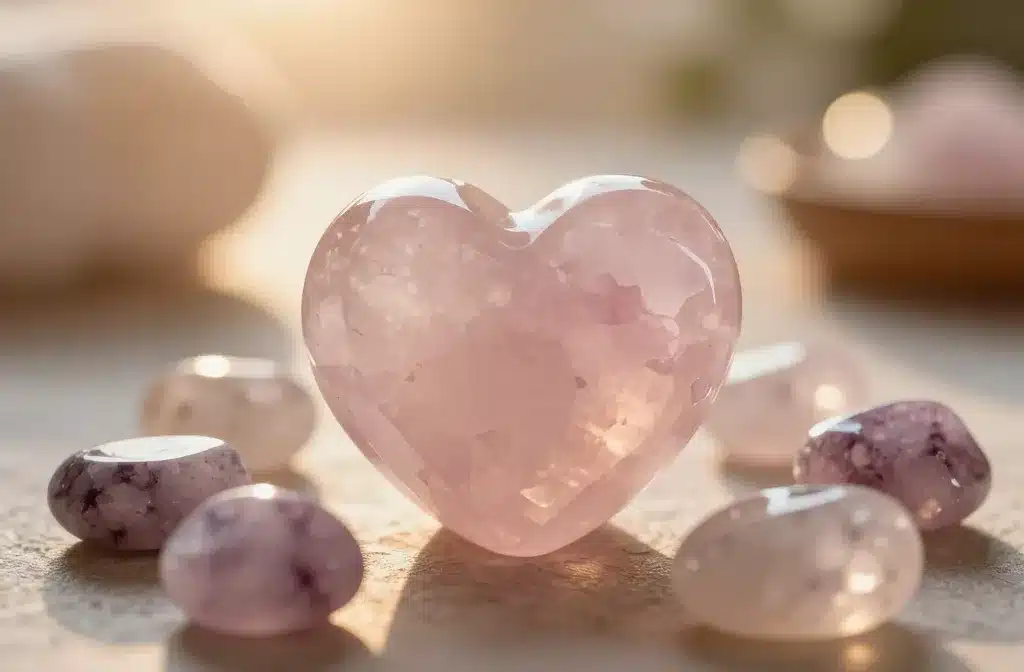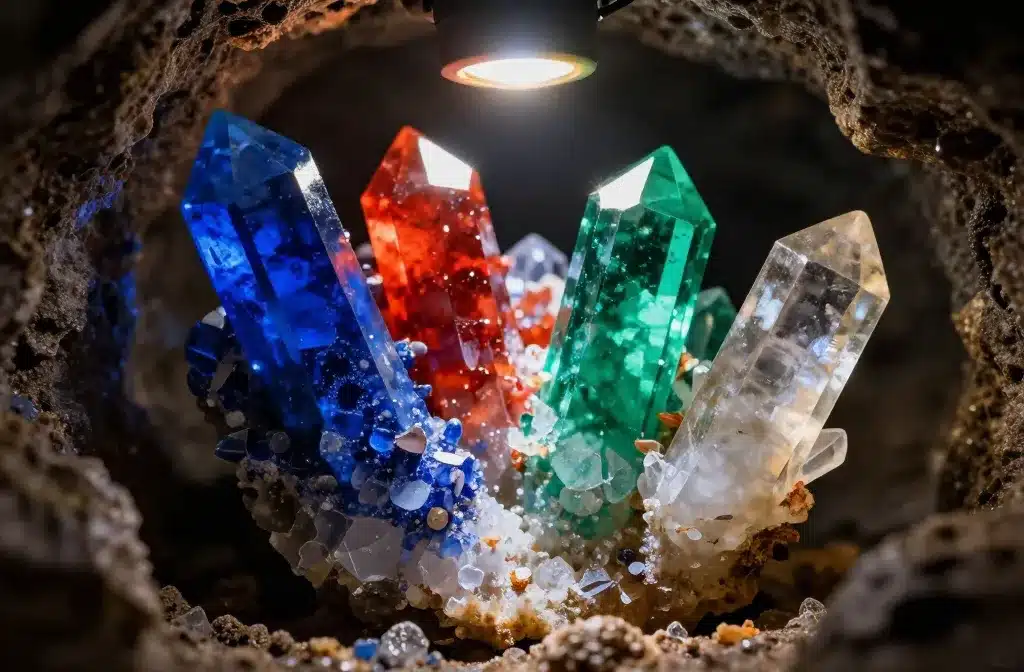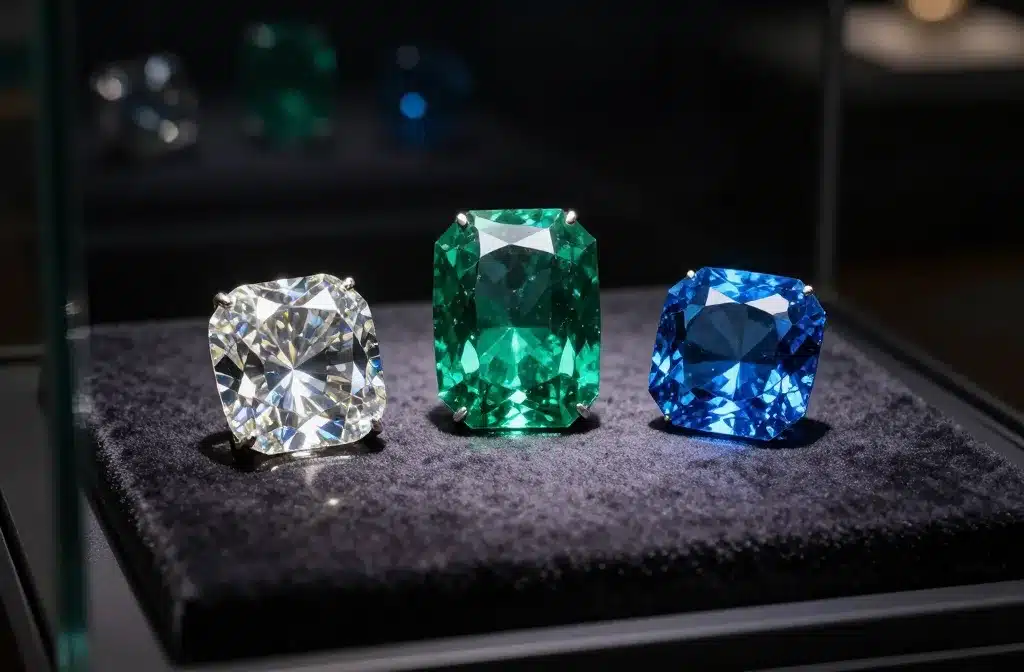
Walk into any crystal shop, and you will be greeted by bins of beautiful, accessible stones like Rose Quartz and Amethyst. They are staples for a reason—they are abundant, affordable, and beloved by many. But then, tucked away in a glass case, you might see a small, unassuming stone with a surprisingly high price tag. You have just encountered one of the elusive members of the mineral kingdom: a rare crystal.
It is easy to assume that rarity is just about beauty or demand, but the real story is much more complex and fascinating. It is a tale of geological chance, of elements that hardly ever meet, and of conditions so specific that they have only occurred a handful of times in our planet’s 4.5-billion-year history. Understanding what makes some crystals rare transforms your appreciation from “that’s expensive” to “that’s a miracle.”
This guide will demystify the factors that contribute to a crystal’s scarcity. We will explore the specific geological, chemical, and human elements that elevate a simple mineral to the status of a rare crystal. Get ready to discover why some stones are as common as sand, while others are geological celebrities.
The Recipe for Rarity: It Starts with the Ingredients
The most fundamental reason some crystals are rare is chemistry. Every crystal is a specific recipe of chemical elements arranged in a perfect, repeating pattern. For a common crystal like Quartz, the ingredients—silicon and oxygen—are the two most abundant elements in the Earth’s crust. It’s like trying to bake a cake where flour and sugar are available everywhere.
However, many rare crystals require ingredients that are incredibly scarce. Certain elements are just not very common in the Earth’s crust.
The Scarcity of Elements
Think about elements like beryllium, lithium, cesium, or tantalum. These are not household names for a reason. They are sprinkled throughout the Earth’s crust in tiny, trace amounts. For a crystal to form that requires one of these elements as a primary ingredient, it needs to be in a location where that element has become highly concentrated.
A great example is the mineral Bixbite, also known as Red Beryl. It is one of the rarest crystals on the planet. Like its cousins, Emerald and Aquamarine, it is a variety of the mineral beryl. While standard beryl requires beryllium (which is already uncommon), Red Beryl needs an extra, even rarer ingredient: manganese.
The only place on Earth where a high concentration of both beryllium and manganese came together under the right conditions was in the Wah Wah Mountains of Utah. This is why Red Beryl is found in only one location on the entire planet, making it astronomically rare.
The Unlikely Combination
Sometimes, the individual ingredients are not exceptionally rare on their own, but they almost never appear in the same place at the same time. It is like having two friends who live on opposite sides of the country and have never met.
Tanzanite is a perfect example of this. It is a blue-violet variety of the mineral zoisite. The specific geological conditions required to form Tanzanite—including the presence of the element vanadium—have only ever been found in one small area at the foothills of Mount Kilimanjaro in Tanzania.
Vanadium is not the rarest element, but its convergence with the other necessary components in that one specific spot is a geological fluke, making Tanzanite one of the most sought-after rare crystals in the world.
The Second Hurdle: Extreme Geological Conditions
Even if all the right chemical ingredients are present, they are just a pile of materials until they are “cooked” under the right conditions. The formation of rare crystals often requires a geological environment so specific and extreme that it barely ever happens.
1. The Perfect Pressure and Temperature Window
Every crystal has a specific “stability field”—a narrow range of temperature and pressure at which it can form. If it is too hot, too cold, too much pressure, or not enough, a different mineral will form, or no crystal will form at all.
Diamonds are a famous example. They are simply carbon atoms, but they require the immense pressure and high temperatures found deep within the Earth’s mantle, about 100 miles below the surface. Carbon that doesn’t experience these conditions forms common graphite instead. The journey to bring those diamonds to the surface via volcanic eruptions without them converting back to graphite is another part of their rare story.
Another stunning example is Painite. For decades, it was considered the rarest mineral on Earth. It requires boron and zirconium, two elements that are almost never found together in nature. Even more unlikely, the conditions needed to form Painite are so precise that for many years, only two small crystals were known to exist.
2. The Need for Open Space
For a mineral to grow into a beautiful, well-formed crystal with sharp faces and points, it needs room to grow. This usually means a pocket or cavity within the rock. Most of the time, crystals grow in cramped, crowded conditions, forming interlocking masses of rock.
The stunning “Herkimer Diamonds” from New York are not actually diamonds, but are a type of quartz. What makes them rare and special is that they grew very slowly in pockets within dolostone rock, allowing them to form as “double-terminated” points (points at both ends). This specific growth environment is uncommon, making these quartz crystals much rarer than standard quartz.
3. A Slow and Steady Growth Rate
Time is a crucial ingredient. The largest and most perfect crystals are the ones that grew incredibly slowly over thousands or millions of years in a stable environment. Any sudden change in temperature, pressure, or chemistry can halt growth or cause flaws in the crystal.
Finding a location that remains geologically stable for that long, with a constant supply of mineral-rich fluids, is exceptionally rare. This is why a massive, flawless crystal of any kind is far rarer than a small, included one.
Location, Location, Location: Geographical Rarity
The third major factor in what makes some crystals rare is geography. As we saw with Red Beryl and Tanzanite, some minerals are only found in a single, specific location. This is known as a “type locality.” When a mineral’s entire world population comes from one mine, its rarity and value skyrocket.
Single-Source Minerals
When a crystal is found in only one place, its supply is inherently limited. If that mine closes down, becomes depleted, or is located in a politically unstable region, the availability of that crystal on the market can cease almost overnight.
- Larimar: This beautiful, sky-blue variety of pectolite is found only in a single square kilometer in the Dominican Republic. Its color mimics the Caribbean Sea, and its limited source makes it a prized collector’s stone.
- Alexandrite: While the original source in Russia’s Ural Mountains is largely depleted, new sources have been found. However, the original Russian Alexandrite, famous for its dramatic green-to-red color change, remains one of the most coveted rare crystals because its original locality is gone.
The Difficulty of Extraction
Some crystals might be more common deep within the Earth, but they are rare on the surface because they are incredibly difficult to mine. They might be located in remote, inhospitable environments like the high Andes or deep in the Siberian tundra.
The cost and danger associated with extracting these minerals mean that very little of the material ever makes it to market, artificially increasing the rarity of the specimens we do see.
Durability and Survival: The Final Test
A mineral might form against all odds, but it still has to survive a brutal journey to the surface and millions of years of weathering to be found by humans. Many rare crystals are also quite soft or fragile, meaning they rarely survive intact.
The Mohs Hardness Scale
Hardness plays a big role in a crystal’s survival. Hard minerals like diamond (10) or corundum (9) can survive the violent journey from the mantle and the grinding action of rivers and glaciers.
Softer minerals are often destroyed before we ever get a chance to see them. For example, some stunning sulfate crystals form in hydrothermal vents, but they are water-soluble. They dissolve as soon as they are exposed to rain. A crystal that is too soft or chemically unstable simply does not last, making well-preserved specimens incredibly rare.
The Perils of Weathering
Even hard minerals can be broken down over time. Erosion by wind, water, and ice can turn a beautiful crystal cluster into a handful of sand. A crystal must be located in a geological setting where it is protected from these forces until it is discovered. Geodes are a perfect example of this, where a hard outer shell protects the delicate crystals inside for millions of years.
The Human Factor: Demand and Recognition
Finally, we cannot ignore the human element in what makes some crystals rare. A mineral can be geologically scarce, but if no one knows about it or wants it, it isn’t considered a “rare gem.”
The Power of Marketing and Fashion
The story of Tanzanite is a great example. When it was first discovered in the 1960s, it was a geological curiosity. It wasn’t until Tiffany & Co. launched a major marketing campaign in 1968, naming it “Tanzanite” after its country of origin, that it became a global sensation. The demand created by this campaign cemented its status as one of the top-selling colored gemstones, and its price soared.
Collector Demand
The world of mineral collecting also plays a huge role. When a new, beautiful mineral is discovered, word spreads quickly among high-end collectors. This can create intense demand for the first few specimens to come out of a new mine, driving up the price and perceived rarity.
Sometimes, a crystal is rare simply because it is a unique variety of a common mineral. For example, a quartz crystal containing a perfect, bubble-like inclusion of water (an “enhydro”) is far rarer and more valuable to a collector than a standard quartz point.
Examples of Stunningly Rare Crystals
Let’s look at a few more examples that tie these concepts together:
- Benitoite: California’s state gem, this brilliant blue crystal is only found in gem-quality in one small area in San Benito County. It requires a bizarre geological environment where sodium, barium, and titanium come together in a subduction zone. It’s a perfect storm of rare ingredients and rare conditions.
- Black Opal: While opal is common, the precious Black Opal from Lightning Ridge, Australia, is exceedingly rare. It needs a specific type of ironstone and carbon to form its dark body tone, which makes the flashes of color more dramatic. The unique geology of this one area is what makes it so special.
- Paraíba Tourmaline: Discovered in the 1980s in the Brazilian state of Paraíba, this tourmaline variety has a shocking, electric blue-green color caused by traces of copper. Copper had never been seen as a coloring agent in tourmaline before. The original mines are now depleted, making these neon gems some of the most expensive and rare crystals on the market.
Appreciating the Miracle of Rarity
Understanding why some crystals are rare gives us a new lens through which to view them. That tiny, expensive stone is not just a luxury item; it is a geological survivor. It is the end result of a cosmic lottery that played out over millions of years, involving a specific recipe of elements, a precise set of cooking instructions, a unique geographic location, and a stroke of luck to survive until today.
The next time you see a display of rare crystals, take a moment to consider the incredible journey that specimen took. It is a tangible piece of our planet’s most exclusive and secret history, a story of chance and chemistry that is unlikely to ever be repeated. We encourage you to ask questions, learn the stories behind the stones, and appreciate the profound scarcity that makes these natural wonders so truly special.

Christian Grey is the creator of GemMeaning, where he shares simple insights about crystals, gemstone meanings, and spiritual guidance. His focus is on making complex ideas easy to understand and practical for everyday life.