Have you ever picked up an interesting stone on a walk and wondered what to call it? It might have a bit of sparkle, some cool stripes, or a unique shape. We often use the words “rock,” “mineral,” and “crystal” almost interchangeably to describe these treasures from the earth. While it’s easy to lump them all together, each term has a distinct meaning that tells a part of a fascinating geological story.
Understanding the difference between rocks, minerals, and crystals can completely change how you see the world around you. It turns a simple stone into a history lesson and a sparkling gem into a marvel of chemistry. This guide will gently unravel the definitions, explaining the relationship between these three terms in a simple, friendly way.
We will start with the biggest category and work our way down to the most specific, clarifying how minerals, crystals, and rocks are all connected. By the end, you’ll have the confidence to identify what you’re looking at and a much deeper appreciation for the natural world. Let’s dig in and sort out the terminology.
Start with Rocks: The Planet’s Building Blocks
The best place to begin is with the most general term: rocks. A rock is a naturally formed solid made up of a collection of mineral grains. Think of a rock as a fruitcake. The cake itself is the rock, and the various bits of fruit, nuts, and peel inside are the different minerals.
Most rocks are aggregates, meaning they are composed of two or more different minerals all stuck together. If you look closely at a piece of granite, for instance, you can see distinct specks of different colors. You might see milky white specks (feldspar), glassy grey specks (quartz), and shiny black flakes (mica or hornblende). All these mineral ingredients are baked together to form one single rock.
Rocks are the very foundation of our planet. They make up the continents, mountains, and the seafloor. Geologists classify them into three main groups based on how they were formed, which tells a story about their past.
1. Igneous Rocks
These are rocks born from fire. Igneous rocks form when molten rock (magma from below the surface or lava from a volcano) cools and solidifies. Granite is an example of magma that cooled slowly underground, while basalt is lava that cooled quickly on the surface.
2. Sedimentary Rocks
These rocks are made from bits and pieces of other things. Over millions of years, particles of sand, shell, mud, and other debris settle in layers, often at the bottom of lakes or oceans. The immense pressure from the layers above cements these particles together to form a new rock. Sandstone, limestone, and shale are common sedimentary rocks.
3. Metamorphic Rocks
These are rocks that have been changed. When an existing rock—be it igneous, sedimentary, or even another metamorphic rock—is subjected to intense heat and pressure deep within the Earth, it transforms. Its chemical structure and texture change without melting completely. For example, limestone can metamorphose into marble, and granite can become gneiss.
Understanding rocks is the first step in our journey through minerals, crystals, and rocks, as rocks are the “homes” where minerals are often found.
Minerals: The Pure Ingredients
If rocks are the fruitcake, then minerals are the individual ingredients like the sugar, flour, and cherries. A mineral is a naturally occurring, inorganic solid that has a definite chemical composition and an ordered internal structure. Let’s break that definition down.
- Naturally Occurring: A mineral must be formed by natural processes, not in a lab.
- Inorganic: It cannot be made from living matter. Coal, for example, is not a mineral because it comes from plants.
- Solid: A mineral must be solid at standard temperatures.
- Definite Chemical Composition: This means it has a specific chemical recipe. The recipe for quartz is always one part silicon to two parts oxygen (SiO₂).
- Ordered Internal Structure: This is the most important part. The atoms inside a mineral are not just jumbled together; they are arranged in a specific, repeating, three-dimensional pattern.
There are over 5,000 known mineral species on Earth, from common ones like quartz and feldspar to rare ones like painite. While rocks are mixtures, minerals are pure substances with their own unique identity.
How to Identify Minerals
Scientists and hobbyists identify minerals using a set of physical properties that arise from their chemical composition and internal structure. These include:
- Color: The most obvious but often least reliable property, as many minerals come in multiple colors.
- Hardness: Measured on the Mohs scale from 1 (softest) to 10 (hardest), this tests a mineral’s resistance to scratching.
- Luster: How the mineral’s surface reflects light (e.g., metallic, glassy, dull).
- Streak: The color of the mineral’s powder when scraped across an unglazed porcelain plate.
- Cleavage and Fracture: How a mineral breaks. Cleavage is a clean break along a flat plane, while fracture is an irregular or curved break.
These properties help distinguish the different types of minerals, crystals, and rocks you might find.
Crystals: The Perfect Expression of a Mineral
This brings us to the most specific and often most beautiful term: crystals. So, what is the difference between a mineral and a crystal? The answer is simple: a crystal is the best possible version of a mineral.
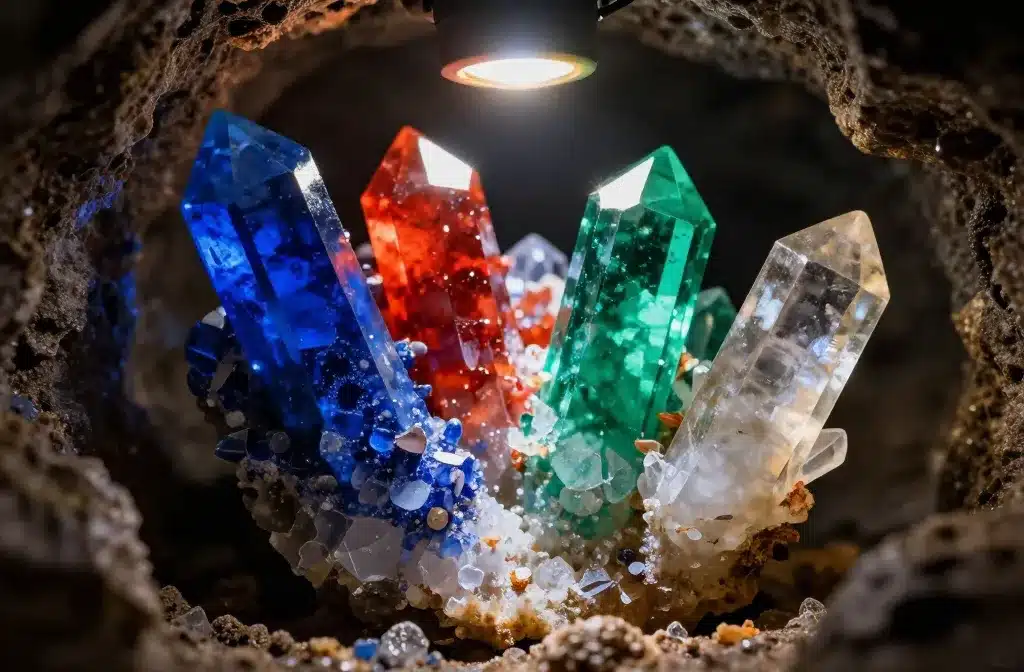
Remember that a mineral has an “ordered internal structure.” A crystal is what happens when a mineral is allowed to grow in an open space, and that internal, repeating pattern can express itself externally. The orderly arrangement of atoms on the inside creates the beautiful, flat faces and sharp, geometric shapes we see on the outside.
Think of it this way: all crystals are minerals, but not all minerals are formed into visible crystals. Most minerals grow in cramped, crowded conditions, pressing up against other minerals. This results in an interlocking mass of tiny mineral grains with no distinct shape. While the internal structure is still crystalline, there is no outward expression of it.
A well-formed crystal—like a six-sided quartz point or a perfect pyrite cube—is a rare gift from nature. It means that the mineral had the perfect conditions to grow:
- Space: An open pocket or cavity to grow into.
- Time: A slow, stable growth period over thousands of years.
- Ingredients: A steady supply of the right chemical elements from water or magma.
Therefore, a crystal is not a different substance from a mineral; it’s just a mineral that hit the geological jackpot and was able to grow into its ideal geometric form.
The Relationship Explained: A Simple Analogy
The relationship between rocks, minerals, and crystals can be a little confusing, so let’s use an analogy with water.
- Rock is like a snowbank. A snowbank is made up of countless individual snowflakes all packed together. It doesn’t have a single, uniform structure; it’s a mass of smaller components. Similarly, a rock is a mass of mineral grains.
- Mineral is like water (H₂O). Water is a specific chemical compound with a defined formula. It’s the “pure ingredient.” A mineral is also a pure substance with a specific chemical recipe.
- Crystal is like a snowflake. A snowflake is the beautiful, geometric form that water takes when it freezes under the right conditions. Its six-sided shape is the outward expression of the internal arrangement of H₂O molecules. A crystal is the same—it’s the beautiful form a mineral takes when it grows freely.
So, when you see minerals, crystals, and rocks together, you are looking at different levels of geological organization.
Putting It All Together: A Real-World Example
Let’s imagine you find a large piece of granite.
- The entire piece is the rock. It’s an igneous rock made of a mixture of different mineral grains.
- As you look closer, you can see the individual grains. The small, grey, glassy bits are the mineral quartz. The pinkish, opaque bits are the mineral feldspar. These are the ingredients.
- Now, imagine this granite had a hollow pocket inside it (a vug). Inside that pocket, the quartz had room to grow freely. Instead of being a shapeless grain, it formed a perfect, six-sided crystal with a pointed tip.
The rock is the house, the minerals are the bricks, and the crystal is a perfectly-formed, standalone brick that was allowed to take its ideal shape.
Opaque Stones vs. Translucent Crystals
In many shops, you might see the term “stone” used for opaque minerals like Jasper and “crystal” used for translucent ones like Amethyst. While this is a common and practical way to categorize them, it’s not scientifically precise.
Both Jasper and Amethyst are varieties of the mineral quartz. The only difference is that Amethyst is “macrocrystalline” (you can see the large crystal structure), while Jasper is “microcrystalline” or “cryptocrystalline” (its crystals are so tiny they can only be seen with a microscope). So, scientifically, both are crystalline. But in everyday language, we often reserve the word “crystal” for the ones that look visibly geometric and glassy.
Why Does This Distinction Matter?
Knowing the difference between rocks, minerals, and crystals isn’t just about winning at trivia. It enriches your connection to the natural world and makes you a more informed collector or hobbyist.
It Deepens Your Appreciation
When you can identify the components of a rock, you start to see the complexity and history in every stone. You can appreciate a quartz crystal not just for its beauty, but for the incredible luck required for it to form so perfectly.
It Helps You Understand Value
The distinction also helps explain why some stones are more valuable than others. A common rock like granite is inexpensive. The mineral quartz is also very common. However, a large, perfectly clear, and well-formed quartz crystal is much rarer and therefore more valuable. Rarity is often tied to the perfection of the crystal form.
It Makes You a Better Rockhound
If you enjoy searching for stones, knowing the difference helps you identify your finds. You’ll learn to look for the waxy luster of chalcedony, the cubic cleavage of calcite, or the glassy fracture of quartz. It adds a whole new layer of fun to hiking and exploring.
The study of minerals, crystals, and rocks is a gateway to understanding the powerful forces that shape our planet. It’s a story of fire, pressure, and time, written in stone. We encourage you to start looking more closely at the ground beneath your feet. Pick up a stone, examine its features, and try to unravel its story. You may find a whole new world opening up to you.

Christian Grey is the creator of GemMeaning, where he shares simple insights about crystals, gemstone meanings, and spiritual guidance. His focus is on making complex ideas easy to understand and practical for everyday life.