Have you ever held a piece of clear quartz in your hand, admired its sharp points and smooth faces, and wondered how nature managed to carve such a perfect shape? It is easy to get lost in the beauty of these stones, but there is a fascinating scientific logic behind every sparkle. To a geologist, that pretty stone is more than just a decoration; it is a puzzle piece that reveals the history of the earth.
For many of us, the terms “crystals” and “minerals” seem interchangeable. We might call a purple stone an Amethyst crystal one day and a mineral specimen the next. However, in the world of science, these words have very specific meanings. Understanding the relationship between crystals minerals unlocks a deeper level of appreciation for your collection.
Mineral science, or mineralogy, is the study of the building blocks of our planet. It explains why diamonds are hard, why mica flakes apart in sheets, and why pyrite forms perfect cubes. Crystals are not just a pretty subset of this science; they are the very foundation of it.
In this guide, we are going to explore exactly how crystals fit into the broader world of mineral science. We will strip away the jargon and look at the simple, elegant rules that govern the rocks beneath our feet. By the end, you will understand the precise definitions that scientists use and see your favorite stones in a whole new light.
The Definition of a Mineral
To understand where crystals fit in, we first need to understand the parent category: minerals. In the United States and around the world, geologists use a strict definition to decide if something qualifies as a mineral. It isn’t enough for something to just be a hard rock.
For a substance to be officially classified as a mineral, it must meet five specific criteria. Think of this as a checklist. If an object misses even one box, it gets kicked out of the mineral club.
1. Naturally Occurring
A mineral must be formed by natural geological processes. A diamond grown in a laboratory might look exactly like a natural one, but to a mineralogist, it is a synthetic gem, not a true mineral.
2. Inorganic
Minerals cannot be formed from living things. Wood, leaves, and shells are organic. However, if that wood is fossilized and replaced by silica over millions of years, the resulting petrified wood is composed of minerals.
3. Solid
This one is simple. Liquids and gases don’t count. Water is not a mineral, but when it freezes into ice, it actually technically qualifies!
4. Definite Chemical Composition
Every mineral has a specific recipe. Quartz is always silicon dioxide ($SiO_2$). Pyrite is always iron sulfide ($FeS_2$). While there can be tiny amounts of impurities (which give us colors), the base recipe never changes.
5. Ordered Internal Structure
This final point is the bridge connecting crystals minerals. For something to be a mineral, its atoms must be arranged in a neat, repeating geometric pattern. They cannot be jumbled together randomly.
The Crystalline Heart of Minerals
That fifth requirement—the ordered internal structure—is where crystals come into play. In the eyes of science, “crystal” refers to this internal arrangement. Therefore, by definition, all true minerals are crystalline.
If you were to shrink yourself down to the size of an atom and walk inside a grain of salt, you would see sodium and chloride atoms stacked in a perfect, grid-like pattern extending in all directions. That internal grid is the crystal lattice.
When is a Mineral Not a Crystal?
There are very few exceptions where a solid natural substance lacks this internal order. These are called “mineraloids.”
- Obsidian: This is volcanic glass. It cools so fast that the atoms don’t have time to organize. They freeze in place randomly. Because it lacks that crystal structure, obsidian is a mineraloid, not a mineral.
- Opal: Opal is composed of silica spheres packed together, but not in a strict crystal lattice. It is also considered a mineraloid.
So, when we talk about crystals minerals, we are essentially talking about the same thing at different scales. The mineral is the substance, and the crystal is the structure that defines it.
Visible Crystals vs. Hidden Crystals
If all minerals have a crystalline structure, why don’t all rocks look like perfect gems? Why does a river rock just look like a lumpy potato, while a quartz point looks like a geometric tower?
This is a common point of confusion for beginners. In mineral science, there is a difference between being crystalline (having an internal order) and having a crystal habit (showing that order on the outside).
Macrocrystalline Minerals
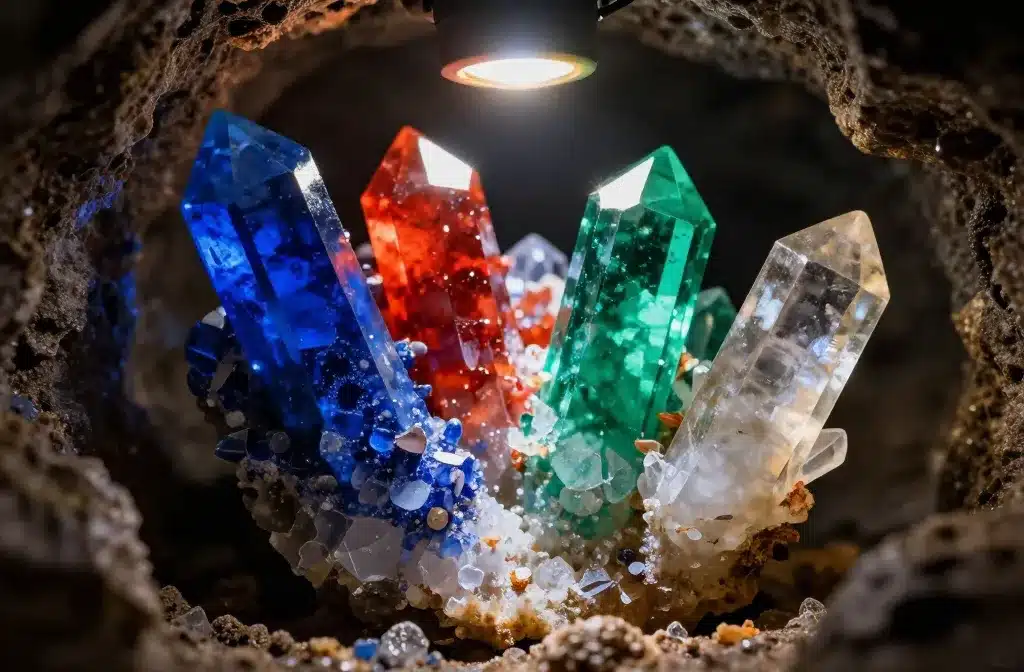
These are the showstoppers. When a mineral grows in an open space, like a cavity in a rock or a gas bubble in lava, its atoms can lay themselves down perfectly, layer by layer. The external shape of the stone begins to mirror its internal atomic structure.
- These form the visible points, cubes, and prisms we collect.
- Scientists call this “euhedral” growth.
Microcrystalline Minerals
Most of the time, minerals grow in cramped, crowded environments. They are squished against other minerals in a solid rock mass. They still have that perfect internal atomic order, but they can’t express it on the outside because they ran out of room.
- A chunk of white marble is made of calcite crystals, but they are interlocking and shapeless to the naked eye.
- Under a microscope, however, you would see the crystalline structure clearly.
So, even a rough, ugly rock is made of crystals minerals—you just need a microscope to see the beauty hidden inside.
The Seven Crystal Systems: Nature’s Sorting Hat
Mineralogists use the shape of crystals to classify and identify them. Since the external shape is determined by the internal atomic lattice, the geometry of a crystal is a fingerprint for the mineral’s identity.
There are seven distinct “systems” or families that all crystals minerals belong to. Understanding these helps scientists predict how a stone will look and break.
1. Cubic (Isometric) System
This is the most symmetrical system. The atoms are arranged in a box shape with equal sides.
- Examples: Pyrite, Fluorite, Garnet, Diamond.
- Look for: Perfect cubes or ball-like shapes with many symmetrical faces.
2. Hexagonal System
These crystals have a six-sided structure, often forming tall columns or flat plates.
- Examples: Emerald, Aquamarine, Apatite.
- Look for: A stop-sign shape (hexagon) if you were to slice the crystal horizontally.
3. Trigonal System
Often grouped with hexagonal, these have a three-fold symmetry.
- Examples: Quartz, Tourmaline, Calcite.
- Look for: Triangular cross-sections or pyramid-shaped terminations.
4. Tetragonal System
Think of a rectangle. These crystals are like a cube that has been stretched out along one axis.
- Examples: Zircon, Apophyllite, Rutile.
- Look for: Square cross-sections but rectangular side faces.
5. Orthorhombic System
These crystals are like a shoebox—rectangular on all sides, but with different lengths for width, depth, and height.
- Examples: Topaz, Barite, Celestite.
- Look for: Diamond-shaped cross-sections or tablet-shaped crystals.
6. Monoclinic System
“Mono” means one, and “clinic” means incline. These crystals look like a skewed box, leaning in one direction.
- Examples: Gypsum (Selenite), Malachite, Azurite.
- Look for: Prisms that look slightly pushed over or slanted.
7. Triclinic System
The least symmetrical of all. None of the sides are equal, and none of the angles are 90 degrees.
- Examples: Turquoise, Amazonite, Kyanite.
- Look for: Odd, non-symmetrical shapes.
How Structure Determines Properties
The most exciting part of how crystals minerals fit together is seeing how that invisible internal structure dictates the physical properties we can feel and test. A mineralogist doesn’t just look at a stone; they test it to see what the crystal lattice does.
Hardness
Why is a diamond the hardest substance on earth, while graphite is so soft you can write with it? Surprisingly, both are made of the exact same ingredient: pure carbon.
- Diamond: The carbon atoms are locked in a super-strong, three-dimensional cubic lattice. Every atom is holding hands tightly with its neighbors.
- Graphite: The carbon atoms are arranged in flat sheets that are only loosely connected. They slide off each other easily (which is why your pencil leaves a mark on paper).
This phenomenon, where the same chemical makes two different minerals, is called polymorphism. It proves that the crystal structure is just as important as the ingredients.
Cleavage and Fracture
If you drop a piece of glass, it shatters into random, curved shards. This is because glass has no internal structure. But if you hit a piece of Calcite with a hammer, it will break into perfect, slanted blocks every single time.
- This is called cleavage.
- The mineral breaks along the weakest points in its crystal lattice.
- Mica peels in thin sheets because its atoms are arranged in layers with weak bonds between them.
- Galena breaks into tiny cubes because of its cubic structure.
When you see a mineral break in a geometric way, you are witnessing the crystal structure reacting to force.
Optical Properties
Have you ever placed a piece of clear Calcite over some text and seen the letters double? This is called double refraction. The crystal structure of the Calcite actually splits the beam of light into two separate rays.
- Only minerals with specific crystal systems can do this.
- It is a property directly tied to the internal arrangement of atoms.
- Gemologists use these optical properties to identify gemstones and distinguish real stones from glass fakes.
Why This Science Matters for Collectors
You might be thinking, “I just like pretty rocks, why do I need to know about atomic lattices?” But understanding the science of crystals minerals enriches the hobby in several practical ways.
1. Spotting Fakes
Once you know that Quartz belongs to the trigonal/hexagonal system, you know it should have six sides. If you see a seller offering a “Quartz” crystal that is a perfect cube, your science alarm bells will ring. Quartz doesn’t do cubes. You just spotted a fake or a mislabeled stone (likely Fluorite or Calcite).
2. Proper Care
Knowing that a mineral has perfect cleavage (like Fluorite or Selenite) tells you that it is fragile. One wrong hit and it will split along those atomic planes. This knowledge helps you handle and store your collection safely, keeping your treasures intact.
3. Deeper Appreciation
There is something profound about holding a Pyrite cube and knowing that its sharp, 90-degree angles were not cut by a machine. They are the visible expression of nature’s laws operating at a microscopic level. It connects you to the fundamental order of the universe.
From Magma to Museum: The Lifecycle
Mineral science also studies how these crystals form, move, and change. It places the static object on your shelf into a dynamic timeline.
- Igneous Roots: Some crystals minerals crystallize from molten magma. As the liquid cools, atoms slow down and lock into the lattice. Slow cooling equals big crystals; fast cooling equals tiny ones.
- Metamorphic Changes: Heat and pressure can force atoms to rearrange. A rock might start with clay minerals, but after being squeezed by a mountain range, those atoms reorganize into Garnets. The ingredients didn’t change, but the crystal structure did.
- Sedimentary Cycles: Water can dissolve minerals and redeposit them elsewhere. The stunning geodes we love are often the result of water slowly depositing silica crystals into a hollow cavity over millions of years.
Mineralogy tells us that the crystal in your hand is just one moment in a billion-year cycle of recycling and reforming.
Summary: The Crystal-Mineral Connection
Let’s recap the relationship between these two important terms.
- A mineral is the substance itself—natural, inorganic, solid, with a specific recipe.
- A crystal is the structure of that substance—the orderly, repeating arrangement of atoms.
- All minerals are crystalline (with rare exceptions), but they only look like “crystals” to the naked eye when they have room to grow.
- The shape, hardness, and way a stone breaks are all determined by this internal crystal structure.
By understanding how crystals minerals fit together, you move from being a passive observer to an informed explorer. You start to see the geometry in the geology.
Encouragement for the Aspiring Mineralogist
The world of mineral science is vast, but you don’t need a PhD to enjoy it. You already have the most important tools: your eyes and your curiosity.
The next time you pick up a rock, look closer. Ask yourself questions about it.
- Does it have flat faces or is it irregular?
- Does it look like it would split in sheets or shatter like glass?
- Is it harder than a penny?
These simple observations are the exact same science that mineralogists perform in laboratories. Every observation brings you closer to understanding the story of that stone.
We encourage you to take a second look at your own collection today. Pick up your favorite piece and try to imagine the trillions of atoms inside, all lined up in perfect formation, creating the beauty you hold in your hand. The science is just as beautiful as the sparkle.

Christian Grey is the creator of GemMeaning, where he shares simple insights about crystals, gemstone meanings, and spiritual guidance. His focus is on making complex ideas easy to understand and practical for everyday life.