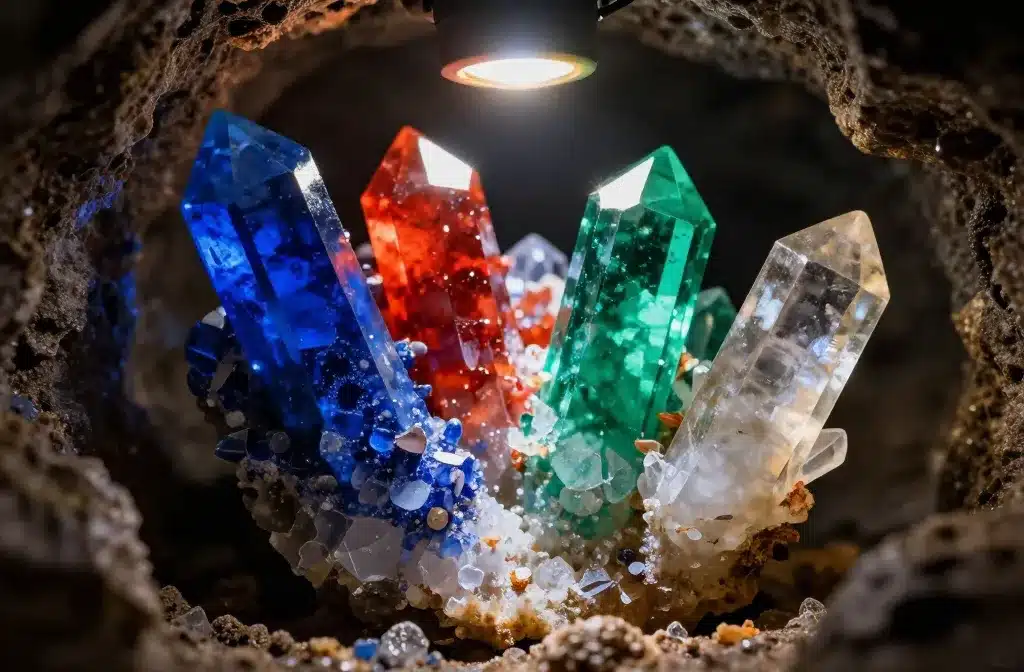
There is a special kind of magic in finding something beautiful that was made by the earth. It is a feeling that connects us to our childhood sense of wonder, turning a simple walk in the woods into a treasure hunt. You might see a stunning amethyst geode in a museum or a polished stone in a shop and wonder, “Where do these things actually come from?”
The exciting truth is that crystals are not just found in faraway, exotic mines. They are hidden all over the world, including in your own state, waiting for a curious eye to spot them. Knowing where to find crystals is less about luck and more about learning to read the geological story of the landscape around you.
This guide is your map to that story. We will explore the common types of environments where crystals form and hide, from volcanic fields to quiet riverbeds. You will learn what signs to look for and how different geological processes create different kinds of mineral treasures.
By the end, you will have the foundational knowledge to start your own rockhounding adventures, turning every outdoor trip into a potential discovery. Let’s dig in and uncover nature’s secret hiding spots.
Start with the Right Environment: The Three Rock Types
Before you can know where to find crystals, you need to understand the three basic types of rock, as each one creates minerals in a different way. Think of them as different kitchens, each with its own unique recipes.
1. Igneous Environments (Born from Fire)
Igneous rocks are formed when molten rock (magma or lava) cools and hardens. This fiery process is one of the most productive for crystal formation. As the liquid rock cools, atoms lock together into orderly patterns, forming crystals.
- What to Look For: Areas with a history of volcanic activity, granite mountains, and large basalt flows.
- Crystals You Might Find: Quartz, Tourmaline, Topaz, Beryl (Aquamarine), and Obsidian.
- Prime Example: The Sierra Nevada mountains in California are a massive granite formation, making the surrounding areas a great place to look for igneous-born crystals.
2. Sedimentary Environments (Formed by Water)
Sedimentary rocks are created from layers of sand, mud, and other debris being compressed over millions of years. Water plays a huge role here, seeping through these layers and depositing minerals in cracks and cavities.
- What to Look For: Limestone quarries, sandstone canyons, river deltas, and dry lake beds.
- Crystals You Might Find: Geodes, Agate, Jasper, Calcite, and Selenite.
- Prime Example: The American Midwest is covered in ancient limestone beds from a time it was underwater, making it a hotspot for finding geodes.
3. Metamorphic Environments (Changed by Pressure)
Metamorphic rocks are rocks that have been transformed by incredible heat and pressure, usually from the collision of tectonic plates. This intense “cooking” forces the atoms in the rock to rearrange into new, often denser, crystal structures.
- What to Look For: The cores of major mountain ranges, like the Appalachians or the Rockies. Look for rocks that appear folded or banded, like schist and gneiss.
- Crystals You Might Find: Garnet, Kyanite, Staurolite, and Jade.
- Prime Example: The mountains of North Carolina are famous for their metamorphic geology, which is why you can find rubies, sapphires, and garnets there.
Prime Hunting Grounds: Specific Locations to Explore
Now that you know the basic environments, let’s get more specific. If you were planning a trip, these are the types of places where your search for crystals would be most fruitful.
Riverbeds and Gravel Bars
This is the absolute best place for a beginner to start. Rivers are nature’s rock tumblers. They carve through mountains, breaking crystals free from their host rock and carrying them downstream. The heavier minerals sink and get trapped in certain spots, waiting for you.
Why it’s a great spot:
- The water has done the hard digging work for you.
- Stones are often washed clean, making them easier to spot.
- The constant movement concentrates heavier stones in predictable places.
Where to look in a river:
- Inside Bends: Water slows down on the inside of a river bend, dropping the heavy rocks it was carrying.
- Gravel Bars: Look for exposed piles of rock and gravel that appear during lower water levels.
- Behind Obstacles: Large boulders or fallen trees can create an eddy where heavy stones settle out.
Old Mine Dumps (Tailings)
When a commercial mine is active, it is usually looking for one specific material, like copper ore or industrial-grade mica. In the process, miners dig up and discard tons of other rock that is considered “waste.” These discarded piles are called tailings or dumps.
For a crystal hunter, these dumps are pure gold. They are often full of beautiful mineral specimens that had no value to the miners but are treasures to a collector. For example, old beryl mines in New England are famous for their dumps, where you can still find aquamarine and tourmaline.
Important Note: Many mine dumps are on private property. You must get permission before you start searching. Never enter an abandoned mine shaft; they are extremely dangerous.
Road Cuts and Construction Sites
Human activity can be a rockhound’s best friend. When we build highways or excavate for new buildings, we slice through hills and expose fresh rock layers that haven’t been seen before.
- Road Cuts: The rock walls along highways can be a fantastic place to see local geology up close. You might spot a vein of quartz or a pocket of calcite. Be extremely careful of traffic and check local laws about stopping along roadways.
- Construction Sites: Foundation digging can unearth all sorts of things. Again, you must get permission from the property owner or site foreman before entering. Trespassing on a construction site is illegal and unsafe.
Volcanic Fields and Deserts
Areas with a volcanic past are prime locations for where to find crystals. The gas bubbles trapped in cooling lava form pockets (vugs) that later fill with crystals like amethyst and agate.
Deserts are also excellent because the lack of vegetation leaves the rocks exposed. Wind erosion scours away the softer material, leaving harder stones like jasper and petrified wood right on the surface. Dry lake beds can be home to “evaporite” crystals like selenite and halite (salt).
Famous Public “Fee Dig” Sites in the USA
If you want to guarantee you find something on your first trip, visiting a fee-dig site is your best bet. These are mines that allow the public to come in and dig for a daily fee. They provide the tools, the location, and often helpful advice.
Herkimer Diamond Mines, New York
“Herkimer Diamonds” are not real diamonds but are exceptionally clear, double-terminated quartz crystals. At several mines in upstate New York, you pay a fee to get access to the rock walls, where you can use a sledgehammer to break open the host rock and find pockets of these brilliant gems.
Crater of Diamonds State Park, Arkansas
This is the only place in the world where the public can search for real diamonds in their original volcanic source. You pay a small entrance fee to access a 37-acre plowed field, which is the eroded surface of a diamond-bearing volcanic crater. Visitors find hundreds of diamonds each year, and the park’s policy is “finders, keepers.”
Emerald Hollow Mine, North Carolina
Nestled in the foothills of the Appalachian Mountains, this is another spot where the public can try their luck. You can search through creek beds or sift through buckets of ore from the mine, looking for emeralds, garnets, sapphires, and dozens of other minerals.
Virgin Valley Opal Fields, Nevada
This remote part of Nevada is world-famous for its precious black opal. Several fee-dig mines here allow you to dig through clay beds for opalized wood and other treasures. The geology is from an ancient lakebed that was covered in volcanic ash, creating the perfect conditions for opal formation.
How to Spot Crystals in the Wild: Training Your Eyes
Knowing where to find crystals is half the battle; the other half is training your eyes to see them. Most crystals don’t look like polished gems when they are in the ground. Here are some tips.
Look for Crystal Shape (Habit)
Nature loves geometry. Even when dirty, a quartz crystal will still have six sides. Pyrite forms cubes. Garnets often form little soccer-ball shapes. Learn the basic crystal “habit” of the minerals you are looking for. Your eye will start to pick out these non-random shapes from the surrounding rock.
Look for Luster and Cleavage
“Luster” is how a mineral reflects light. Is it glassy like quartz? Metallic like pyrite? Pearly like mica? Even a dirty crystal might give off a tell-tale glint. “Cleavage” is how a mineral breaks. If you see a rock with perfectly flat, shiny break surfaces, you are likely looking at a crystal’s cleavage plane.
Use a Spray Bottle
This is the single best trick for any rockhound. A dusty, sun-baked rock can look completely uninteresting. A quick spray of water will wash away the dirt and reveal the stone’s true color and internal structure. This simple tool can instantly show you if a dull brown rock is actually a beautiful piece of jasper or agate.
Search After a Rain
A heavy rainstorm is like a power wash for the landscape. It can wash away loose dirt and expose new rocks that were previously hidden. Hiking through a creek bed or along a gravel wash right after a rain can be incredibly productive.
A Note on Ethics and Safety
The rockhounding community is built on a foundation of respect for the land and for each other. Following these simple rules ensures that these places will be available for future generations to enjoy.
1. Know the Law: Always confirm land ownership. Never collect on private property without permission. In National Parks, collecting is strictly forbidden. On most Bureau of Land Management (BLM) and National Forest land, casual collecting for personal use is allowed, but commercial collecting is not.
2. Leave No Trace: If you dig a hole, fill it back in. Pack out everything you pack in, including trash. Do not damage vegetation or disturb wildlife.
3. Stay Safe: Never go rockhounding alone if you can help it. Tell someone where you are going and when you plan to be back. Wear sturdy shoes, bring plenty of water, and always, always wear safety glasses when using a hammer.
Putting It All Together: A Plan for Your First Hunt
Feeling inspired? Here is a simple plan to get started.
- Do Your Research: Use the internet to search for “rockhounding [your state]” or “fee-dig mines near me.” Look up a geological map of your area to see what kinds of rocks are common.
- Gather Your Gear: At a minimum, you will need a backpack, water, safety glasses, and maybe a small hammer or trowel.
- Start Easy: Visit a local creek with gravel bars or a known public collecting area. Don’t try to tackle a remote mountain on your first trip.
- Be Patient: You are not going to find a perfect crystal under every rock. The joy is in the search itself. Slow down, enjoy being in nature, and celebrate every interesting rock you find.
Conclusion: The Adventure Is Out There
The world beneath our feet is a library of geological history, and crystals are its most beautiful words. Knowing where to find crystals is a skill that opens up a new way of interacting with the natural world. It turns a simple hike into an engaging treasure hunt and connects you to the immense and powerful forces that shaped our planet.
You don’t need to be an expert to start. You just need a sense of curiosity and a willingness to explore. The thrill of pulling a sparkling stone from the earth—a stone that you found yourself—is an experience that will stay with you forever.
We encourage you to take these concepts and apply them to your own backyard. Start looking at the rocks around you, do a little research, and plan a small adventure. You might be surprised at what treasures are hiding just a short drive away. Happy hunting

Christian Grey is the creator of GemMeaning, where he shares simple insights about crystals, gemstone meanings, and spiritual guidance. His focus is on making complex ideas easy to understand and practical for everyday life.