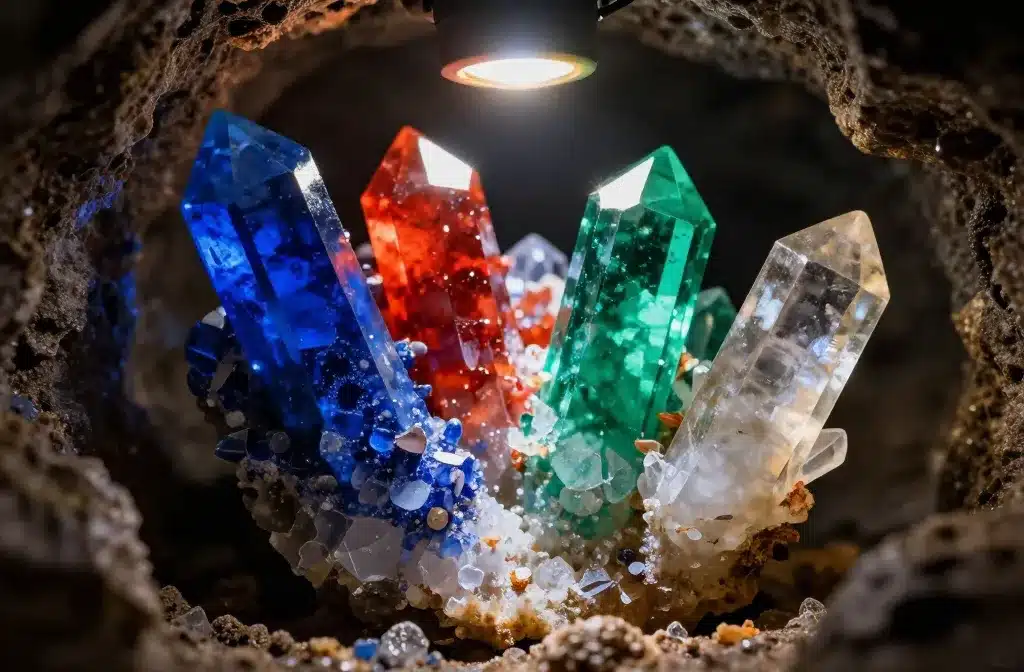
Have you ever looked at a perfect quartz point, with its six sharp sides and flawless termination, and thought, “How did the Earth do that?” It seems almost impossible that something so geometric and precise could form naturally, without a single chisel or polishing wheel. The process feels like magic, but it is actually a beautiful and slow dance of chemistry, physics, and time.
Understanding the science behind growing crystals doesn’t take away the magic; it deepens it. It transforms a pretty rock into a fascinating story of planetary forces. Learning how a jumble of disconnected atoms organizes itself into a sparkling gem gives you a profound appreciation for the treasures you collect.
This guide will demystify the incredible process of crystal formation. We will journey deep into the Earth’s crust to explore the different ways crystals are born and how they develop from a microscopic seed into the magnificent specimens we see in museums. By understanding the recipe, you will see your own collection in a whole new light.
Let’s explore the slow, patient, and powerful ways nature has been growing crystals for billions of years.
The Universal Recipe for Crystal Growth
Whether it is a tiny grain of salt or a giant amethyst geode, every natural crystal starts with the same four essential conditions. If any one of these is missing, the crystal simply cannot form. Think of it as a geological recipe that must be followed perfectly.
- Ingredients (The Elements): First, you need the right chemical elements. To grow quartz, you need a high concentration of silicon and oxygen ($SiO_2$). For a diamond, you need pure carbon. These building blocks must be present and available.
- Temperature & Pressure (The Oven): Every mineral has a “stability zone”—a specific range of heat and pressure where its atoms can link up correctly. Too much heat and the atoms move too fast to connect. Not enough, and they lack the energy to get into position.
- Space (The Elbow Room): For a mineral to express its beautiful, geometric external shape (its “crystal habit”), it needs an open cavity to grow into. Without space, it just becomes an interlocking grain in a solid rock.
- Time (The Secret Ingredient): This is perhaps the most crucial factor. Most of the large, beautiful crystals you see grew at an agonizingly slow pace, often over thousands or millions of years. This slow and steady growth allows each atom to find its perfect place, resulting in a flawless structure.
Nature uses three primary methods to bring these four conditions together, each creating a different type of crystal environment.
Method 1: Crystallization from a Melt (Igneous Formation)
The most dramatic method of growing crystals starts with fire. Deep within the Earth, intense heat melts rock into a chaotic soup of atoms called magma. As this molten rock cools, atoms lose energy and begin to bond together, forming orderly, repeating patterns.
The Slow Cooling Process
When a massive body of magma cools slowly over millions of years deep underground, different minerals crystallize out at different temperatures. Feldspar might form first, followed by mica, and finally quartz. This is how rocks like granite are formed, with their visible, interlocking mineral grains.
Pegmatites: The Giant Crystal Factories
Sometimes, the last dregs of magma—a watery, mineral-rich fluid—get injected into cracks in the surrounding rock. This special fluid, called a pegmatite, is often loaded with rare elements like lithium, beryllium, and tourmaline.
Because it is trapped and insulated deep underground, it cools extremely slowly. This gives crystals an immense amount of time to grow, often reaching enormous sizes. The world’s largest tourmalines, aquamarines, and kunzites are found in these pegmatite veins.
Volcanic Vugs: The Birthplace of Geodes
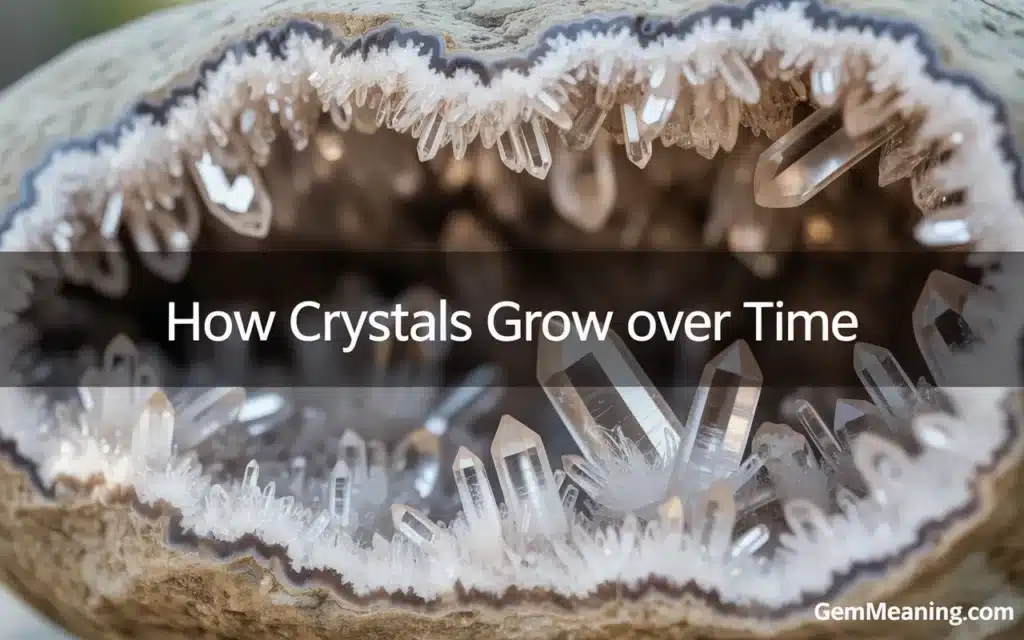
When lava erupts onto the surface, it is full of dissolved gases that form bubbles. As the lava cools and solidifies into rock (like basalt), these bubbles get trapped, creating hollow pockets called vugs. These vugs provide the essential “space” needed for growing crystals with beautiful faces.
Over thousands of years, mineral-rich groundwater seeps into these cavities. The water slowly deposits minerals layer by layer on the walls of the vug, eventually forming the agate bands and amethyst points we see in a classic geode.
Method 2: Precipitation from a Solution (The Power of Water)
Water is one of the most powerful forces for growing crystals on Earth. It acts as a universal solvent, dissolving minerals in one place, transporting them, and then redepositing them as crystals somewhere else. This method is all about patience.
Evaporation Creates Crystal Fields
Imagine a vast, salty sea slowly evaporating under the sun over thousands of years. As the water disappears, the dissolved minerals (like salt and gypsum) become so concentrated that they can no longer stay in the solution. They precipitate out and begin to form crystals.
- The Great Salt Lake in Utah is a modern example. As the water evaporates along its shores, it leaves behind crusts of halite (salt) crystals.
- In deserts, this process can form beautiful “desert roses,” which are blade-like gypsum crystals that trap sand as they grow.
Hydrothermal Veins: Earth’s Plumbing System
Deep underground, water can be heated by magma to extreme temperatures. This superheated water is a powerful solvent, dissolving minerals and metals from the surrounding rock. This hot, mineral-rich fluid is then forced through cracks and fissures.
As the fluid moves into cooler areas, the dissolved minerals precipitate out, lining the walls of the fissure with crystals. This is how many of the world’s most valuable ore deposits of gold and silver are formed. It is also a primary method for growing crystals like quartz, fluorite, and calcite.
The Slow Drip in Caves
Caves are a perfect, slow-motion laboratory for crystal growth. Rainwater absorbs carbon dioxide from the air and soil, becoming weakly acidic. This water dissolves limestone (calcite) as it travels underground.
When the water drips into an open cave, it re-releases the carbon dioxide, causing the calcite to precipitate out. Over millennia, each tiny drop leaves behind an infinitesimal layer of calcite, slowly building stalactites from the ceiling and stalagmites from the floor.
Method 3: Solid-State Growth (Metamorphism)
The third method of growing crystals is perhaps the most mind-boggling. It does not involve a liquid at all. Instead, it involves transforming a rock that is already solid. This happens during metamorphism, when a rock is subjected to intense heat and pressure deep within the Earth’s crust, usually during mountain-building events.
The atoms within the existing minerals are squeezed so forcefully that they break their chemical bonds and migrate, reorganizing themselves into new, more stable crystal structures without ever melting.
How Metamorphism Grows New Crystals
Imagine a piece of shale (sedimentary mudrock) being buried miles deep and squeezed by colliding continents. The simple clay minerals in the shale will break down. Their atoms of aluminum, silicon, iron, and magnesium will slowly rearrange to form brand new minerals that are stable at that high pressure.
This is how beautiful metamorphic gems are born right inside solid rock:
- Garnets: These classic, ball-shaped crystals often grow within a rock called schist. They start as a microscopic seed and slowly expand, pushing the surrounding flaky mica minerals out of the way.
- Kyanite: These blue, blade-like crystals are a tell-tale sign of high-pressure metamorphism. Their presence tells a geologist a story about the immense forces that shaped a landscape.
- Staurolite: Famous for forming natural cross shapes, these “fairy crosses” grow within metamorphic rocks in a similar way, a testament to the organizing power of atomic bonds under pressure.
From Seed to Specimen: The Stages of Growth
No matter which of the three methods is at play, the actual process of a crystal getting larger happens in a similar way, starting from a single point of nucleation.
1. Nucleation: The First Seed
Crystal growth cannot begin until a “seed” is formed. This is the initial moment when a few atoms find each other and lock into the correct geometric arrangement. This point of nucleation can be a tiny, microscopic impurity or just a random statistical cluster of atoms.
2. Accretion: Adding Layers
Once the seed crystal exists, it begins to grow through accretion. Atoms from the surrounding fluid (magma, water) or solid matrix attach themselves to the faces of the seed crystal, layer by atomic layer. It is like building a house brick by brick, where each brick is a single molecule of the mineral.
3. The Role of Growth Rate
The speed of this process has a huge impact on the final quality of the crystal.
- Slow Growth: A slow, stable growth rate with a steady supply of ingredients allows each atom to land in its perfect spot. This is how you get large, clear, and perfectly formed crystals. This is the secret to successful natural growing crystals.
- Fast Growth: If cooling or evaporation happens too quickly, the atoms are forced to solidify rapidly. This leads to many small, imperfect crystals or even prevents crystallization altogether, forming a glass like obsidian.
4. Why Do Crystals Have Different Shapes?
The final shape of a crystal (its “habit”) is determined by the interplay between its internal atomic structure and the conditions in which it grew. While the internal angles of a quartz crystal are always the same, its external shape can vary. If it grows faster along one axis, it will be a long, slender point. If growth is constrained in one direction, it might form a flat, tabular crystal.
Factors That Affect Crystal Growth
The real world is messy, and many factors can influence or interrupt the process of growing crystals.
Impurities and Inclusions
Sometimes, other minerals get trapped inside a growing crystal. These are called inclusions. A speck of another mineral, a tiny bubble of water or gas, or even fractures can be incorporated into the structure. These “flaws” are what make stones like Rutilated Quartz (with its needles of rutile) or Garden Quartz so unique.
Color and Zoning
The color of a crystal can change as it grows if the chemistry of the surrounding solution changes. A famous example is “watermelon” tourmaline. It may start growing in a lithium-rich environment, making it pink. Later, the chemistry might shift to become iron-rich, causing the outer layers to grow green, creating a beautiful zoned crystal.
Twinned Crystals
Sometimes, two or more crystals will grow together in a specific, symmetrical way. This is called “twinning.” Staurolite’s crosses are a form of twinning, as are the beautiful “fishtail” twins in Selenite. It happens when a new crystal starts growing on the face of another but in a different orientation.
A Story Billions of Years in the Making
The next time you hold a crystal, take a moment to consider its incredible life story. That small stone in your hand is the result of a process that may have started before the dinosaurs existed. It is a physical artifact of unimaginable heat, crushing pressure, and, most of all, an immense amount of time.
Understanding the science behind growing crystals transforms them from passive objects into active storytellers. A garnet tells a tale of colliding continents. An amethyst geode whispers of ancient volcanoes. A piece of selenite holds the memory of a long-vanished sea.
This knowledge empowers you as a collector and nature enthusiast. When you are out hiking, you can look at the rocks and see not just a jumble of stones, but a landscape of potential. You can start to recognize the geological clues that point toward nature’s hidden workshops.
We encourage you to look at your own collection with new eyes. Try to imagine the journey each piece took. Was it born in fire? Shaped by water? Or forged under the weight of a mountain? The closer you look, the more fascinating the story becomes.

Christian Grey is the creator of GemMeaning, where he shares simple insights about crystals, gemstone meanings, and spiritual guidance. His focus is on making complex ideas easy to understand and practical for everyday life.