Have you ever walked into a crystal shop or scrolled through an online store and felt a little overwhelmed by the terminology? You see terms like “stone,” “crystal,” “gemstone,” and “rock” used almost interchangeably. You might pick up a smooth, opaque piece of Jasper and call it a stone, then glance at a sparkling Amethyst geode and call it a crystal. But what’s the real difference? Are they the same thing?
This is one of the most common points of confusion for anyone starting their journey with minerals. It feels like you need a geology textbook just to understand what you’re buying. The good news is that the distinctions are simpler than you think, and learning them can deeply enrich your appreciation for your collection.
Understanding the various types of stones and crystals helps you grasp why they look and feel different, how they were formed, and how to care for them properly. This guide will break down these terms in a clear, beginner-friendly way. We’ll explore the science behind what makes a crystal a crystal, how stones and rocks are different, and where precious gemstones fit into the picture.
Let’s clear up the confusion and build your confidence as a collector.
The Building Block: What is a Mineral?
Before we can compare stones and crystals, we need to start with the fundamental building block of them all: a mineral. In geology, a mineral has a very specific definition. To be classified as a mineral, a substance must meet five criteria:
- It must be naturally occurring. It cannot be man-made.
- It must be inorganic. It was never alive and is not derived from living matter (this is why Amber is not a mineral, as it is fossilized tree resin).
- It must be a solid. It cannot be a liquid or a gas.
- It must have a definite chemical composition. It has a specific chemical “recipe” (e.g., Quartz is always SiO₂).
- It must have an ordered internal structure. Its atoms are arranged in a repeating, geometric pattern.
This last point is the most important one for our discussion. It’s the key that unlocks the difference between a crystal and other types of rocks.
Crystal: The Definition of Order
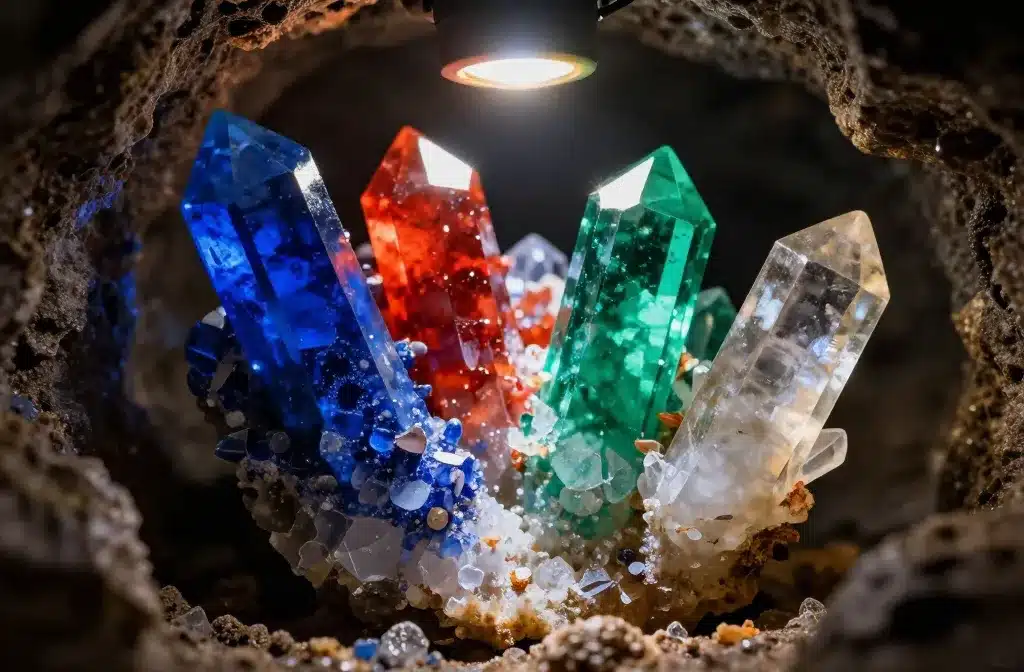
A crystal is the physical expression of a mineral’s ordered internal structure. When a mineral has the time and space to grow without being constrained, its atoms will arrange themselves into that perfect, repeating pattern, forming a recognizable geometric shape.
Think of it like building with LEGOs. If you follow the instructions, you create a structured object like a house or a car. This is a crystal. That perfectly formed, six-sided Quartz point you own? It grew that way, atom by atom, because its internal structure is hexagonal.
Key Characteristics of a Crystal:
- Ordered Atomic Structure: This is the defining feature. The atoms are locked in a precise, repeating 3D pattern called a crystal lattice.
- Geometric Shape: This internal order results in the smooth, flat faces and sharp angles we see on the outside. This natural shape is called its “crystal habit.”
- Often Transparent or Translucent: Because light can pass through the orderly structure in a uniform way, many crystals are see-through to some degree.
Examples of Crystals: A raw Amethyst point, a cubic chunk of Fluorite, a needle-like spray of Scolecite. These are all minerals that have grown into their ideal crystalline form.
Rock: A Mineral Medley
So, if a crystal is an orderly mineral, what is a rock? A rock is a solid, naturally occurring aggregate of one or more minerals.
Imagine going back to our LEGO analogy. Instead of following the instructions to build a car, you just take a huge bucket of assorted LEGOs and press them all together into a solid lump. That lump is a rock. It’s made of the same building blocks (minerals), but they are jumbled together without a uniform structure.
Key Characteristics of a Rock:
- Aggregate of Minerals: Most rocks are composed of several different types of mineral grains packed together. For example, granite is a rock made up of Quartz, Feldspar, and Mica.
- No Uniform Structure: A rock does not have a single, repeating atomic pattern throughout.
- Generally Opaque: Because the mineral grains are randomly oriented, light cannot pass through easily, making most rocks opaque.
Examples of Rocks: The granite countertops in a kitchen, the sandstone in a canyon wall, or a piece of Lapis Lazuli. Lapis Lazuli is a great example—it’s a rock composed primarily of the mineral Lazurite, but it also contains Calcite (the white veins) and Pyrite (the gold flecks).
Stone: The Casual, Catch-All Term
This brings us to the word “stone.” In geological terms, “stone” is not a scientific word. It’s a common, general term we use to describe any small piece of rock or mineral.
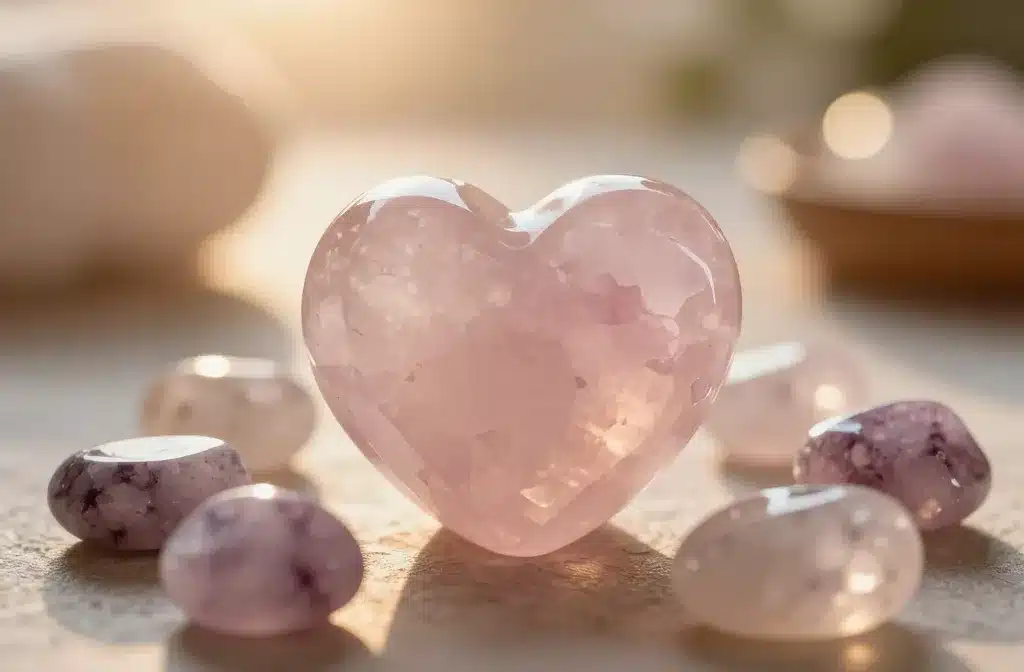
Think of it as a casual nickname. You might refer to a piece of granite you picked up on a hike as a “stone.” You might also call a smooth, water-worn piece of Jasper a “stone.” In the crystal community, “stone” is often used to describe any mineral specimen that is tumbled, polished, or opaque.
How the term “Stone” is commonly used:
- For Tumbled Pieces: A tumbled Amethyst is often called an “Amethyst stone” rather than an “Amethyst crystal,” because its natural crystal faces have been polished away.
- For Opaque Minerals: Minerals that are typically opaque, like Jasper, Bloodstone, or Howlite, are almost always referred to as stones.
- A General Descriptor: It’s a handy, non-technical word for a piece of rock or mineral.
So, is it wrong to call a crystal a stone? Not at all! It’s just a less specific term. All crystals can be called stones, but not all stones have a crystalline structure.
Chart: Crystal vs. Rock vs. Stone at a Glance
| Feature | Crystal | Rock | Stone |
|---|---|---|---|
| Structure | Single, ordered atomic pattern | Aggregate of jumbled mineral grains | General term; can be either |
| Composition | Single mineral with a set formula | Made of one or more minerals | General term; can be either |
| Appearance | Often has flat faces and sharp angles | Irregular shape, grainy texture | General term; often tumbled/smooth |
| Clarity | Often transparent or translucent | Usually opaque | Usually opaque |
| Example | Quartz Point, Raw Fluorite Cube | Granite, Lapis Lazuli, Sandstone | Tumbled Jasper, River Rock |
Gemstone: A Cut Above the Rest
Now, let’s add one more term to the mix: “gemstone.” What makes a mineral a gemstone? The answer has more to do with human value than geology.
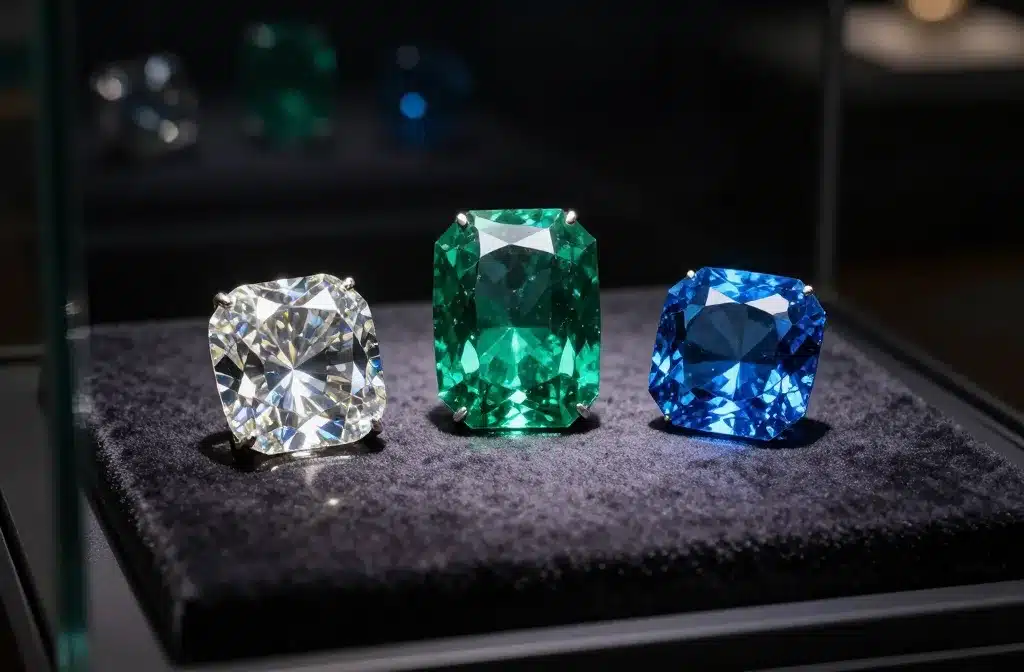
A gemstone (or gem) is a mineral that has been chosen for its beauty, rarity, and durability to be cut, polished, and used in jewelry or adornment.
The “Big Three” Qualities of a Gemstone:
- Beauty: This is paramount. It includes the stone’s color, clarity, luster, and “fire” (how it breaks up light). A beautiful emerald is prized for its deep green color, while a diamond is valued for its brilliance.
- Rarity: The rarer a mineral is, the more valuable it becomes. Stones like Tanzanite, found only in one small area of the world, are highly prized for their scarcity.
- Durability: A gemstone needs to be tough enough to withstand being worn every day. This relates to its hardness (resistance to scratching) and toughness (resistance to chipping). Diamonds are the hardest mineral (10 on the Mohs scale), making them perfect for engagement rings.
So, a raw ruby crystal found in the earth is a mineral. When it is cut, polished, and set in a ring, it becomes a gemstone. Many types of stones and crystals can be considered “semi-precious” gemstones, including Amethyst, Citrine, and Garnet.
Crystalline vs. Amorphous: The Structural Divide
To really solidify your understanding, it helps to know about the opposite of a crystalline structure: an amorphous one.
Crystalline materials have that orderly, repeating atomic structure we’ve been discussing. Quartz, Tourmaline, and Pyrite are all crystalline.
Amorphous materials lack this internal order. Their atoms are jumbled together randomly, like a liquid that has been frozen in place.
- Obsidian: This is a perfect example. It’s a volcanic glass that cooled so quickly its atoms didn’t have time to organize into a crystal lattice. This is why it breaks with such smooth, curved (conchoidal) fractures.
- Amber: This is fossilized tree resin, an organic material that hardened without crystallizing.
- Opal: Opal is a unique case. It’s made of microscopic silica spheres stacked together. While there’s a certain order to the spheres (which creates the play-of-color), it lacks a true crystal lattice, so it’s considered a mineraloid, not a mineral.
So, while we often group Obsidian and Opal in with our crystals, they are technically amorphous solids.
Putting It All Together: A Practical Example
Let’s trace the journey of one of the most popular types of stones and crystals: Amethyst.
- Mineral: Deep underground, hot silica-rich water with traces of iron fills a cavity in a rock. As it cools slowly, the atoms lock into place. At this point, it is the mineral Quartz (SiO₂ with iron impurities).
- Crystal: Because it has space to grow, the atoms form their natural hexagonal lattice, creating six-sided purple crystals inside the cavity. We now have an Amethyst geode filled with visible crystals.
- Rock: A miner breaks the geode out of the larger mass of volcanic rock it formed in. The geode itself—the layer of Amethyst crystals on its matrix of host rock—can be considered a rock.
- Stone: A piece of the Amethyst is broken off and tumbled in a machine until it is smooth and rounded. This is now a “tumbled Amethyst stone.”
- Gemstone: A particularly clear, deep purple crystal is carefully cut into a faceted shape, polished to a high shine, and set in a necklace. It is now an Amethyst gemstone.
As you can see, the same material can be referred to by different names depending on its form and how it’s being used.
Conclusion: A Newfound Appreciation
Navigating the world of types of stones and crystals is much easier once you understand the core concepts. It all boils down to atomic structure. If a mineral’s atoms are neatly ordered, it can form a crystal. If different mineral grains are mashed together, it’s a rock. “Stone” is our friendly, everyday term for any piece of these materials, and “gemstone” is a title reserved for the most beautiful, rare, and durable among them.
This knowledge does more than just help you sound like an expert. It connects you to the incredible geological forces that created these treasures. You can now look at a quartz point and see not just a pretty object, but a perfect manifestation of atomic order that took millions of years to form.
Key Takeaways:
- Crystals are minerals with a highly ordered, repeating internal atomic structure, often resulting in geometric shapes.
- Rocks are aggregates of one or more minerals jumbled together without a uniform structure.
- Stones is a general, non-scientific term for a piece of rock or mineral, often used for tumbled or opaque specimens.
- Gemstones are minerals valued for their beauty, rarity, and durability, and are cut and polished for adornment.
We encourage you to pick up a few pieces from your own collection. Can you identify which are true crystals with visible faces? Which are rocks made of multiple minerals? Which are smooth, tumbled stones? By applying this new lens, you’ll uncover a deeper layer of wonder in the beautiful objects you’ve chosen to bring into your life.

Christian Grey is the creator of GemMeaning, where he shares simple insights about crystals, gemstone meanings, and spiritual guidance. His focus is on making complex ideas easy to understand and practical for everyday life.