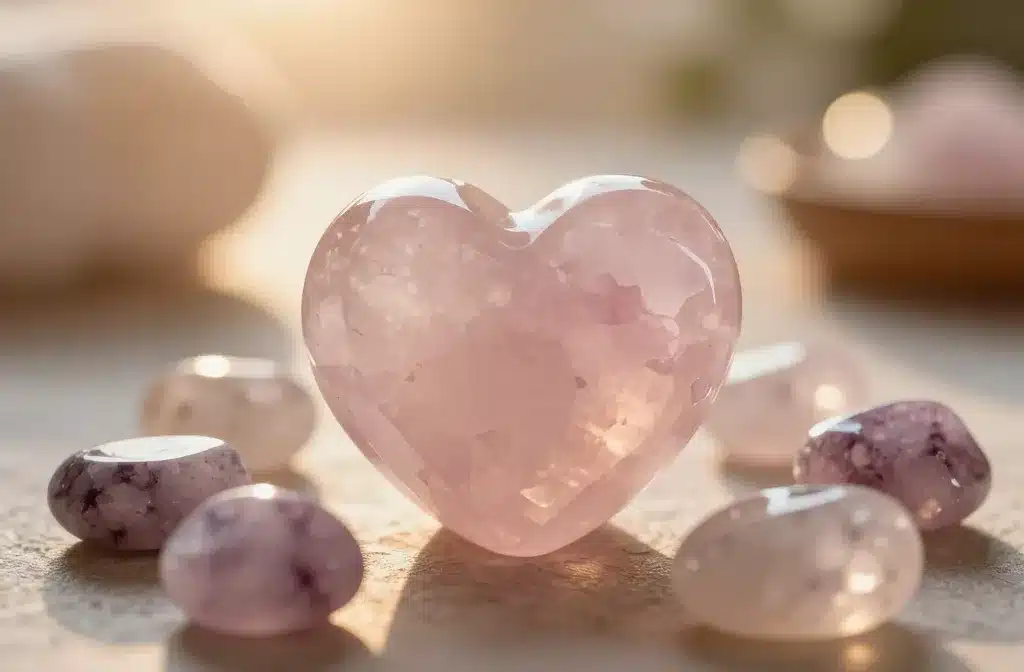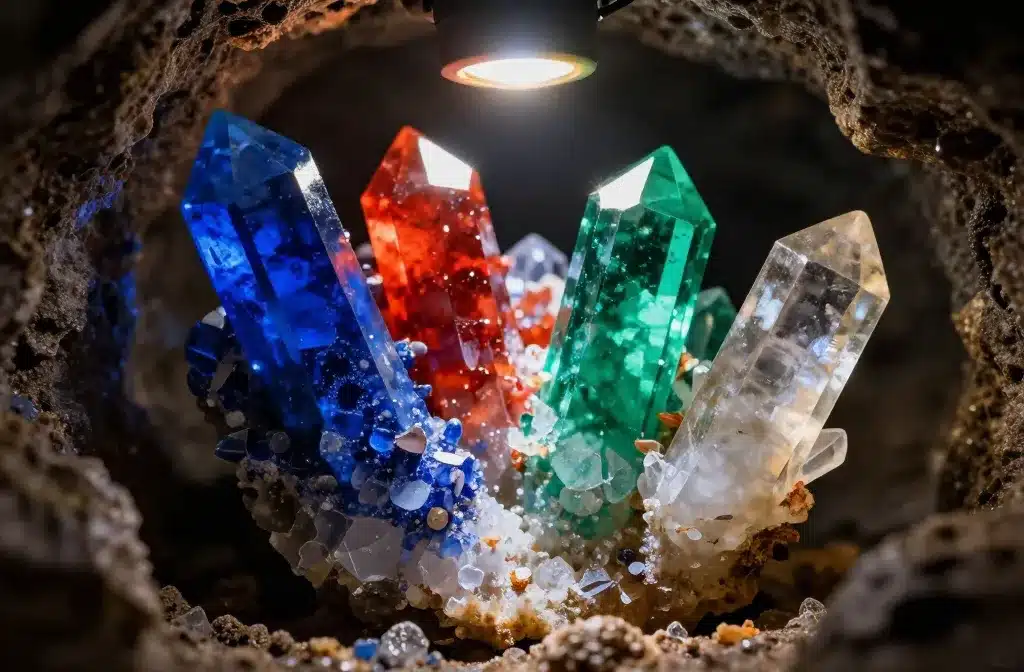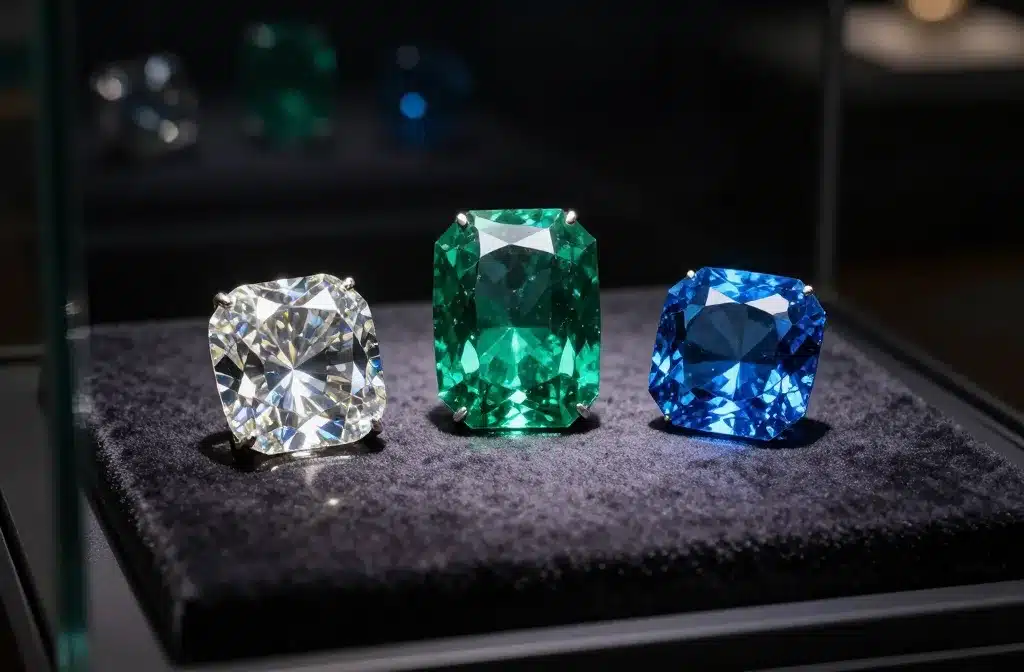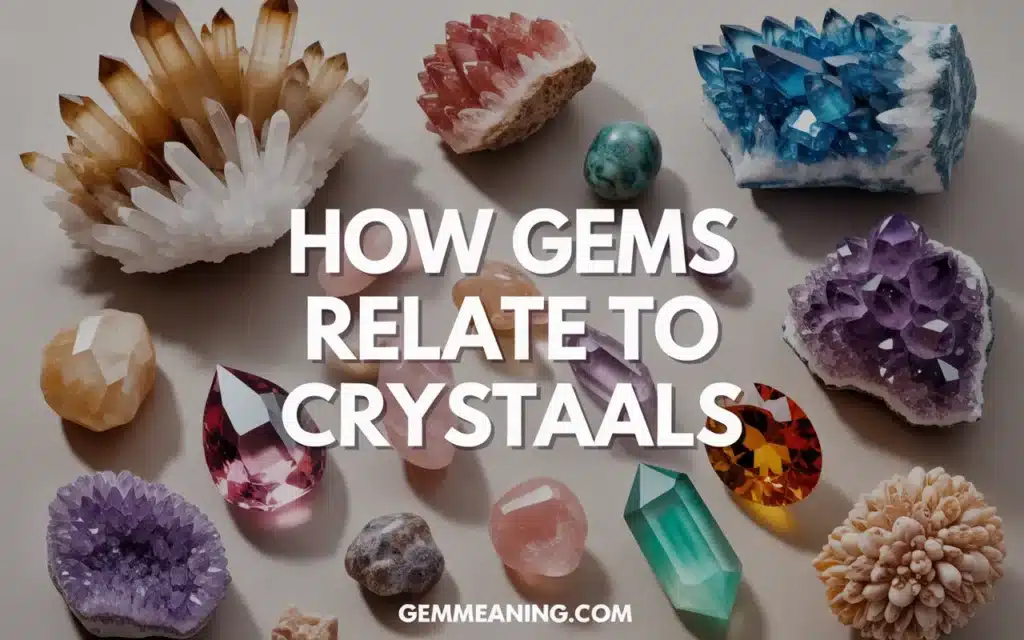
Imagine you’re window shopping at a jewelry store. You see a stunning sapphire ring, a pair of sparkling diamond earrings, and a deep red ruby pendant. You admire these beautiful “gems.” Later that day, you visit a metaphysical shop and see a raw amethyst geode, a polished quartz point, and a chunk of black tourmaline. You admire these powerful “crystals.”
Are these two separate categories of items? Is a diamond a crystal? Is an amethyst a gem? The language surrounding the world of minerals can be confusing, with terms often used interchangeably. This overlap can leave newcomers wondering about the real connection between gems and crystals.
The truth is, their relationship is deeply intertwined. Understanding how a raw mineral from the earth becomes a prized jewel is a fascinating journey. This guide will clarify the distinction, explain the transformation process, and show you that every gem begins its life as a crystal.
Let’s polish away the confusion and reveal the brilliant connection between these earthly treasures.
The Foundation: What is a Crystal?
To understand how gems are made, we first have to start with their origin: the crystal. In the world of geology, a “crystal” has a very specific scientific definition. It isn’t just a generic term for a shiny rock.
A crystal is a solid material whose atoms are arranged in a highly ordered, repeating three-dimensional pattern. This internal blueprint is called a crystal lattice. This perfect, microscopic structure is what gives a crystal its unique properties, including its characteristic shape.
For example, a quartz crystal naturally grows into a six-sided (hexagonal) shape with a pointed top. This is not because it was cut that way, but because its internal atomic structure dictates that form.
Key Characteristics of a Crystal:
- Ordered Internal Structure: This is the non-negotiable, defining feature.
- Natural Geometric Shape: When allowed to grow freely, crystals form flat faces and sharp angles (known as their “crystal habit”).
- Mineral Origin: Crystals are the visible, well-formed expression of a single mineral.
Think of a raw tourmaline wand or a natural fluorite octahedron. These are crystals in their pure, unaltered state, exactly as they formed within the earth.
The Definition of a Gemstone
Now, let’s turn our attention to the sparkling world of gemstones. Unlike the term “crystal,” the definition of a “gemstone” (or “gem”) is not based on geology. It’s based entirely on human value.
A gemstone is a crystal that has been selected for its exceptional qualities, then cut and polished for use in jewelry or ornamentation. It’s a title that a crystal earns. Not every crystal can be a gem.
To be considered a gemstone, a crystal must possess three key attributes, often called the pillars of gemology:
1. Beauty
This is the most important factor. The beauty of a gemstone is determined by several visual characteristics.
- Color: The richness and saturation of its hue are critical. Think of the perfect “pigeon’s blood” red of a ruby or the deep cornflower blue of a sapphire.
- Clarity: This refers to the absence of internal flaws or inclusions. A flawless diamond is far more valuable than one with visible imperfections.
- Luster: How light reflects off the surface. A high luster gives a gem its brilliant shine.
- Fire & Brilliance: How the stone breaks down light into a rainbow of colors (fire) and returns it to the eye (brilliance).
2. Rarity
As with most things, scarcity increases value. A crystal that is beautiful but common will be less valuable than one that is equally beautiful but found in only one small corner of the world. Tanzanite, for example, is highly prized because it is only found in a tiny mining area in Tanzania.
3. Durability
A gemstone needs to be tough enough to survive the rigors of daily wear. Durability is a combination of two factors:
- Hardness: Its resistance to being scratched. This is measured on the Mohs scale from 1 to 10. Diamond, at a 10, is the hardest natural substance and can resist scratches from almost anything.
- Toughness: Its resistance to chipping, cracking, or breaking. Jade is famously tough, even though its hardness is lower than a diamond’s.
So, when you look at a sapphire in a ring, you are looking at a crystal (the mineral corundum) that was deemed beautiful, rare, and durable enough to be transformed into a gemstone.
The Transformation: From Crystal to Gem
This is the heart of the relationship between gems and crystals. Every gemstone starts its journey as a raw crystal, mined from the earth. The process of turning that rough stone into a sparkling jewel is a masterful blend of art and science performed by a skilled gem cutter, known as a lapidary.
Step 1: Evaluating the Rough
A gem cutter doesn’t just start grinding away. First, they carefully examine the raw crystal. They look for the best color, identify any internal fractures or inclusions, and decide how to orient the stone to maximize its beauty and minimize waste. This is the most critical step, as one wrong decision can shatter a priceless crystal.
Step 2: Cleaving or Sawing
The large rough crystal is then split into smaller, more manageable pieces. The lapidary might strike the crystal along a natural cleavage plane to split it cleanly, or they might use a diamond-tipped saw to cut through it. The goal is to remove flawed sections and rough out the basic shape of the final gem.
Step 3: Grinding and Shaping (Faceting)
This is where the magic happens. The cutter uses a machine with spinning laps (flat discs coated with abrasive powders like diamond dust) to grind flat, polished planes onto the stone. These tiny windows are called facets.
The precise angles of these facets are calculated mathematically to control how light enters the stone, bounces around inside (total internal reflection), and exits back through the top, creating that dazzling sparkle. The bottom facets (the pavilion) are designed to act like mirrors, while the top facets (the crown) are the windows through which we see the brilliance.
Step 4: Polishing
Finally, each facet is polished using progressively finer abrasive powders until it achieves a mirror-like finish. This final step brings out the stone’s luster and makes it truly shine.
The rough, often dull-looking crystal that came out of the ground is now a beautifully proportioned, fiery gemstone, ready to be set in jewelry.
Are All Crystals Gems? No.
This is a crucial distinction. While all gems originate as crystals, the vast majority of crystals will never become gems. Think of it like this: all professional athletes are people, but very few people will ever become professional athletes.
A crystal must be of “gem quality” to make the cut. Here’s why most don’t qualify:
- Too Many Inclusions: Most crystals are heavily included, meaning they are filled with fractures, mineral deposits, or other flaws that make them opaque or cloudy.
- Poor Color: A piece of quartz might have a faint, washed-out purple color, making it amethyst, but not the deep, rich purple required for a gemstone.
- Too Soft: Many beautiful crystals, like Fluorite or Calcite, are simply too soft (4 and 3 on the Mohs scale, respectively) to be used in jewelry. They would scratch and abrade almost immediately.
- Too Common: Clear quartz is one of the most abundant minerals on Earth. While beautiful, its commonness means it has little monetary value as a gemstone, though it is highly valued for its metaphysical properties.
Are All Gems Crystals? Mostly, Yes.
The overwhelming majority of gemstones are faceted from single crystals. Diamonds, Rubies, Sapphires, Emeralds, Amethysts, and Citrines all start as well-formed crystals.
However, there are a few notable exceptions in the world of gems and crystals:
Gems That Aren’t Single Crystals
- Rocks: Some gems are technically rocks, which are aggregates of multiple minerals. Lapis Lazuli is a rock made of Lazurite, Calcite, and Pyrite.
- Mineraloids (Amorphous Gems): Some gems lack a crystalline structure. Their atoms are jumbled together randomly.
- Opal: Made of microscopic silica spheres, its lack of a crystal lattice is what allows it to produce its famous play-of-color.
- Obsidian: This is natural volcanic glass that cooled too fast for a crystal structure to form.
- Organic Gems: These gems are produced by living organisms and are not minerals at all.
- Pearl: Formed inside a mollusk.
- Amber: Fossilized tree resin.
- Coral: The skeletal remains of marine polyps.
So, while it’s a good rule of thumb to say “all gems come from crystals,” it’s more accurate to say “most gems come from minerals, the majority of which are crystalline.”
Value: A Tale of Two Markets
The difference between gems and crystals is most apparent when looking at their value. They are judged by two completely different sets of standards.
How Gems are Valued (The 4 Cs)
The gem industry uses a standardized system, most famously the “4 Cs” for diamonds, but the principles apply to all gems.
- Carat: The weight of the stone. One carat equals 0.2 grams. Larger stones are rarer and thus more valuable per carat.
- Color: The purity and intensity of the hue.
- Clarity: The absence of internal and external flaws. “Flawless” is the highest grade.
- Cut: The quality of the faceting and polishing, which determines the stone’s brilliance.
How Crystals are Valued
The market for raw or lightly polished crystals operates on a different set of criteria.
- Aesthetics and Form: A perfectly formed, undamaged crystal point or a geode with large, well-defined crystals is highly prized. Unique shapes and formations are desirable.
- Size and “Energy”: Larger specimens are often valued more. In metaphysical markets, a crystal’s perceived “energy” or vibration can heavily influence its price.
- Inclusions (The Opposite of Clarity): While inclusions are bad for a gem, they can be fascinating in a crystal. A quartz crystal with tourmaline needles or colorful chlorite “phantoms” inside can be more valuable than a perfectly clear one.
- Locality: The origin of a crystal matters. A specimen from a classic, depleted mine can be worth more than an identical one from a new find.
This is why a large amethyst crystal cluster might be sold for a few hundred dollars, while a tiny, flawless amethyst gemstone cut from a similar crystal could be worth just as much, if not more.
Conclusion: Two Sides of the Same Beautiful Coin
The relationship between gems and crystals is one of raw potential and refined beauty. A crystal is the natural, scientific form—a mineral with a perfectly ordered soul, just as it was born from the earth. A gem is what that crystal can become when it possesses exceptional quality and is touched by the hand of a skilled artisan.
You can think of a crystal as a beautiful wildflower growing in a field, and a gem as that same flower, carefully selected and arranged in a prize-winning bouquet. One is a product of pure nature; the other is a collaboration between nature and human artistry.
Key Takeaways:
- A crystal is a mineral with an ordered internal atomic structure.
- A gemstone is a crystal (or sometimes a rock or organic material) that is cut and polished for jewelry due to its beauty, rarity, and durability.
- All gems start as raw minerals, and most of those minerals are crystals.
- The vast majority of crystals are not of “gem quality” and will never become gemstones.
- Crystals are valued for their natural form, size, and unique inclusions, while gems are valued by the “4 Cs”: carat, color, clarity, and cut.
The next time you admire a piece of jewelry, remember the incredible journey that stone has taken. It began its life millions of years ago as a humble crystal, deep within the earth, waiting to be discovered and transformed into the brilliant gem you see today. This understanding bridges the gap between the geology shelf and the jewelry box, deepening our appreciation for both.

Christian Grey is the creator of GemMeaning, where he shares simple insights about crystals, gemstone meanings, and spiritual guidance. His focus is on making complex ideas easy to understand and practical for everyday life.