If you’ve ever picked up a sparkling rock, admired a deep purple amethyst, or even just walked on a sandy beach, you’ve encountered a member of the most diverse and abundant mineral family on Earth: quartz. From the clear points used in technology to the colorful tumbled stones in every crystal shop, quartz is truly the reigning monarch of the mineral kingdom.
For anyone new to the world of minerals, the sheer variety can be overwhelming. You might learn that amethyst, citrine, and rose quartz are all related, which seems confusing when they look so different. How can a single mineral family encompass such a vast array of colors, forms, and energies?
Understanding the family of crystals quartz belongs to is one of the most rewarding steps a collector can take. It provides a framework for identifying stones, understanding their properties, and appreciating the subtle geological forces that create such incredible diversity. This guide will introduce you to the two main branches of the quartz family and highlight some of its most famous and beloved members.
Let’s dive into the fascinating, multifaceted world of quartz and see how one simple chemical formula can create a rainbow of possibilities.
What Defines the Quartz Crystal Family?
At its core, all quartz is made of the same two elements: silicon and oxygen. Its chemical formula is simple: SiO₂ (one part silicon, two parts oxygen), which forms silicon dioxide. This compound is the second most abundant mineral in Earth’s continental crust, second only to feldspar.
The defining characteristic of quartz is its internal atomic structure. The silicon and oxygen atoms link together in a strong, stable, repeating tetrahedral pattern. When given space to grow, this internal order expresses itself externally as a six-sided (hexagonal) crystal, often with a pointed termination.
This strong atomic bond also gives quartz a hardness of 7 on the Mohs scale. This makes it harder than steel and most other common minerals, which is why it’s so durable and widely used.
The Two Main Branches of Quartz
The vast world of crystals quartz is divided into two main categories based on the size of their individual crystals. This simple distinction—visible crystals versus microscopic crystals—is what creates the two major branches of the family.
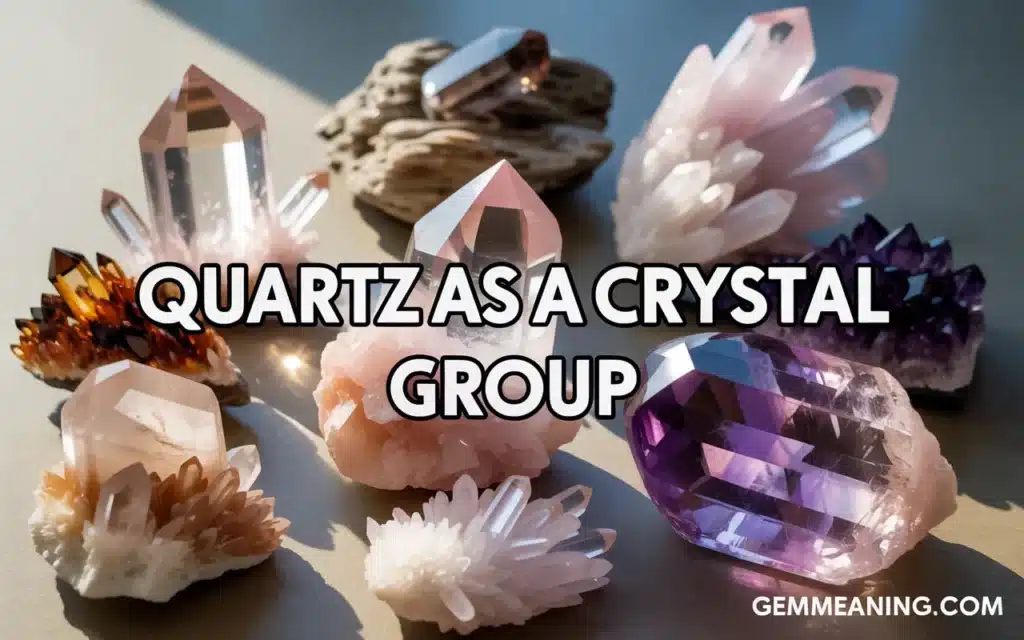
- Macrocrystalline Quartz: This group includes varieties where individual crystals are visible to the naked eye. These are the classic, sparkly crystals we often picture, like amethyst and clear quartz points.
- Cryptocrystalline (or Microcrystalline) Quartz: This group includes varieties where the individual crystals are too small to be seen without a microscope. These stones are formed from microscopic fibrous crystals packed tightly together, giving them a more solid, opaque, and waxy appearance. This branch is also known as Chalcedony.
Let’s explore the famous members of each branch.
Macrocrystalline Quartz: The Showstoppers
This is the family of “classic” quartz. These are the crystals that often form in large, distinct points and clusters, prized for their clarity and sparkle. The differences between them are caused by trace elements, inclusions, or natural irradiation that occurred during their growth.
Clear Quartz (Rock Crystal)
The patriarch of the family, Clear Quartz is quartz in its purest form. Lacking any significant trace elements or inclusions, it is transparent and colorless. It has been valued for centuries, once mistaken for ice that was frozen so solid it could never melt. Clear Quartz is prized for its clarity and its ability to amplify energy.
Amethyst
Arguably the most popular of all the crystals quartz varieties, Amethyst gets its beautiful purple hue from trace amounts of iron and other elements that have been altered by natural radiation within the earth. Its color can range from a pale, delicate lilac to a deep, royal purple.
Citrine
Natural Citrine is a relatively rare variety of quartz that gets its yellow-to-orange color from iron inclusions. Its color is often described as sunny and warm. It’s important to note that much of the “Citrine” on the market today is actually heat-treated Amethyst. When Amethyst is heated to high temperatures, its iron impurities change, turning the purple to a golden yellow or burnt orange.
Rose Quartz
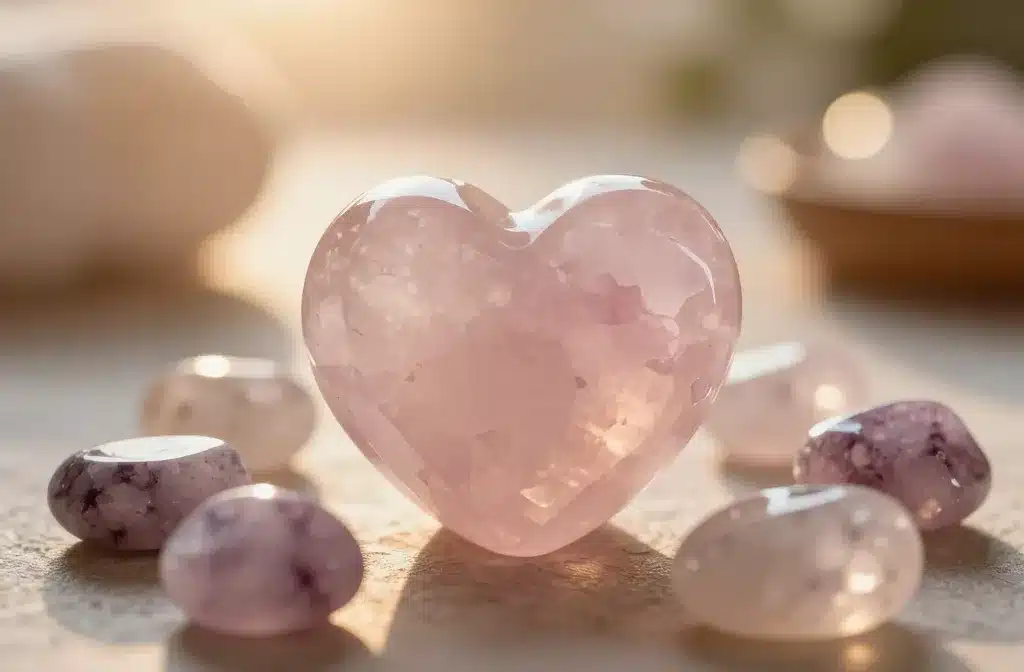
The gentle, pink member of the family, Rose Quartz gets its color from microscopic inclusions of a pink fibrous mineral related to dumortierite. This is why Rose Quartz is almost always cloudy or translucent rather than transparent. Its soft, loving energy makes it one of the most cherished stones for emotional healing.
Smoky Quartz
Smoky Quartz gets its brown to black color from natural radiation that activates aluminum impurities within the crystal lattice. The color can range from a light, wispy grey to a deep, nearly opaque brown-black (at which point it’s often called Morion). Despite its dark color, it is still a variety of quartz.
Prasiolite (Green Amethyst)
Prasiolite is a light green variety of quartz. While it can occur naturally, it is incredibly rare. Most Prasiolite on the market is created by heating specific types of Amethyst from certain locations. Not all Amethyst will turn green when heated; most will turn yellow (becoming “Citrine”).
Cryptocrystalline Quartz (Chalcedony): The Solid Beauties
This branch of the quartz family looks and feels very different from its macrocrystalline cousins. Instead of sparkly points, these stones are typically opaque, solid, and have a waxy or dull luster. They are all forms of Chalcedony, which is the catch-all term for quartz formed from microscopic crystals.
The Chalcedony family is further divided into two groups based on its appearance:
- Fibrous Varieties: Those that show banding or patterns.
- Granular Varieties: Those with a more grainy, uniform texture.
The Chalcedony Group (Banded and Patterned)
Agate
Agate is the name for Chalcedony that exhibits concentric bands or layers of color. These bands are formed as silica-rich water slowly deposits layers inside a cavity in a host rock. Agates come in an endless variety of colors and patterns, often named for their appearance or locality.
- Blue Lace Agate: Features delicate, wavy bands of light blue.
- Moss Agate: Is not truly banded but contains green mineral inclusions that look like moss or foliage.
- Dendritic Agate: Contains dark, tree-like or fern-like inclusions of manganese or iron oxides.
Carnelian
Carnelian is a solid or semi-translucent reddish-orange variety of Chalcedony. Its warm color comes from iron oxide impurities. It has been used in jewelry and decorative objects for thousands of years.
Onyx
True Onyx is a type of Agate characterized by parallel bands of black and white. However, in the modern market, the term “Onyx” is almost exclusively used to refer to solid black Chalcedony, which has often been dyed to achieve a uniform color.
Chrysoprase
One of the more valuable varieties of Chalcedony, Chrysoprase gets its stunning apple-green color from nickel impurities. Its bright, vibrant color makes it a popular stone for jewelry.
The Granular Varieties
Jasper
Jasper is an opaque variety of Chalcedony that is colored by various mineral impurities, most commonly iron. These impurities can make up to 20% of the stone, giving Jasper its rich, earthy tones of red, yellow, brown, and green. It is almost always multicolored and patterned.
- Red Jasper: Gets its deep brick-red color from iron.
- Polychrome Jasper: Known for its incredible swirls of earthy reds, browns, and tans, resembling a desert landscape.
- Ocean Jasper: A unique variety from Madagascar known for its colorful orbs and patterns.
Flint and Chert
While not typically thought of as collector’s crystals quartz, Flint and Chert are granular, microcrystalline forms of quartz. They are known for their hardness and conchoidal fracture, which allowed early humans to shape them into sharp tools and arrowheads.
Bloodstone (Heliotrope)
Bloodstone is a deep green variety of Jasper that is speckled with red spots of iron oxide (hematite). The green base is the “heliotrope,” and the red spots, resembling drops of blood, give the stone its common name.
How to Tell the Quartz Families Apart
With so many varieties, how can you start to identify them? Here are some simple tips for distinguishing between the macrocrystalline and cryptocrystalline branches.
Look for Sparkle and Form:
- Macrocrystalline: Does it have visible crystal faces? Does it sparkle as light reflects off its surfaces? Can you see a distinct point or cluster formation? If yes, it’s likely in the macrocrystalline family (Amethyst, Citrine, etc.).
- Cryptocrystalline: Is the stone opaque and solid-looking? Does it have a waxy or dull luster rather than a glassy sparkle? Does it have bands or mottled patterns? If yes, it’s likely a Chalcedony (Agate, Jasper, etc.).
Consider the Hardness:
- All varieties of quartz, from Agate to Amethyst, have a hardness of 7. This means they can scratch glass (hardness ~5.5) and cannot be scratched by a steel knife (~5.5). This is a great way to distinguish quartz from softer look-alikes like Fluorite (hardness 4) or Calcite (hardness 3).
Conclusion: A Family Worth Knowing
The world of crystals quartz is a perfect illustration of nature’s artistry. From a single, simple chemical compound, an incredible spectrum of colors, patterns, and forms can emerge. Understanding the fundamental difference between the large-crystalled macrocrystalline varieties and the microscopic-crystalled Chalcedonies provides a solid foundation for any collector.
This knowledge helps you see the connection between a sparkling Amethyst geode and a smoothly banded Agate. They are not distant strangers but members of the same vast and beautiful family, each telling a unique story of its formation through its color and form.
Key Takeaways:
- All quartz is silicon dioxide (SiO₂) with a hardness of 7.
- Macrocrystalline Quartz has crystals visible to the naked eye and includes varieties like Clear Quartz, Amethyst, Citrine, and Rose Quartz.
- Cryptocrystalline Quartz (Chalcedony) is made of microscopic crystals, making it appear solid and opaque. This group includes Agate, Jasper, Carnelian, and Onyx.
- The differences in color and appearance are caused by trace mineral impurities, inclusions, or the effects of natural radiation.
We encourage you to look at your own collection with this new perspective. Can you identify which of your stones are macrocrystalline and which are from the Chalcedony branch? Recognizing these family ties will deepen your connection to your stones and enrich your journey as a collector.

Christian Grey is the creator of GemMeaning, where he shares simple insights about crystals, gemstone meanings, and spiritual guidance. His focus is on making complex ideas easy to understand and practical for everyday life.