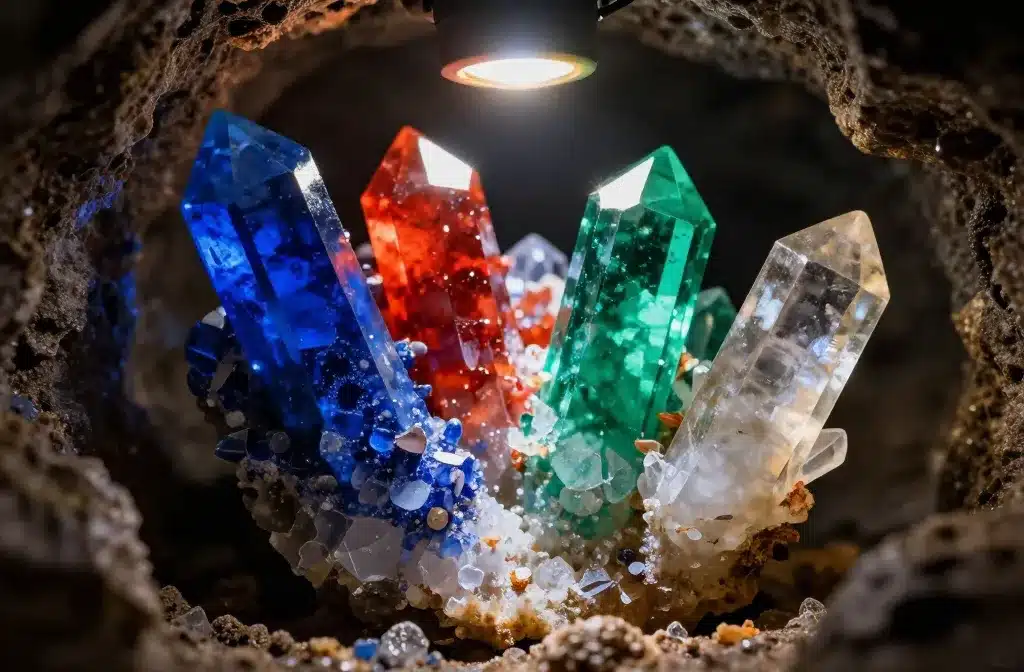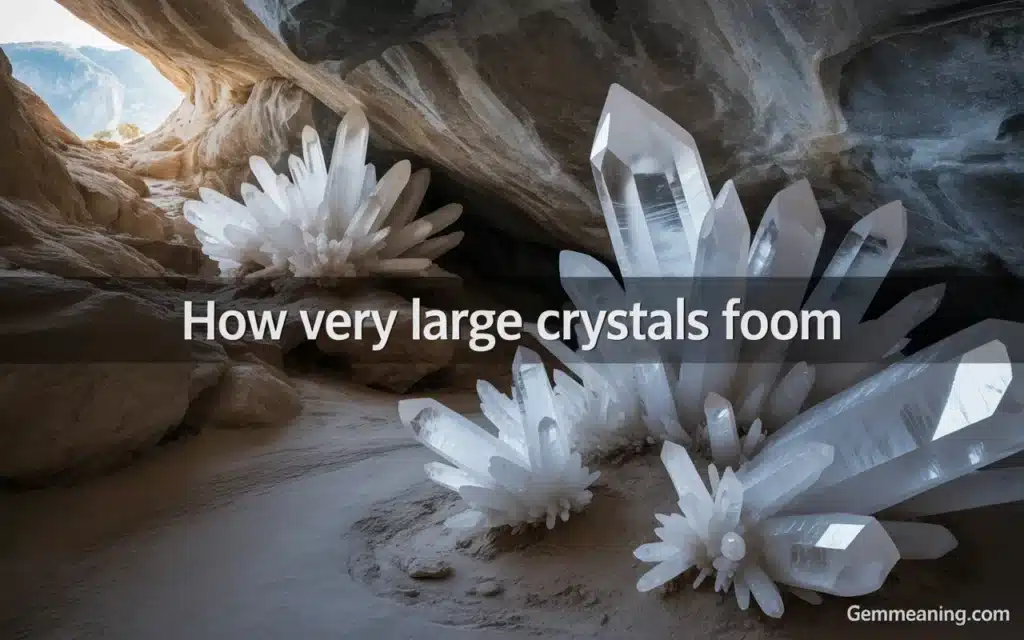
Imagine standing next to a crystal so big that you look like an ant beside it. We aren’t talking about the palm-sized stones you might find in a gift shop, or even the coffee-table-sized geodes that collectors prize. We are talking about true giants—massive beams of selenite longer than a school bus, or quartz points weighing as much as a small car.
When we see pictures of these geological marvels, like the famous Cave of the Crystals in Mexico, it feels like science fiction. It’s hard to believe that nature, usually so slow and subtle, can create structures of such staggering size. How does the Earth manage to grow huge crystals that dwarf humans?
The answer is a rare and perfect recipe of time, stability, and chemistry. It’s a geological lottery that happens only once in a blue moon.
In this post, we are going to explore the incredible science behind these titans of the mineral world. We will break down exactly what conditions are needed to grow massive stones, visit some of the most famous locations on Earth where they are found, and uncover the secrets hidden inside these giants. Get ready to feel small as we dive into the world of mega-crystals.
The Basic Recipe for Crystal Growth
To understand how the giants form, we first need to understand how any crystal forms. Whether it’s a tiny grain of salt or a massive emerald, the basic process is the same. It starts with a solution—usually hot water mixed with dissolved minerals.
Think of it like making rock candy in your kitchen. You dissolve sugar in hot water until the water can’t hold any more (this is called a supersaturated solution). As the water cools or evaporates, the sugar has to go somewhere. It starts to come out of the solution and latch onto a surface, building a crystal molecule by molecule.
For nature to grow huge crystals, this kitchen experiment needs to happen on a planetary scale, and it needs to go right for a very, very long time.
The Three Critical Ingredients
- Space: You can’t grow a giant in a closet. To get massive crystals, there must be a large, open cavity deep underground—a “womb” where they can expand without hitting a wall.
- Ingredients: There needs to be a constant supply of mineral-rich fluids. If the water runs out of the necessary building blocks (like silica or calcium), growth stops.
- Stability: This is the most difficult ingredient to find. The temperature and pressure must remain perfectly stable for hundreds of thousands, sometimes millions, of years.
The Secret to Size: The Goldilocks Zone
Why are huge crystals so rare? Because the Earth is a chaotic place. Earthquakes shake the ground, temperatures fluctuate, and water sources dry up. Most crystals stop growing after a few thousand years because their environment changes.
For a crystal to become a giant, it needs to stay in the “Goldilocks Zone”—not too hot, not too cold—for an exceptionally long time.
The Problem with Rapid Cooling
If the mineral-rich water cools down quickly, the minerals precipitate out all at once. This creates millions of tiny microscopic crystals (like in a rock of basalt) or a mass of small, jumbled crystals. It’s like a flash mob—everyone rushes in at once, and there’s no room to move.
The Magic of Slow Cooling
To get one massive crystal instead of a million tiny ones, the cooling process must be excruciatingly slow. We are talking about a temperature drop of just a fraction of a degree over thousands of years.
When cooling is this slow, the minerals have time to be picky. Instead of starting new crystals everywhere, the new molecules prefer to attach themselves to an existing crystal structure. It is energetically easier to join a team than to start a new one. This allows a few lucky “seed” crystals to gobble up all the available resources and grow into huge crystals.
Case Study: The Cave of the Crystals (Mexico)
You cannot talk about massive mineral formations without mentioning the Naica Mine in Chihuahua, Mexico. Discovered in 2000, this cave contains the largest natural crystals ever found on Earth.
These aren’t just big; they are monstrous. These beams of selenite (gypsum) reach lengths of up to 39 feet (12 meters) and weigh up to 55 tons. They crisscross the cavern like light beams in a sci-fi movie.
How Did They Get So Big?
The recipe at Naica was geologically perfect.
- The Heat Source: About two miles below the cave lies a pool of magma. This magma acted like a stove burner set to “simmer,” keeping the groundwater hot.
- The Temperature: For about 500,000 years, the water temperature in the cave stayed consistently at around 136°F (58°C).
- The Mineral: The water was saturated with anhydrite (a form of calcium sulfate). At exactly 136°F, anhydrite dissolves and transforms into gypsum (selenite).
Because the temperature stayed at that precise tipping point for half a million years, the gypsum crystals never stopped growing. They just kept adding layer after layer, undisturbed, until they became the huge crystals we see today.
Pegmatites: The Nurseries of Giants
While the Naica cave is unique, there is another geological environment famous for producing oversized crystals: pegmatites. If you are a collector, many of your largest tourmalines, aquamarines, and kunzites likely came from a pegmatite.
Pegmatites are essentially the “leftovers” of magma cooling. Imagine a massive chamber of molten rock cooling underground to form granite. As the granite hardens, water and rare elements (like lithium, boron, and beryllium) get pushed out and concentrated in the final pockets of liquid.
Why Pegmatites Grow Big Stones
This leftover liquid is incredibly rich in water. Water makes the magma less viscous (thinner), which allows atoms to move around quickly.
In thick, sticky magma, atoms have a hard time finding each other, so they form small crystals. In the watery, fluid-rich environment of a pegmatite, atoms can zip around and latch onto growing crystals very efficiently. This rapid movement allows crystals to grow to enormous sizes surprisingly quickly—sometimes in just a few days or weeks!
This is where we find:
- Massive Spodumene: Some crystals found in the Etta Mine in South Dakota were 42 feet long.
- Giant Beryl: Madagascar and Brazil have produced Beryl crystals (the family that includes Aquamarine and Emerald) that are taller than a house.
- Huge Mica Sheets: In the 19th century, sheets of mica were mined from pegmatites that were large enough to be used as windows for ovens.
Geodes: The Hidden Giants
Sometimes, the huge crystals aren’t standing out in the open; they are hiding inside rocks. Geodes offer a different perspective on massive crystal growth.
The largest amethyst geodes in the world come from the Artigas region of Uruguay and Rio Grande do Sul in Brazil. These aren’t the little baseball-sized rocks you crack open with a hammer. These are “cathedral” geodes that can stand 10 to 20 feet tall and weigh several tons.
How Giant Geodes Form
These giants start as gas bubbles trapped in ancient lava flows. Imagine a massive volcanic eruption millions of years ago. As the lava flowed, huge bubbles of gas got stuck, forming hollow cavities.
Over millions of years, mineral-rich groundwater seeped through the porous volcanic rock and into these hollow bubbles. Layer by layer, amethyst crystals grew inward from the walls of the bubble. Because the bubbles were protected by the hard basalt rock on the outside, the crystals inside were safe from erosion and weathering, allowing them to grow undisturbed for eons.
The Role of Pressure
We often think of heat as the main driver for crystal growth, but pressure plays a massive role too. Deep within the Earth, the weight of the rock above creates immense pressure.
For diamonds, this is essential. Diamonds are essentially just carbon. At the surface, carbon is soft graphite (like pencil lead). But under the crushing weight of 100 miles of rock, carbon atoms are forced into a super-strong, rigid crystal lattice.
While diamonds rarely reach the “huge” sizes of quartz or selenite (the largest gem-quality diamond, the Cullinan, was about the size of a human fist), the pressure allows for the creation of the hardest material known to nature.
For other minerals, pressure helps maintain the solubility of fluids. It keeps water liquid at temperatures far above boiling (superheated water), which allows it to hold way more dissolved minerals than normal water. This super-charged soup is excellent food for growing huge crystals.
Why Don’t We Find More of Them?
If the Earth is 4.5 billion years old, shouldn’t there be giant crystals everywhere? Why are they so rare?
1. They Are Hard to Find
Most of these giants grow deep underground. Unless we accidentally stumble upon them while mining for something else (like lead, silver, or zinc), they remain hidden forever. The Cave of the Crystals was only found because miners pumped the water out of the caverns to reach silver deposits. Without that human intervention, the crystals would still be submerged and growing in the dark.
2. They Are Fragile
Ironically, huge crystals are often incredibly fragile. The selenite beams in Naica are soft (you can scratch them with a fingernail). If an earthquake hits, they can snap under their own immense weight.
3. Erosion Destroys Them
Geological forces eventually bring deep rocks to the surface. Once exposed to rain, wind, and ice, most crystals break down. A selenite crystal that took a million years to grow can be dissolved by rainwater in a few decades. Finding a giant crystal intact means finding it at the exact right moment in geological history.
Can We Grow Huge Crystals in a Lab?
Humans are impatient. We don’t want to wait a million years for a quartz point. Scientists have figured out how to speed up the process to create large crystals for technology.
Using massive pressure vessels called autoclaves, scientists replicate the conditions deep inside the Earth. They use high heat and high pressure to dissolve silica and grow synthetic quartz.
However, even with our best technology, we struggle to match the sheer scale of nature. We can grow perfect, flawless crystals that are a few feet long, but growing a 40-foot beam like the ones in Naica? That requires a stability and timescale that is simply impossible to replicate in a lab. Nature is still the undisputed champion of heavyweights.
Famous Locations for Giant Crystals
If you want to see huge crystals with your own eyes (or at least in museums), here are the hotspots on the global map.
1. Chihuahua, Mexico (Selenite)
Home to the Cave of the Crystals. While the cave itself is currently closed to the public and re-flooded to preserve the crystals, specimens and photos from this location are legendary.
2. Minas Gerais, Brazil (Quartz and Pegmatites)
This region is the holy grail for gem collectors. It produces massive clusters of Quartz, huge Aquamarines, and tourmalines of staggering size. Many of the giant crystals you see in museums originated here.
3. South Dakota, USA (Spodumene)
The Black Hills of South Dakota are famous for the Etta Mine, which produced the largest spodumene crystals ever recorded. These massive “logs” of crystal were mined for their lithium content.
4. Arkansas, USA (Clear Quartz)
The Ouachita Mountains are known for producing world-class clear quartz clusters. While they rarely reach the “bus-sized” category, clusters weighing hundreds of pounds are regularly pulled from the red clay.
5. Madagascar (Beryl and Quartz)
Similar to Brazil, the pegmatites of Madagascar yield incredible giants. It is a primary source for massive Celestine geodes and giant Rose Quartz chunks.
What Huge Crystals Tell Us About Earth
Finding a deposit of massive crystals is like finding a geological time capsule. These formations tell scientists incredible stories about the Earth’s past.
By analyzing tiny bubbles of fluid trapped inside these crystals (called fluid inclusions), scientists can sample water from millions of years ago. They can learn exactly what the temperature, pressure, and chemical composition of the Earth’s crust was at the time the crystal formed.
These huge crystals are evidence of the Earth’s quiet, patient power. They remind us that beneath our feet, incredible things are happening in the dark.
Conclusion: Nature’s Masterpieces
The existence of huge crystals challenges our perception of the world. We are used to things that are built quickly and break down quickly. But these giants operate on a timeline that is almost impossible for us to comprehend.
It takes a perfect storm of geological luck—stable temperatures, rich fluids, open space, and millions of years of silence—to create these marvels. They are rare, they are beautiful, and they serve as a reminder that nature is the greatest artist of all.
Whether it’s a towering amethyst cathedral or a beam of selenite that bridges a cavern, these formations capture our imagination because they seem magical. But as we’ve learned, it’s not magic; it’s just very, very slow chemistry.
Key Takeaways:
- The Recipe: Huge crystals require open space, mineral-rich fluids, and extremely stable temperatures over thousands of years.
- Slow Cooling: The key to size is slow cooling, which allows crystals to grow layer by layer rather than forming millions of tiny grains.
- Locations: Famous giants are found in places like Mexico (Naica Mine), Brazil, and Madagascar.
- Pegmatites: These fluid-rich magma leftovers allow crystals to grow to massive sizes very quickly due to the movement of water.
- Rarity: Giant crystals are rare because geological conditions usually change (earthquakes, temperature drops) before they can reach immense sizes.
Next time you hold a small crystal in your hand, close your eyes and imagine what it could have become if it had just a little more space, a little more time, and a little more luck. The potential for greatness lies in every grain of sand. We encourage you to visit a natural history museum near you—chances are, they have a giant waiting to meet you.

Christian Grey is the creator of GemMeaning, where he shares simple insights about crystals, gemstone meanings, and spiritual guidance. His focus is on making complex ideas easy to understand and practical for everyday life.