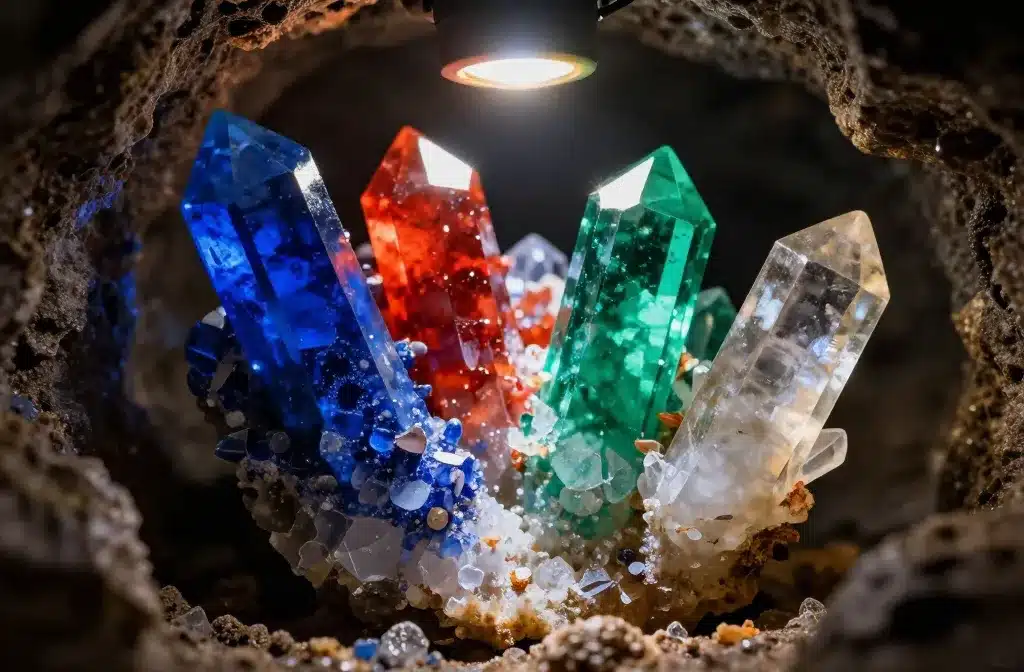
Have you ever dreamed of stepping inside a geode? Imagine cracking open one of those small, hollow rocks you see in gift shops, but instead of holding it in your hand, you are small enough to walk inside it. The walls are lined with sparkling points, and beams of translucent minerals crisscross the air above your head like something out of a science fiction movie.
While it sounds like a fantasy, these places actually exist deep beneath the Earth’s surface. They are known as natural crystal cave systems. While most caves are famous for their stalactites and stalagmites, a rare few take geological beauty to an entirely different level, filled with massive, perfectly formed crystals that defy imagination.
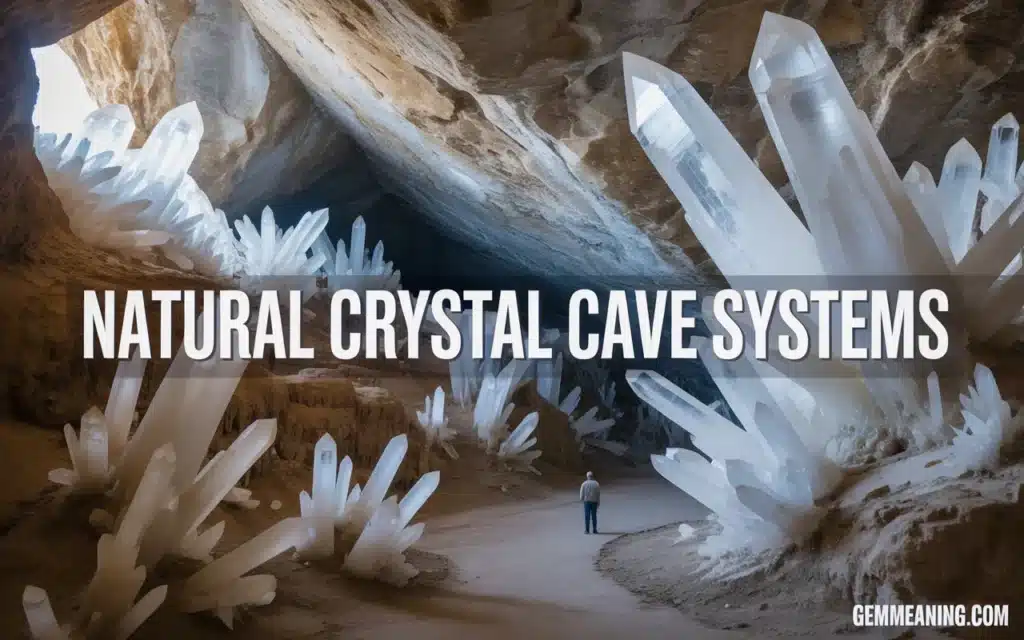
Among these geological wonders, the famous cave of crystals in Naica, Mexico, stands as the undisputed king—a cavern filled with selenite beams the size of telephone poles. But it is not the only one. From hidden chambers in New Mexico to sparkling marble caverns in California, the Earth has created several of these underground jewel boxes.
In this post, we are going to journey into the dark to explore the glittering world of crystal cave systems. We will look at the science that allows these giants to grow, visit the most spectacular locations on the planet, and uncover the secrets of the legendary cave of crystals. Grab your helmet and flashlight; we’re going underground.
What Makes a Crystal Cave System Unique?
To understand just how special these systems are, we first have to look at what makes a “normal” cave. Most caves we visit are solution caves formed in limestone. They are wet, drippy, and filled with rock formations (speleothems) made of calcite. While beautiful, these formations usually look like melted wax or stone icicles.
A true crystal cave system offers something different. Instead of just dripping rock, these spaces provided the perfect environment for distinct, geometric crystals to grow.
The Difference is in the Details
In a standard cave, water drips and leaves behind minerals in layers. In a crystal cave, the process is often much slower and more stable, allowing individual molecules to lock into a perfect atomic lattice. This creates flat faces, sharp points, and transparency that you don’t see in standard dripstone.
Rare Conditions
Finding a cave filled with large crystals is incredibly rare because it requires a “Goldilocks” set of conditions.
- Space: There must be a void large enough for crystals to expand.
- Mineral Supply: There must be a constant flow of mineral-rich water.
- Stability: The temperature and environment must remain undisturbed for hundreds of thousands of years.
When these stars align, nature creates masterpieces like the cave of crystals, transforming a dark hole in the ground into a glittering palace.
The Giant of Them All: The Cave of Crystals in Naica
You cannot discuss crystal caves without paying homage to the most spectacular discovery in modern geology: the Cueva de los Cristales, or the Cave of Crystals. Located nearly 1,000 feet underground in the Naica Mine in Chihuahua, Mexico, this cave contains the largest natural crystals ever found on Earth.
A Serendipitous Discovery
The cave was discovered accidentally in the year 2000 by two miners who were drilling a new tunnel for a lead and silver mine. When they broke through the rock wall, they were stunned to find a cavern roughly the size of a basketball court, crisscrossed by massive, white beams of selenite.
The Scale of the Giants
The crystals in this cave are truly monstrous. Some measure up to 39 feet (12 meters) in length and weigh as much as 55 tons. To put that in perspective, imagine a crystal pillar longer than a school bus and heavy enough to crush a truck. They jut out from the floor, walls, and ceiling, creating a chaotic, beautiful web of white stone that humans look like insects crawling through.
A Deadly Environment
Despite its beauty, the cave of crystals is incredibly hostile to human life. It is not a cool, damp cave like the ones you might tour on a vacation.
- Extreme Heat: The temperature inside hovers around 136°F (58°C).
- Extreme Humidity: The humidity is close to 100%.
Because of these conditions, a human without protective gear would succumb to heatstroke in less than 10 minutes. The moisture in your lungs would begin to condense, essentially drowning you from the inside. Scientists who explored the cave had to wear special ice-cooled suits and respirators just to survive for short trips.
The Science Behind the Giants
How did the cave of crystals produce such massive formations when other caves only produce small points? The answer lies in a geological “slow cook.”
The Magma Chamber
About two miles beneath the cave lies a pool of magma. This heat source acted like a burner on a stove, keeping the groundwater in the cave heated to a very specific temperature for an incredibly long time.
The Mineral Transformation
The water in the cave was rich in a mineral called anhydrite. As long as the water stayed above 136°F, the anhydrite remained stable. However, roughly 500,000 years ago, the water temperature cooled slightly to just below that mark.
At this specific temperature, the anhydrite dissolved and re-formed as gypsum (selenite). Because the cooling was so incredibly slow and stable—maintaining that perfect temperature for hundreds of thousands of years—the crystals didn’t form as millions of tiny grains. Instead, they grew layer by layer onto a few select crystals, allowing them to reach immense sizes.
It is a perfect example of patience. If the cave had cooled quickly, we would have just seen a room of white mud or small rocks. But because it took its time, we got the cave of crystals.
Other Breathtaking Crystal Cave Systems
While the Naica mine holds the heavyweights, there are other stunning crystal cave systems around the world, some of which are accessible to the public right here in the USA.
The Giant Geode of Pulpí (Spain)
If you want the experience of standing inside a crystal without the deadly heat of Naica, the Geode of Pulpí in Almería, Spain, is the place to go.
- The Experience: It is an egg-shaped cavity about 26 feet long, lined entirely with gigantic, transparent gypsum crystals.
- Accessibility: Unlike Naica, this geode has been opened to the public for guided tours. It is currently the largest accessible crystal cave in the world. The crystals are so clear you can read a book through them.
Crystal Cave (Sequoia National Park, California)
For those in the United States, Sequoia National Park hides a secret underground.
- The Geology: This is a marble cave. Marble is metamorphosed limestone, meaning the rock itself has already crystallized.
- The Formations: While you won’t see 40-foot beams, the cave is packed with polished marble walls and sparkling calcite formations. The “Fairy Pools” section features terraced pools filled with crystal-clear water and delicate formations.
- Visiting: This is a designated “show cave,” meaning it is safe and open for family tours, making it a perfect introduction to underground geology.
Lechuguilla Cave (New Mexico, USA)
Located in Carlsbad Caverns National Park, Lechuguilla is the “holy grail” for cavers, though it is not open to the general public.
- The Reputation: It is considered one of the most beautiful caves in the world. Because it was sealed off from the surface for millions of years until its discovery in 1986, it is pristine.
- The Crystals: It is famous for its massive gypsum chandeliers—formations that hang from the ceiling and extend up to 20 feet long. It also features rare subaqueous helictites and “cave pearls.”
- Access: To protect its fragile ecosystem, access is restricted to scientific researchers only. It serves as a pristine laboratory for understanding how a cave of crystals evolves in isolation.
How Natural Crystal Cave Systems Form
We know how the giants in Mexico formed, but what about crystal caves in general? The process is a fascinating mix of chemistry and hydrology.
Step 1: The Cavity
Before any crystals can grow, nature needs to clear a space. This usually happens when acidic groundwater moves through limestone or gypsum bedrock. Over thousands of years, the acid dissolves the rock, carving out tunnels, rooms, and vast chambers.
Step 2: The Mineral Bath
Once the room is hollowed out, it needs to be filled or coated with mineral-rich water. This water picks up elements like calcium, sulfur, and silica from the surrounding rock as it trickles down from the surface.
Step 3: Evaporation and Precipitation
This is where the magic happens.
- Dripstones: In air-filled caves, water drips from the ceiling. As it hits the air, it releases carbon dioxide, which forces the dissolved minerals to turn back into solid stone (calcite). This creates sparkling stalactites.
- Submerged Growth: In underwater caves (like the cave of crystals used to be), the crystals grow directly from the fluid, allowing them to form perfect geometric shapes without gravity weighing them down.
Step 4: The Factor of Time
The most critical ingredient is time. A crystal might grow only the width of a human hair in a year. To get a sparkling cavern, the geological conditions must remain stable for eons. If an earthquake hits or the water chemistry changes, the growth stops.
The Fragility of Crystal Caves
It is important to understand that these environments are incredibly fragile. A crystal cave system that took a million years to build can be destroyed in a human afternoon.
The Naica Dilemma
The famous cave of crystals in Mexico is actually no longer accessible for a heartbreaking but necessary reason. The cave was only dry because the mining company pumped out the groundwater to reach the silver deposits.
- ** Deterioration:** When exposed to air, the massive selenite beams began to degrade. The air dried them out, and they started to become opaque and crack.
- Preservation: After mining operations concluded, the pumps were turned off. The cave has been allowed to re-flood with natural groundwater. This returns the crystals to their natural, stable environment, preserving them for future generations, even if we can no longer see them.
Conservation in Show Caves
In public caves, the oil from human skin can kill a growing crystal. If you touch a sparkling formation, the oil prevents the mineral water from sticking to the rock, effectively stopping the growth forever. This is why the golden rule of caving is “look but don’t touch.”
Visiting Crystal Caves: What You Need to Know
If reading about the cave of crystals has given you the itch to explore, here is how you can experience these wonders safely and responsibly.
- Stick to Show Caves: “Show caves” are caverns that have been developed for tourism with lights, paths, and handrails. They are the safest way to see crystal formations. Excellent examples in the USA include Carlsbad Caverns (NM), Caverns of Sonora (TX), and Jewel Cave (SD).
- Bring a Jacket: Caves maintain a constant temperature year-round, which usually matches the average annual temperature of the region. In most of the US, this means caves are a cool 50-60°F, even in summer.
- Respect the Rules: Never cross barriers or touch formations. You are walking through a geological museum where the exhibits cannot be repaired.
- Look for “Speleothems”: When looking up cave tours, look for descriptions of “speleothems.” This is the scientific word for crystal formations. Caves with abundant speleothems will be the most sparkly and visually stunning.
The Metaphysical Allure of Crystal Caves
Beyond the science, there is a reason we are so drawn to places like the cave of crystals. For centuries, humans have viewed caves as entrances to the underworld or places of spiritual power.
For those interested in the energy of stones, a crystal cave represents the ultimate grounding experience. Being surrounded by tons of natural quartz, calcite, or gypsum is believed by many to amplify the earth’s energy. It is a place of silence, darkness, and stillness—a stark contrast to the chaotic, noisy world above ground.
Even if you look at it purely scientifically, there is a spiritual quality to realizing that beauty of this magnitude exists in the dark, completely independent of human eyes. It reminds us that the Earth is an artist that creates for the sheer joy of creation.
Conclusion: The hidden Beauty Beneath Our Feet
The existence of natural crystal cave systems challenges our perception of the world. We walk around on the surface, largely unaware that miles beneath our feet, nature has built cathedrals of white stone and shimmering curtains of rock.
While the massive, deadly, and beautiful cave of crystals in Mexico may be the most famous example, it is just one chapter in a global story of geological wonder. From the accessible marble halls of Sequoia to the hidden depths of Lechuguilla, these systems are time capsules of Earth’s history.
They teach us about the power of patience. They show us that with enough time and stability, simple water and rock can be transformed into something extraordinary.
Key Takeaways:
- Unique Geology: Crystal caves differ from standard caves due to stable conditions that allow for distinct, geometric crystal growth.
- The Giant: The famous cave of crystals in Naica, Mexico, contains selenite beams up to 39 feet long, grown over 500,000 years in 136°F water.
- Formation: These systems require a cavity, mineral-rich water, and immense geological stability to form.
- USA Locations: You can visit beautiful crystal systems in the US, such as Crystal Cave in California and the caverns of Carlsbad, New Mexico.
- Conservation: These environments are fragile. The Naica cave has been re-flooded to preserve it, reminding us of the need to protect these natural wonders.
We encourage you to find a cavern near you and take a tour. You might not find a 50-ton crystal beam, but you will find a sparkling, silent world that will change the way you look at the ground beneath your feet. Happy exploring!

Christian Grey is the creator of GemMeaning, where he shares simple insights about crystals, gemstone meanings, and spiritual guidance. His focus is on making complex ideas easy to understand and practical for everyday life.