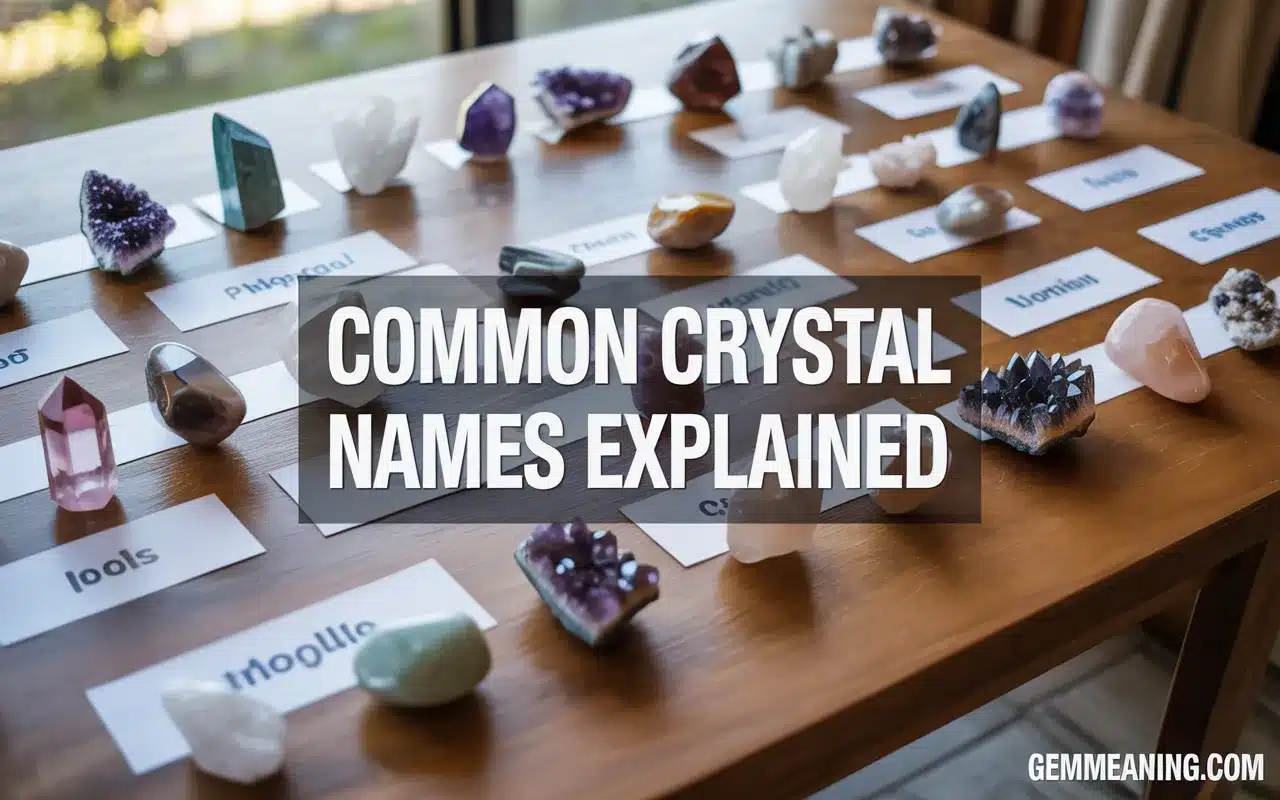
Have you ever walked into a crystal shop, picked up a beautiful blue stone, and felt completely baffled by the label? One tag says “Angelite,” another says “Celestite,” and a third says “Blue Lace Agate.” It can feel like learning a whole new language. Where do these names come from? Why are some named after people, others after places, and some after Greek myths?
Entering the world of mineral collecting often means navigating a confusing sea of crystals names. Sometimes a single stone has three different names depending on who is selling it! Understanding the stories and meanings behind these labels doesn’t just clear up the confusion; it adds a layer of magic and history to your collection.
This guide is your Rosetta Stone for the mineral world. We are going to decode the origins of the most common crystal monikers. We will explore which names are scientific, which are historical, and which are purely marketing terms created to make a stone sound more exciting.
By the end of this post, you won’t just know what to call your favorite stones; you’ll understand the “why” behind the label. Let’s dive into the fascinating etymology of the mineral kingdom.
The Three Main Sources of Crystal Names
Before we look at specific examples, it helps to understand the general rules (or lack thereof) for naming minerals. Unlike biology, which has a very strict system for naming animals and plants, mineralogy is a bit more of a patchwork quilt.
Generally, crystals names come from one of three main sources:
- Physical Characteristics: The name describes what the stone looks like (color, shape, or weight).
- Locations: The name tells you where the stone was first discovered.
- People: The name honors a specific person, often the discoverer or a famous scientist.
However, there is a fourth “unofficial” category that causes the most confusion: trade names. These are names invented by sellers to make a stone sound more mystical or valuable. We will explore all of these categories to help you become a savvy collector.
Names Based on Color and Appearance
The most intuitive way to name a stone is simply to describe it. Many of the oldest and most traditional crystals names are derived from ancient Greek or Latin words describing the stone’s color or physical nature.
Hematite (The Blood Stone)
Hematite is a heavy, metallic silver-grey stone. So, why is its name derived from the Greek word haima, meaning “blood”?
If you scratch a piece of Hematite across a rough surface, or if you grind it into a powder, it turns a vivid, rust-red color. Ancient Greeks used crushed Hematite as a red pigment. So, despite its silver exterior, it is named for its bloody red interior.
Rhodonite and Rhodochrosite (The Roses)
These pink stones often get confused, and their similar names don’t help! Both come from the Greek word rhodon, meaning “rose.”
- Rhodonite: Means “rose-stone.” It is usually pink with black veins.
- Rhodochrosite: Means “rose-colored.” It is often a more vibrant, banded pink and white.
The root word gives you a hint: if it starts with “Rhodo,” expect it to be pink.
Aquamarine (Water of the Sea)
This is one of the most poetic names in the mineral world. It comes directly from the Latin aqua marina, literally translating to “water of the sea.” Looking at a high-quality, pale blue-green Aquamarine gem, it is easy to see why ancient Romans gave it this moniker. It perfectly captures the clarity and hue of the Mediterranean ocean.
Citrine (The Lemon Stone)
Citrine is the yellow variety of quartz. Its name comes from the French word citron, meaning “lemon.” While natural Citrine is often more of a smoky champagne color than a bright lemon yellow, the name has stuck for centuries to describe golden quartz varieties.
Azurite (The Blue Stone)
Sometimes the naming convention is very straightforward. Azurite is a deep, intense blue mineral. Its name comes from the Persian word lazhward, which means “blue.” This is the same root word that gives us “azure” (the color) and “Lapis Lazuli.”
Names Based on Mythology and Legends
Some crystals names are steeped in ancient storytelling. These names connect the stone to the gods, spirits, and legends of the cultures that first treasured them.
Amethyst (The Sobriety Stone)
The name “Amethyst” comes from the Greek amethystos, which translates to “not drunk.” According to Greek mythology, a maiden named Amethyst was turned into a clear quartz statue by the goddess Diana to protect her from the wrath of Dionysus, the god of wine.
In his remorse, Dionysus poured his wine over the statue, staining the quartz purple. Ancient Greeks believed that wearing Amethyst or drinking from Amethyst goblets would prevent intoxication.
Selenite (The Moon Stone)
This beautiful, translucent white form of gypsum has a glowing, pearly luster that resembles moonlight. It is named after Selene, the ancient Greek goddess of the moon. It is a fitting name for a stone that seems to hold an inner light.
- Note: Do not confuse this with “Moonstone” (a feldspar mineral). Selenite is named after the goddess of the moon, while Moonstone is named for its visual effect (adularescence).
Pyrite (The Fire Stone)
You likely know Pyrite as “Fool’s Gold” because of its metallic brassy color. But its official name comes from the Greek word pyr, meaning “fire.”
Why fire? Because if you strike a piece of Pyrite against steel or a hard rock, it creates sparks. Ancient people used Pyrite to start fires long before matches existed. The name literally describes its function as a fire-starter.
Names Based on Locations
Geology is all about place. Often, a new mineral is named after the specific town, region, or even the mine where it was first documented. These crystals names serve as a geographical tag, telling you exactly where the stone’s history began.
Labradorite (The Stone from Labrador)
This magical stone, known for its flashing rainbow colors (labradorescence), was discovered by Moravian missionaries in 1770. Where did they find it? On Paul Island, near Nain, in Labrador, Canada. While Labradorite is now found in Madagascar and other places, it will forever be linked to that chilly Canadian province.
Aragonite (The Spanish Stone)
Aragonite is a common mineral that forms in many shapes, including “sputnik” stars. It was first officially defined based on specimens found in the Rio Gallo in Molina de Aragón, Spain.
Tanzanite (The Pride of Tanzania)
This is a relatively modern name. When a stunning blue-violet variety of zoisite was discovered in 1967, it needed a catchy name. Tiffany & Co. introduced it to the market and named it Tanzanite to honor the only country on Earth where it is found: Tanzania. It remains one of the few gems named specifically to boost tourism and national pride.
Amazonite (The River Stone)
Here is a case of mistaken identity! Amazonite is a blue-green variety of microcline feldspar. It was named after the Amazon River in South America.
However, mineralogists now believe that no Amazonite deposits actually exist in the Amazon basin. It is likely that the green stones found there historically were actually Nephrite Jade, and the name Amazonite was applied to the wrong stone. Despite the error, the name stuck.
Names Based on People
When a scientist discovers a new mineral, they often have the privilege of naming it. Frequently, they choose to honor a mentor, a famous figure, or a fellow scientist. If a crystal name ends in “-ite” and the first part sounds like a last name, it’s usually a tribute.
Prehnite (The Colonel’s Stone)
Prehnite has a special distinction: it was the first mineral ever named after a person. It honors Colonel Hendrik Von Prehn (1733–1785), a Dutch mineralogist and governor of the Cape of Good Hope in South Africa, who discovered the mineral in 1774.
Kunzite (The Gemologist’s Stone)
Kunzite is a lovely pink variety of Spodumene. It was named in 1902 after George Frederick Kunz, a legendary gemologist for Tiffany & Co. He was a giant in the field of mineralogy, and having a gemstone named after him was a major honor.
Lepidolite (Wait, Not a Person!)
Be careful! Not all “-ite” names are people. Lepidolite sounds like it could be named after a “Mr. Lepid,” but it actually comes from the Greek lepidos, meaning “scale.” This refers to its scaly, flaky texture. It is easy to get tripped up when decoding crystals names.
The Confusion of Trade Names
This is where things get tricky for beginners. In the metaphysical and jewelry trade, sellers often invent names to make a stone sound more appealing or mystical. These are not scientific names; they are marketing labels.
Knowing the difference between a trade name and a mineral name can save you money and confusion.
“Angel Aura” and “Aqua Aura” Quartz
These are not natural varieties of quartz found in the earth. These names refer to natural Clear Quartz crystals that have been treated in a lab. They are bonded with precious metals like gold, platinum, or titanium to create an iridescent, metallic sheen. The names “Angel Aura” and “Aqua Aura” describe the treatment, not a distinct mineral species.
“Lemurian Seed Crystals”
Scientifically, these are simply Quartz crystals. The name “Lemurian” refers to a specific growth habit (horizontal striations on the sides) and a metaphysical backstory connecting them to the lost civilization of Lemuria. While the name helps collectors identify this specific look, it is not a recognized geological term.
“Super Seven” or “Melody Stone”
This is a very expensive stone composed of seven specific minerals (Amethyst, Cacoxenite, Goethite, Lepidocrocite, Rutile, Smoky Quartz, and Quartz) all in one. The name “Super Seven” is purely a trade name used to market this specific combination found in Brazil. A geologist would likely just call it “Included Quartz.”
“Apache Tears”
This is a poetic trade name for rounded nodules of Obsidian (volcanic glass). The name comes from a legend about the tears of Apache women mourning warriors who leaped off a cliff to avoid capture. While the story is moving, scientifically, it is just Obsidian.
How to Decode a Name You Don’t Know
When you encounter a new crystal name, how can you figure out what it actually is? Here are a few tips for cutting through the jargon.
1. Look for the “-ite”
The suffix “-ite” is the standard naming convention for minerals (Calcite, Pyrite, Fluorite). If a name ends in “-ite,” there is a good chance it is a scientifically recognized mineral species.
2. Check for Adjectives
If a name consists of a regular rock name with a fancy adjective in front of it, be skeptical.
- “Sunset Aura Quartz” = Treated Quartz.
- “Mystic Topaz” = Coated/Treated Topaz.
- “Strawberry Obsidian” = Often man-made glass (red obsidian is extremely rare).
3. Use a Mineral Database
Websites like Mindat.org are excellent resources. If you type in a trade name, it will usually tell you, “Trade name for…” or “Variety of…” This helps you understand the true geological identity of the stone.
Why Do Crystal Names Change?
You might notice that crystals names seem to evolve. Stones that were called one thing ten years ago might have a new name today. This happens for a few reasons.
Scientific Reclassification:
Sometimes, scientists realize that what they thought was one mineral is actually two different ones. For example, stones labeled “Stilbite” might be further divided into “Stilbite-Ca” (calcium dominant) and “Stilbite-Na” (sodium dominant).
Marketing Trends:
Sellers are always looking for the next big thing. A common grey stone might not sell well, but rename it “Silver Mist Jasper,” and suddenly it flies off the shelves. While some purists dislike this, it is a reality of the rock trade.
Language Drift:
Names can be lost in translation. “Lapis Lazuli” is often shortened to just “Lapis.” “Blue Lace Agate” is a specific type of Chalcedony, but people often drop the “Lace” and just call it blue agate, which is less specific.
The Case of Quartz: The Stone of Many Names
No mineral has more names than Quartz. Because it comes in so many colors and forms, humanity has given almost every variety its own unique moniker.
- Rock Crystal: Clear Quartz.
- Amethyst: Purple Quartz.
- Citrine: Yellow Quartz.
- Rose Quartz: Pink Quartz.
- Smoky Quartz: Brown/Black Quartz.
- Prasiolite: Green Quartz (often heat-treated).
- Ametrine: A mix of Amethyst and Citrine.
- Chalcedony: Microcrystalline Quartz.
- Agate: Banded Chalcedony.
- Jasper: Opaque Chalcedony.
- Onyx: Black/White banded Chalcedony.
- Carnelian: Red/Orange Chalcedony.
It is mind-blowing to realize that all twelve of those stones are chemically identical ($SiO_2$). They are all quartz. The different crystals names just describe the color or the structure. It’s like calling a red apple “Red Delicious” and a green apple “Granny Smith”—they are different varieties, but they are both apples.
Cultural Differences in Naming
It is also worth noting that names vary by country. In the USA, we use the standard International Mineralogical Association (IMA) names for science, but common names can differ.
For example, in China, Jade is a revered stone with many specific names depending on the exact shade of green and texture, distinctions that don’t exist in English. In the UK, “Blue John” is a specific historic name for a banded purple-blue Fluorite found only in Derbyshire. If you brought that stone to the USA without knowing the history, you might just call it “Banded Fluorite.”
Summary: What’s in a Name?
Navigating the world of crystals names is a journey through history, geography, language, and science. A name can tell you that a stone was found in a snowy Canadian province (Labradorite), that it was used by Greeks to stay sober (Amethyst), or that it honors a famous gemologist (Kunzite).
Understanding these names empowers you as a collector.
- It protects you: You know that “Aqua Aura” is a treated stone, not a natural find.
- It connects you: You understand the mythology and history behind the stone in your pocket.
- It educates you: You learn about chemical elements and geography just by reading labels.
Don’t be intimidated by the long, scientific-sounding words or the flashy trade names. Take a moment to look them up. Behind every difficult-to-pronounce label is a story waiting to be told.
We encourage you to go through your own collection this week. Pick up a few stones and look up the origin of their names. You might be surprised to find that the little grey rock on your shelf is named after a goddess, a river, or a fire. Happy researching!