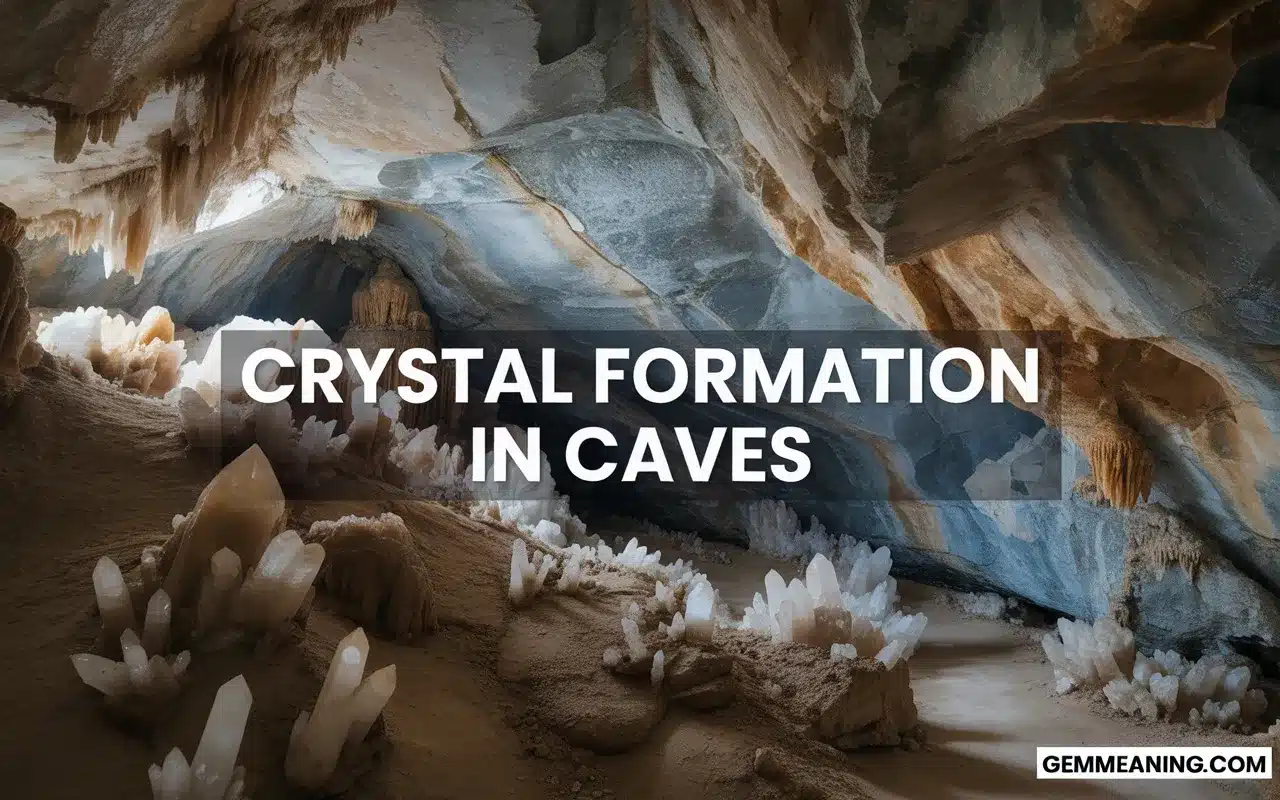
Imagine stepping out of the bright sunlight and into the cool, silent darkness of a cave. As your eyes adjust, the beam of your flashlight catches something that sparkles. You move closer and find the walls and ceiling are covered in a breathtaking landscape of shimmering formations—dazzling stalactites, flowing draperies, and delicate, needle-like crystals.
Caves are some of the most magical places on Earth, holding natural treasures that have been growing in total darkness for thousands of years. But how does this happen? How does a dark, damp hole in the ground become a gallery of natural art? The formation of cave crystals is a slow, beautiful dance between water, rock, and time.
This guide will take you deep underground to explore the science behind these stunning formations. We’ll uncover the simple chemistry that creates complex structures, learn the difference between a stalactite and a stalagmite, and discover the incredible variety of crystals that can grow in these hidden worlds. Let’s illuminate the secrets of cave geology.
The Two Essential Ingredients: Water and Rock
At its heart, the formation of nearly all cave crystals comes down to two simple things: water and a specific type of rock.
1. The Water: A Weak Acid
The journey begins with rainwater. As rain falls from the sky, it mixes with carbon dioxide (CO₂) from the atmosphere and from decaying plants in the soil. This combination creates a very weak solution of carbonic acid. It’s the same acid that gives fizzy drinks their bite, and it’s completely harmless, but it has a special power: it can dissolve certain types of rock.
2. The Rock: Soluble Limestone
This acidic rainwater is most effective on rocks made of calcite (calcium carbonate). Limestone, marble, and dolomite are the most common types of carbonate rock. When the weak carbonic acid seeps through cracks in the ground and comes into contact with limestone, it works like a solvent, slowly dissolving the rock and carrying the calcium carbonate away with it. This is the process that carves out the caves themselves.
This mineral-rich water is the lifeblood of the cave. It holds the essential building blocks that will, drop by drop, construct the incredible crystal formations inside.
Speleothems: The Stars of the Show
The scientific name for any crystal formation inside a cave is a “speleothem.” This word comes from the Greek words spēlaion (cave) and théma (deposit). Every stalactite, stalagmite, and flowstone you see is a type of speleothem. Most are made of calcite, but they can also be formed from other minerals like aragonite and gypsum.
The magic happens when the mineral-rich water finally reaches the open air of the cave. The chemistry that put the minerals into the water is reversed. As the water drips or flows, it comes into contact with the cave’s atmosphere. This causes it to release its trapped carbon dioxide, much like opening a soda bottle releases the fizz.
When the CO₂ is released, the water can no longer hold as much dissolved calcite. The calcite precipitates out of the solution, leaving behind a microscopic crystal deposit. This process repeats, drop after drop, over thousands of years, building the magnificent formations we see today.
The Dripstone Family: Stalactites and Stalagmites
Dripstones are the most famous and recognizable types of cave crystals. They are formed, as the name suggests, by water slowly dripping from the cave ceiling.
Stalactites: Holding “Tite” to the Ceiling
A stalactite begins its life as a single drop of calcite-rich water hanging from the cave roof. Before the drop falls, it deposits a tiny, paper-thin ring of calcite. The next drop deposits another ring on top of the first. Over centuries, these rings build upon each other, forming a hollow, fragile tube called a “soda straw.”
These soda straws are the infant stage of every stalactite. Some can grow several feet long while remaining as thin as a drinking straw. Eventually, the hole in the center of the soda straw gets clogged. The water is then forced to flow down the outside of the straw, depositing more layers of calcite and thickening it into the classic, cone-like stalactite shape we know.
A good way to remember this is that stalactites hold on “tite” (tight) to the ceiling.
Stalagmites: Might Reach the Ceiling
When a drop of water falls from the ceiling or from the end of a stalactite, it still contains some dissolved calcite. When this drop splatters on the cave floor, it deposits another tiny layer of calcite. Over immense periods of time, these splash-deposits build up, creating a mound-like formation that grows upward. This is a stalagmite.
Stalagmites are typically thicker and more rounded than their stalactite counterparts because the water spreads out more when it hits the floor. To remember them, think that they grow from the ground up with all their “mite” (might), hoping to one day reach the ceiling.
Columns: When Two Become One
When a stalactite growing down and a stalagmite growing up finally meet, they fuse together. This creates a single, continuous formation that stretches from the floor to the ceiling, known as a column or pillar. A cave filled with these majestic columns can look like an ancient, underground temple.
Flowstones and Draperies: Crystals in Motion
Not all water in a cave drips. Sometimes, it flows in thin sheets down walls or along slanted ceilings. This creates a completely different, but equally beautiful, type of cave crystals known as flowstone.
Flowstone
When water trickles down the walls or over the floor of a cave, it deposits broad, sheet-like layers of calcite. These formations can look like frozen waterfalls or cascading rivers of stone. The surface of flowstone is often smooth and polished by the continuous movement of water over its surface.
Draperies and Cave Bacon
If water trickles down an inclined ceiling, it builds up a thin, curtain-like sheet of calcite. These formations are called draperies. They can be incredibly delicate and translucent, sometimes so thin that you can see the light of a flashlight pass through them.
If the water contains impurities from minerals like iron oxide or from organic materials in the soil, it can create colored bands within the drapery. When these bands are shades of red, brown, and white, the formation looks remarkably like a giant strip of bacon, earning it the popular nickname “cave bacon.”
Evaporation Crystals: Delicate and Exotic Formations
While dripping and flowing water create the most common cave crystals, some of the most intricate and unusual formations are created through evaporation. These often grow in areas of the cave with better air circulation, where water evaporates more quickly.
Gypsum Flowers and Needles
Gypsum is a different type of mineral (calcium sulfate) that is also soluble in water. In drier parts of a cave, gypsum-rich water can seep out of porous rock walls. As the water evaporates, it leaves behind beautiful, curving crystal formations that look like delicate flowers. The “petals” of a gypsum flower often extrude and curl outward from the base as the crystal grows from the root.
In other cases, gypsum can form vast mats of long, slender, needle-like crystals that look like a carpet of frost.
Aragonite and Helictites: The Rule-Breakers
Aragonite is a mineral that has the exact same chemical formula as calcite (CaCO₃) but a different crystal structure. It often forms spiky, branching clusters that look like sea coral or frostwork.
The most bizarre of all cave formations are helictites. These are small, twig-like formations that seem to defy gravity. They twist and turn in all directions—sideways, downward, and even upward—from walls and ceilings. Scientists believe that helictites form when water is forced out of tiny pores in the rock under pressure. Capillary action allows the water to travel through a tiny central canal, depositing calcite at the tip of the crystal in any direction it pleases.
The Rate of Growth: A Lesson in Patience
One of the most mind-boggling aspects of cave crystals is the timescale on which they grow. The growth rate is incredibly slow and varies wildly depending on the conditions in the cave.
Factors that influence growth include:
- The amount of rainfall on the surface.
- The thickness of the limestone bed.
- The temperature and humidity inside the cave.
- The amount of CO₂ in the cave’s atmosphere.
In ideal conditions, a stalactite might grow one cubic inch in 100 years. In many caves, the rate is far slower. This means that a six-foot-long stalactite could easily be over 100,000 years old. When you are looking at a cave full of large speleothems, you are looking at a project that has been under construction for millions of years.
This is why it is so critically important to never touch formations in a cave. The oils from your skin can seal the surface of the crystal, stopping water from depositing new layers and halting growth that has been proceeding uninterrupted since the last ice age.
Conclusion: A Fragile Underground World
The formation of cave crystals is a story of profound patience. It’s a slow, silent process where acidic rainwater dissolves ancient rock and then, drop by drop, rebuilds it into something new and beautiful. From the classic elegance of stalactites to the wild, gravity-defying forms of helictites, each speleothem is a unique sculpture shaped by the subtle chemistry of its environment.
These subterranean galleries are more than just pretty rocks; they are active geological laboratories that contain records of past climates and ecosystems. Their fragility and incredibly slow growth are a powerful reminder of the importance of conservation. The magnificent column that took a million years to form can be destroyed in a single careless moment.
Key Takeaways:
- Cave crystals (speleothems) are formed when rainwater, turned into a weak carbonic acid, dissolves limestone and carries dissolved calcite into a cave.
- When the water releases its carbon dioxide, the calcite precipitates out, depositing a tiny crystal layer. This process repeats over thousands of years.
- Stalactites grow down from the ceiling, while Stalagmites grow up from the floor. When they meet, they form a column.
- Flowstone and draperies are formed by water flowing in sheets down walls and inclined ceilings.
- Exotic formations like gypsum flowers and helictites often form through evaporation in drier parts of a cave.
- Growth rates are extremely slow, so it is crucial to never touch cave formations.
We encourage you to visit a local show cave and see these wonders for yourself. As you walk through the silent, glittering passages, you’ll have a newfound appreciation for the slow, persistent, and beautiful power of water to shape the world beneath our feet.