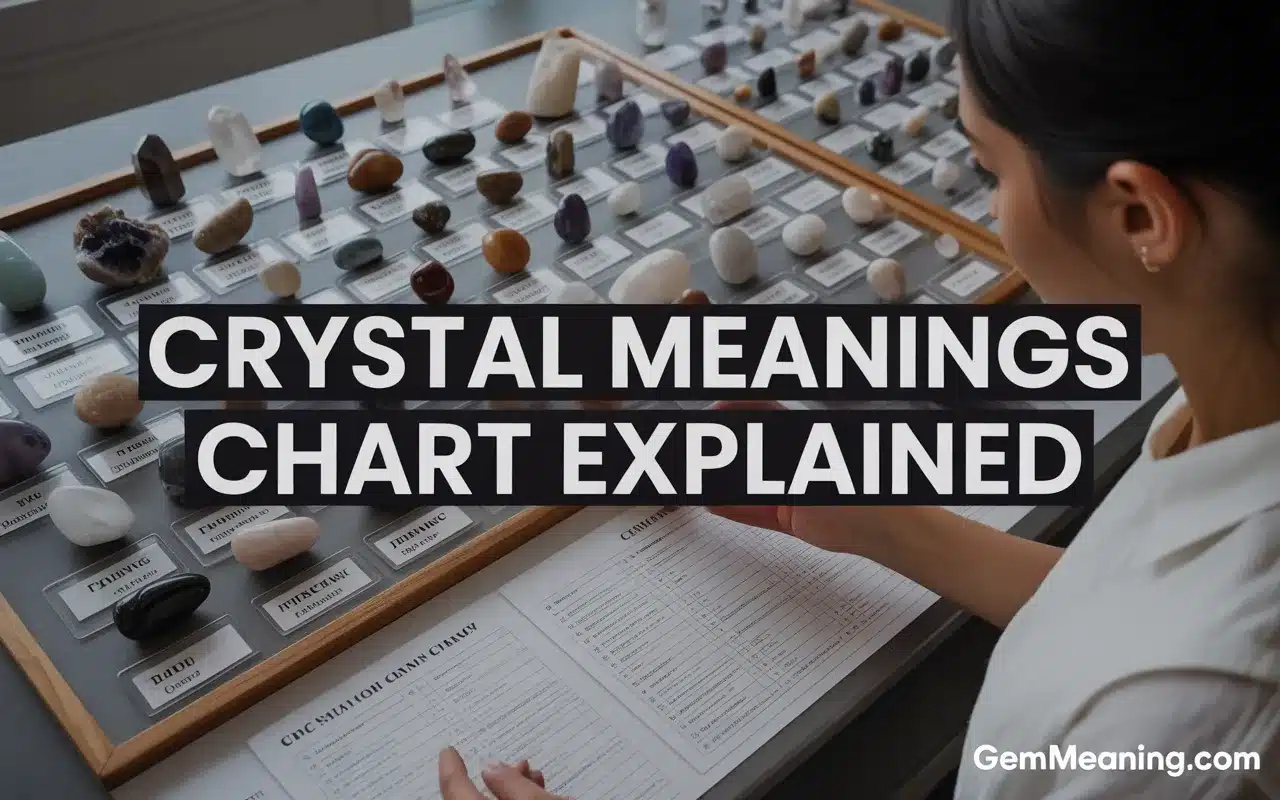
If you have ever walked into a metaphysical shop or browsed an online gemstone store, you have probably felt that moment of overwhelm. There are hundreds of beautiful stones, each with a different name, color, and purported energy. You might see a laminated poster on the wall or a colorful infographic online listing dozens of stones. These are crystals meanings charts, and while they look helpful, they can sometimes feel like a foreign language to a beginner.
How do you know which stone is for anxiety? Which one is for love? And does the color of the chart matter? It is easy to feel lost in the sea of information. But don’t worry—understanding these charts is actually the key to unlocking the entire world of crystal healing.
In this guide, we are going to demystify the crystals meanings charts you encounter. We will break down how to read them, what the common categories mean, and how to create your own personalized reference guide. Think of this as your Rosetta Stone for the mineral kingdom. Let’s dive in and decode the magic together.
Why You Need a Crystal Meanings Chart
When you are first starting out, your brain is trying to absorb a lot of new information. You are learning about chakras, elements, colors, and vibrations. Relying on memory alone is tough. This is where crystals meanings charts become your best friend.
They serve as a quick-reference guide, bridging the gap between a pretty rock and a powerful tool. Instead of having to Google every single stone you pick up, a good chart gives you the “at-a-glance” essence of the crystal.
Using these charts helps you:
- Identify Intentions: Quickly find stones that match your specific goal (like sleep or focus).
- Understand Associations: Learn which stones correspond to specific birth months or zodiac signs.
- Spot Patterns: Begin to see how color often correlates with energy (e.g., blue stones are often calming).
- Build Confidence: Move from guessing to knowing exactly what energetic support you are holding.
Decoding the Columns: How to Read the Chart
Most crystals meanings charts follow a similar structure. They are usually organized by one of three main categories: Color, Intention, or Chakra. Understanding these categories is the first step to mastering the chart.
1. Categorized by Color
This is the most common and intuitive way charts are organized. In crystal healing, color is not just aesthetic; it is a clue to the stone’s vibration.
- Red/Black: Grounding, protection, survival (Root Chakra).
- Orange: Creativity, passion, emotion (Sacral Chakra).
- Yellow: Confidence, personal power, will (Solar Plexus Chakra).
- Green/Pink: Love, healing, compassion (Heart Chakra).
- Blue: Communication, truth, peace (Throat Chakra).
- Purple/Indigo: Intuition, wisdom, spirituality (Third Eye Chakra).
- White/Clear: Clarity, higher consciousness, cleansing (Crown Chakra).
When you see a chart organized by color, you can generally guess the meaning. If you need to calm down, look at the blue section. If you need energy, look at the red section.
2. Categorized by Intention
These crystals meanings charts are functional. They list a problem or a goal and then suggest stones to help.
- For Anxiety: Amethyst, Lepidolite, Blue Lace Agate.
- For Wealth: Citrine, Pyrite, Green Aventurine.
- For Love: Rose Quartz, Rhodonite, Emerald.
- For Protection: Black Tourmaline, Obsidian, Hematite.
This type of chart is perfect for beginners who have a specific “symptom” they want to treat energeticallly.
3. Categorized by Chakra
These charts show a diagram of the human body with seven colored points (chakras). Next to each point, they list corresponding stones.
- Root: Red Jasper, Smoky Quartz.
- Sacral: Carnelian, Sunstone.
- Solar Plexus: Tiger’s Eye, Citrine.
- Heart: Malachite, Jade.
- Throat: Lapis Lazuli, Aquamarine.
- Third Eye: Sodalite, Amethyst.
- Crown: Clear Quartz, Selenite.
If you are into yoga or Reiki, a chakra-based chart will be the most useful format for you.
Breaking Down Common Terms on the Chart
As you study crystals meanings charts, you will run into some specific vocabulary. These buzzwords appear frequently in descriptions. Let’s translate them into plain English.
“Grounding”
You will see this word next to almost every black, brown, or red stone.
- What it means: It helps you feel present in your body and connected to reality.
- When you need it: If you feel “spacey,” anxious, dizzy, or can’t focus on the task at hand.
- Go-to stones: Hematite, Black Tourmaline, Smoky Quartz.
“Amplifying”
This is usually reserved for clear or high-vibration stones.
- What it means: It makes energy stronger. It acts like a volume knob for your intentions.
- When you need it: When you want to boost the power of another crystal or manifest something quickly.
- Go-to stones: Clear Quartz, Selenite, Diamond.
“Cleansing” or “Clearing”
This appears next to stones that move energy.
- What it means: It removes negative or stagnant vibes. Think of it like a spiritual vacuum cleaner.
- When you need it: After a bad day, an argument, or being in a crowded place.
- Go-to stones: Selenite, Black Kyanite, Shungite.
“Manifesting”
This is a popular term on modern charts.
- What it means: Bringing something from your imagination into real life.
- When you need it: When setting goals for money, jobs, or relationships.
- Go-to stones: Citrine, Pyrite, Green Aventurine.
The “Master Healers” of the Chart
If you look closely at crystals meanings charts, you will notice a few names pop up over and over again. These are the “Master Healers” or the essential stones. If you are building a starter kit based on a chart, these are the ones to prioritize.
1. Amethyst (The All-Purpose Healer)
On almost every chart, Amethyst is listed for stress relief, sleep, and intuition. It is the purple powerhouse that does a little bit of everything. It soothes the mind and connects you to spirit.
2. Clear Quartz (The Amplifier)
You will find this in the “Crown Chakra” or “Clarity” sections. It is the blank slate of the crystal world. It amplifies whatever energy is near it, making it the most versatile tool in your kit.
3. Rose Quartz (The Love Stone)
Always found in the pink or green section, this is the universal stone of love. But charts will remind you it isn’t just for romance; it is for self-love, family harmony, and emotional healing.
4. Citrine (The Merchant’s Stone)
Listed under “Wealth” or “Abundance,” this yellow gem is sunny and bright. Charts often note that it does not hold negative energy, making it great for optimism.
5. Black Tourmaline (The Bodyguard)
This is the heavyweight champion of protection. Charts list it for blocking EMFs (electromagnetic frequencies) and shielding you from negative people.
How to Create Your Own Personal Chart
While pre-made crystals meanings charts are wonderful, the most powerful chart is the one you make yourself. Why? Because your relationship with a stone is personal. A stone that makes one person feel calm might make another feel sad.
Creating your own reference guide helps you track what actually works for you.
Step 1: Start a Crystal Journal
Grab a notebook. Dedicate one page to each crystal you own. You don’t need to be an artist; just write the name of the stone at the top.
Step 2: The “Hold and Feel” Test
Before you look up the meaning online, hold the stone. Close your eyes.
- Does it feel warm or cool?
- Does it make you feel heavy (grounded) or light (uplifted)?
- Do any emotions come up?
Write these initial impressions down. This is your intuition speaking.
Step 3: Consult the Reference Charts
Now, look up the traditional meaning on standard crystals meanings charts.
- Does the traditional meaning match your feeling?
- If a chart says “energy boost” but you felt “calm,” trust your feeling first.
- Write down the keywords that resonate with you.
Step 4: Categorize Your Collection
Once you have journaled about a few stones, create a summary page—your very own chart.
- My Sleep Stones: Amethyst, Lepidolite.
- My Focus Stones: Fluorite, Tiger’s Eye.
- My “Bad Day” Stones: Smoky Quartz, Rose Quartz.
Having this personalized chart means you will actually use your crystals, rather than just letting them gather dust.
Common Mistakes When Using Charts
Even with the best intentions, it is easy to get tripped up when interpreting crystals meanings charts. Here are a few pitfalls to avoid.
Mistake #1: Taking it too literally.
If a chart says a stone is for “liver health,” do not stop taking your medicine. Crystal healing is complementary. It works on the energetic body, not as a replacement for medical care.
Mistake #2: Thinking you need the exact stone.
Charts are suggestions, not laws. If a chart says you need Citrine for wealth but you only have Pyrite, use the Pyrite! Both carry the energy of abundance. Intent matters more than the specific mineral.
Mistake #3: Ignoring the “secondary” meanings.
Most stones are multitaskers. A chart might list Rose Quartz only under “Love,” but it is also great for anxiety. Don’t pigeonhole your crystals based on a single keyword on a poster.
Mistake #4: Overcomplicating it.
You don’t need to memorize the chemical composition or the Mohs hardness scale. The simple keywords found on crystals meanings charts (e.g., “Peace,” “Love,” “Focus”) are usually enough for effective energy work.
Integrating Charts into Daily Life
Now that you understand how to read them, how do you actually use crystals meanings charts in your day-to-day routine?
The Morning Check-In
Keep a simple chart near your jewelry box or where you get dressed.
- Ask yourself: “How do I want to feel today?”
- Glance at the chart.
- If you want to feel Confident, the chart points you to Tiger’s Eye.
- Put that stone in your pocket or wear it as jewelry.
The Meditation Selection
Before you sit down to meditate, consult your chart.
- If your mind is racing, the chart suggests Amethyst or Celestite.
- If you feel tired, the chart suggests Carnelian.
- Holding the right stone can deepen your practice significantly.
The Gift Guide
Charts make you an excellent gift-giver.
- Friend going through a breakup? Check the chart for “Heart Healing” (Rhodonite).
- Sibling starting a new job? Check the chart for “Luck” (Jade).
- You are giving them energetic support, not just a rock.
Beyond the Basics: Advanced Charting
As you get more comfortable, you might find crystals meanings charts that include more advanced concepts. Don’t let these scare you off; they are just deeper layers of the same onion.
Astrological Associations
Some charts link stones to zodiac signs.
- Leo: Sunstone, Citrine.
- Pisces: Aquamarine, Amethyst.
- Capricorn: Garnet, Onyx.
This adds another layer of personalization. If you are a Leo, Sunstone might work faster for you than for a Virgo.
Elemental Associations
Charts may list Earth, Air, Fire, or Water.
- Fire Stones (Action): Carnelian, Red Jasper.
- Water Stones (Emotion): Moonstone, Larimar.
- Air Stones (Intellect): Fluorite, Sodalite.
- Earth Stones (Stability): Moss Agate, Obsidian.
This helps you balance your energy. If you are feeling “fiery” (angry), a Water stone can cool you down.
Numerical Vibrations
Some esoteric charts list numbers (like “Vibrates to the number 4”). This relates to numerology. Unless you are studying numerology, you can usually skip this column without missing out on the stone’s benefits.
Final Thoughts on Your Crystal Journey
Navigating the world of crystal healing can feel like learning a new language. At first, the symbols and terms on crystals meanings charts might seem confusing. But with a little patience, they transform from random lists into powerful maps.
Remember, these charts are tools, not rules. They are there to guide you, to spark your curiosity, and to help you narrow down your choices. But the ultimate authority on what a crystal means is you.
Your intuition is the most accurate chart in existence. Use the posters and the books as a starting point, but trust your gut feeling above all else.
So, the next time you look at a chart and see a stone that sparks your interest, go find it. Hold it. See what it has to say. You might just find that the meaning written on your heart is even more powerful than the one written on the page.
Happy charting and happy healing!