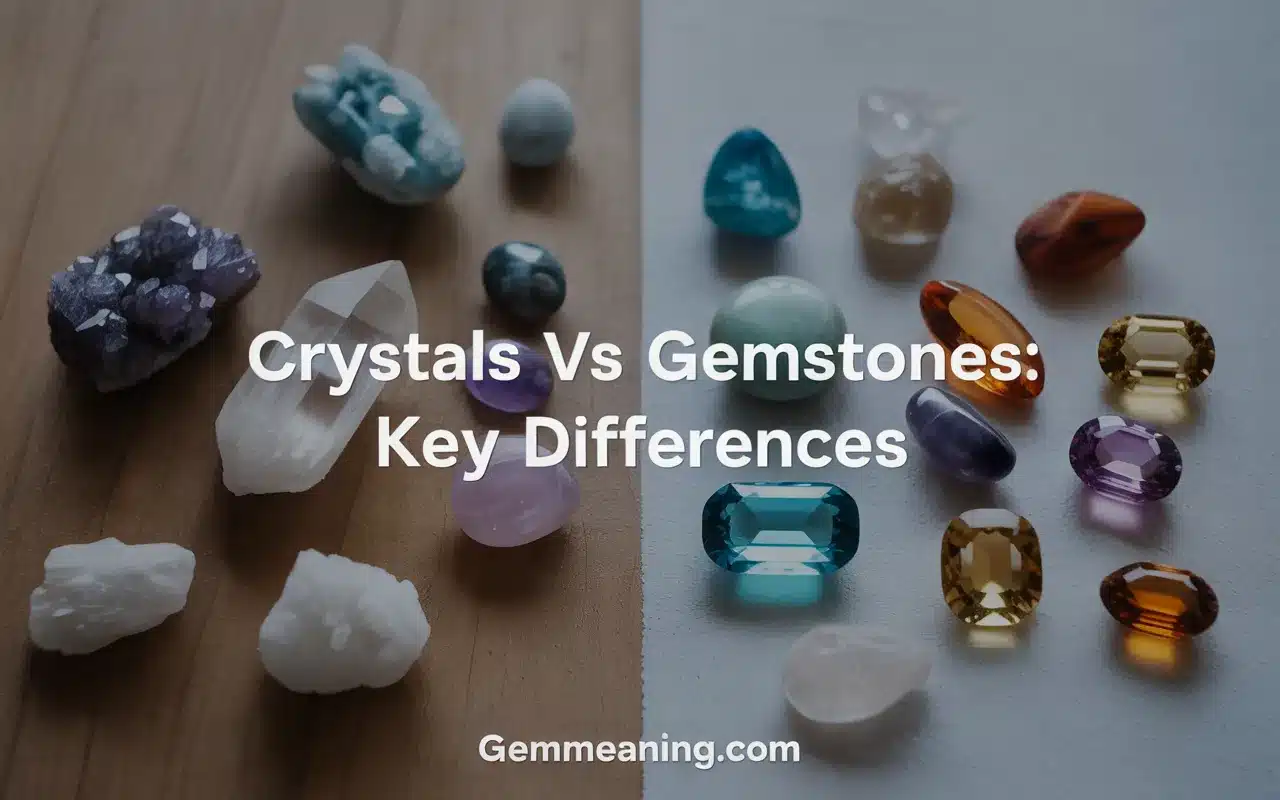
Have you ever found yourself admiring a sparkling ring in a jewelry store and then later browsing a shop filled with colorful, raw stones? You might have heard the words “gemstone” and “crystal” used in both places and wondered if they mean the same thing. It’s a common point of confusion, and the answer isn’t a simple yes or no.
While every gemstone is a crystal, not every crystal is considered a gemstone. Think of it like this: every square is a rectangle, but not every rectangle is a square. The distinction between them comes down to a few key factors like rarity, durability, and how humans have decided to value them.
This guide will gently walk you through the key differences in the crystals vs gemstones debate. We will explore what makes a mineral a crystal, when that crystal earns the prestigious “gemstone” title, and why this matters to collectors, jewelry lovers, and anyone curious about these beautiful treasures from the earth.
Understanding the relationship between these two terms will help you appreciate both the raw, natural beauty of a crystal cluster and the refined sparkle of a cut gemstone. Let’s clear up the confusion and dive into this fascinating topic together.
What Exactly Is a Crystal?
Before we can compare crystals and gemstones, we need a clear definition of what a crystal is. At its core, a crystal is a solid material whose atoms are arranged in a highly ordered, repeating pattern. This internal geometric structure is what gives crystals their characteristic flat faces and sharp angles.
Imagine building with LEGOs. The repeating pattern of the bricks allows you to create structured, stable shapes. In a similar way, atoms in a mineral lock together in a specific, predictable framework. This internal structure is the defining feature of a crystal, regardless of its size, color, or shape.
Crystals are everywhere in nature. Salt, sugar, and snowflakes are all common examples of crystals. In the world of mineralogy, a crystal is a naturally occurring mineral with this organized atomic structure. They form deep within the earth over millions of years under immense heat and pressure.
From the giant Amethyst geodes found in South America to the tiny Clear Quartz points you can hold in your hand, they all share this fundamental, organized internal latticework. This is the foundation from which our discussion of crystals vs gemstones begins.
When Does a Crystal Become a Gemstone?
So, if gemstones are crystals, what elevates a crystal to gemstone status? The transition from “crystal” to “gemstone” is not a scientific one but rather a human-devised classification based on specific qualities that we find desirable. It is a title of honor we bestow upon certain minerals.
Traditionally, three main factors—often called the “three virtues”—are used to determine if a crystal qualifies as a gemstone: beauty, rarity, and durability. A fourth factor, human tradition or fashion, also plays a significant role.
The First Virtue: Beauty
Beauty is the most immediate and obvious quality of a gemstone. This includes several visual elements that make a stone captivating to the human eye.
- Color: The richness, depth, and evenness of a stone’s color are critical. A vibrant, deep-red Ruby is more valuable than a pale, pinkish one.
- Clarity: This refers to the absence of internal flaws or inclusions. For stones like diamonds, clarity is paramount. A flawless diamond is far more valuable than one with visible specks inside.
- Luster: This is the way light reflects off the stone’s surface. It can be glassy (like Quartz), metallic (like Pyrite), or brilliant (like a Diamond).
- Fire: In some stones, light splits into a rainbow of colors as it passes through. This dazzling effect, known as dispersion or “fire,” is highly prized in diamonds.
A crystal might be beautiful in its raw, natural form, but a gemstone’s beauty is often enhanced through cutting and polishing. A skilled gem cutter, or lapidary, can bring out a stone’s hidden color and brilliance.
The Second Virtue: Rarity
Part of what makes something precious is its scarcity. If diamonds were as common as everyday rocks, they wouldn’t hold the same value or mystique. The rarity of a mineral contributes significantly to its status as a gemstone.
Some minerals, like Alexandrite, are incredibly rare because they require a unique combination of chemical elements and geological conditions to form. Alexandrite is famous for changing color from green in daylight to red in incandescent light, a phenomenon that adds to its allure and value.
Quartz, on the other hand, is one of the most abundant minerals on Earth. While a beautiful Amethyst (a type of quartz) is certainly a crystal, a standard piece of it might not be considered a “precious” gemstone because it is relatively common. However, a piece of Amethyst with exceptional color and clarity could absolutely be cut and sold as a gemstone.
The Third Virtue: Durability
A gemstone, especially one set in jewelry, needs to be tough enough to withstand daily wear and tear. Durability is a measure of a stone’s ability to resist scratching, chipping, and breaking. This is primarily assessed using the Mohs Scale of Hardness.
The Mohs scale ranks minerals from 1 (softest) to 10 (hardest). Talc is a 1, while Diamond is a 10. For a crystal to be considered a suitable gemstone for everyday jewelry, it generally needs to have a hardness of 7 or higher. Quartz, at a 7, is a good benchmark. Anything softer is prone to scratches from common materials like dust (which contains microscopic quartz particles).
This is why stones like Selenite (hardness of 2) or Fluorite (hardness of 4) are rarely used in rings, even though they are beautiful. They are simply too soft and would be damaged quickly.
Key Differences in the Crystals vs Gemstones Comparison
Let’s summarize the key distinctions in a way that is easy to remember. This will help you understand the nuances when you encounter these terms.
1. The Scope of the Definition
The term “crystal” is a broad scientific category. It refers to any mineral with an ordered internal structure. “Gemstone,” however, is a more exclusive, cultural, and commercial term applied to a select group of crystals that meet certain standards of beauty, rarity, and durability.
- Crystal: A scientific term for a mineral’s structure.
- Gemstone: A cultural and commercial label of quality.
All gemstones originate as crystals, but the vast majority of crystals found on Earth will never be classified as gemstones.
2. Form and Finish
Crystals are often appreciated and sold in their raw, natural form. People love to see the organic shapes, the clusters of points growing together, or the rough texture of the stone as it was found. This celebrates the unaltered beauty of the mineral.
Gemstones are almost always cut and polished. The art of lapidary transforms a rough crystal into a faceted jewel designed to maximize its light performance, color, and brilliance. While a raw diamond is a crystal, it is the expertly cut diamond that is sold as a precious gem.
3. Perceived Value and Use
The value of a crystal is often tied to its perceived energetic properties, its use in spiritual practices, or its appeal as a natural decorative object. A large Amethyst cluster might be valued for its beauty as a home decor piece.
The value of a gemstone is determined by the “4 Cs”: Carat (weight), Color, Clarity, and Cut. Its primary use is in jewelry, and its value is standardized by the gem trade industry. A small, high-quality Sapphire gemstone used in a ring can be worth thousands of dollars, far more than a much larger piece of raw Sapphire crystal of lower quality.
4. Precious vs. Semi-Precious
Within the world of gemstones, there is another historical classification: precious and semi-precious.
- Precious Gemstones: Traditionally, this exclusive group included only Diamond, Ruby, Sapphire, and Emerald. These were historically the rarest and most valuable.
- Semi-Precious Gemstones: This category includes all other gemstones, such as Amethyst, Topaz, Garnet, and Peridot.
These terms are becoming outdated in the modern gem trade. A high-quality semi-precious stone, like a rare Tsavorite Garnet, can be far more valuable than a low-quality precious stone, like a heavily included Emerald. However, you will still commonly hear these terms used.
Practical Examples: Crystals vs Gemstones
To make this even clearer, let’s look at a few examples.
The Case of Quartz
Quartz is the perfect mineral to illustrate the difference.
- As a Crystal: A piece of raw Rose Quartz, a milky Clear Quartz point, or a tumbled stone you carry in your pocket are all enjoyed as crystals. Their value is modest, and they are appreciated for their form and associated properties.
- As a Gemstone: A piece of Amethyst with deep purple color and excellent clarity can be faceted into a beautiful gemstone for a necklace. A piece of Citrine can be cut into a sparkling gem for a ring. In this form, they are judged by their cut and quality and are considered gemstones.
The Case of Corundum
Corundum is another excellent example. In its raw, opaque form, it is just an industrial mineral, often used for sandpaper because of its hardness (a 9 on the Mohs scale).
- As a Crystal: A rough, opaque piece of Corundum is simply a mineral crystal.
- As a Gemstone: When Corundum contains traces of chromium, it becomes a vibrant red Ruby. When it contains traces of iron and titanium, it becomes a deep blue Sapphire. In these rare, beautiful, and durable forms, Corundum becomes one of the most precious gemstones in the world.
What About Organic Gems?
To add one more layer, some materials used in jewelry are not minerals at all. Pearls, Amber (fossilized tree resin), and Coral are considered organic gems. They do not have a crystalline internal structure but are still prized for their beauty and used in jewelry.
Does the Distinction Really Matter?
For the average person, the line between crystals and gemstones can feel blurry, and that is okay. The most important thing is what the stone means to you. Whether you are drawn to the earthy energy of a raw crystal or the refined elegance of a faceted gemstone, both offer a unique connection to the natural world.
Knowing the difference, however, empowers you as a consumer. It helps you understand why an Amethyst ring might be more expensive than a large Amethyst cluster. It also helps you appreciate the journey a stone takes from being a rough mineral deep in the earth to a polished gem in a display case.
The debate of crystals vs gemstones is less of a competition and more of a family tree. Crystals are the large, diverse family, and gemstones are the celebrated members who have been chosen for their exceptional qualities.
So, the next time you see a sparkling stone, ask yourself: Is this a raw crystal, showing its natural form? Or is it a cut gemstone, polished to reveal its inner fire? By simply asking that question, you deepen your appreciation for the stone’s unique story and its long journey into your hands. We encourage you to explore both worlds and find the treasures that speak to you.