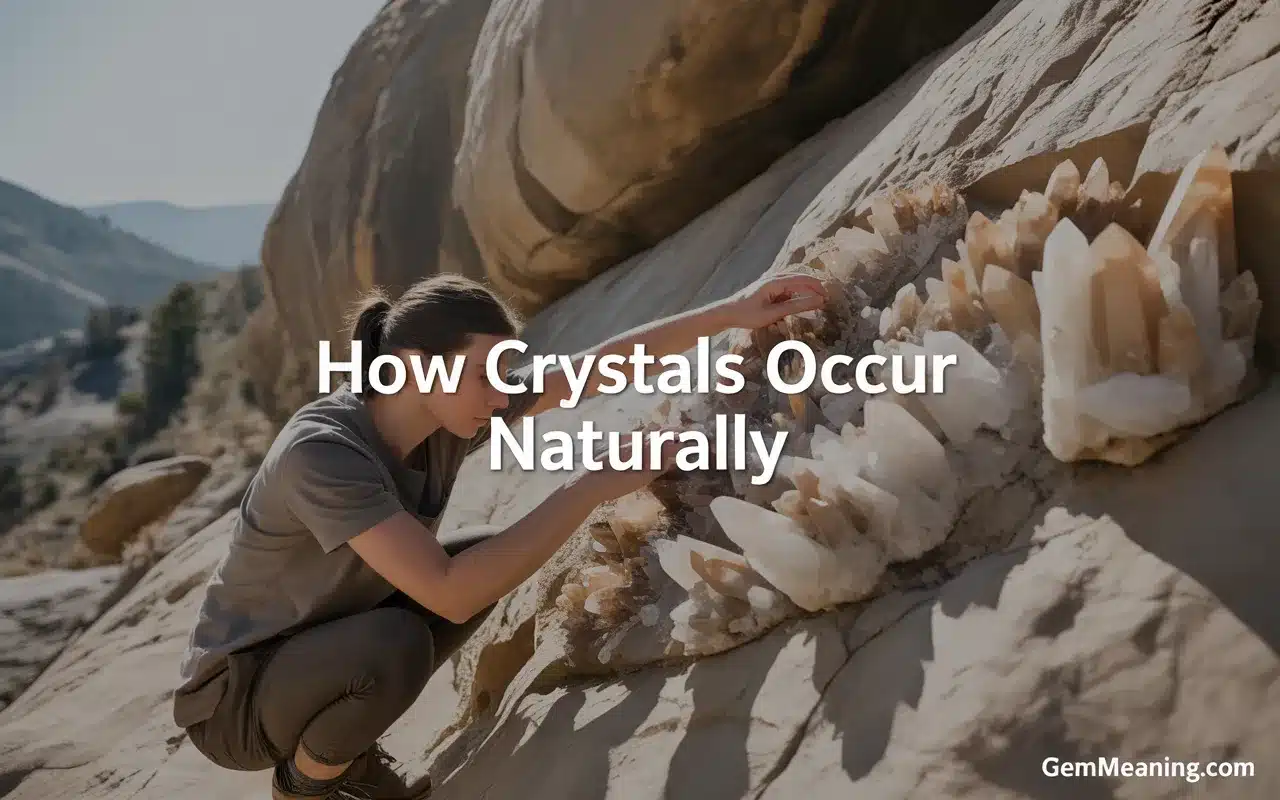
Have you ever held a perfectly formed crystal in your hand and felt a sense of awe? It’s almost hard to believe that nature, without any tools or plans, can create something so geometric and precise. A six-sided quartz point or a perfect pyrite cube feels like it should have been cut and polished by an artist, but these are masterpieces made by the Earth itself.
For anyone who has felt the pull to start finding crystals in nature, understanding how they form is like learning the secret language of the planet. It’s the difference between randomly kicking rocks and knowing exactly where to look for buried treasure. The process isn’t magic, but it is a miraculous series of geological events that happen over immense spans of time.
This guide will take you deep into the Earth’s crust to uncover the science behind how crystals occur. We will explore the different geological “kitchens” where crystals are cooked up, from the fiery heart of a volcano to the slow, patient drip of water in a cave. By understanding the recipe, you will be better equipped to start your own adventure.
Let’s dig into the fascinating story of how a jumble of atoms organizes itself into the beautiful, sparkling gems we love.
The Basic Recipe: What Every Crystal Needs
Before we explore the different environments, it is crucial to understand that every crystal, regardless of its shape or size, requires the same four fundamental ingredients to form. If even one of these is missing, you simply get a plain old rock.
- Ingredients: Every crystal has a specific chemical recipe. For Quartz, it’s silicon and oxygen. For Pyrite, it’s iron and sulfur. These elements must be present and concentrated in one place.
- Temperature & Pressure: Each mineral has a specific “Goldilocks zone” of heat and pressure where it is stable. Too hot, and the atoms won’t lock together. Too cold, and they won’t have the energy to move into position.
- Space: To form the beautiful, sharp-faced shapes we recognize as crystals, a mineral needs an open cavity to grow into. Without space, it just becomes an interlocking grain in a solid rock mass.
- Time: This is the magic ingredient. Most large, perfect crystals grew incredibly slowly over thousands or millions of years, atom by atom, in a stable environment.
With this basic recipe in mind, let’s look at the different ways the Earth brings these four ingredients together.
Birth by Fire: The Igneous Process
The most dramatic way crystals occur is through volcanic activity. When rock is melted into magma or lava, it is a chaotic soup of free-floating atoms. As this molten rock begins to cool, the atoms lose energy and start arranging themselves into orderly, repeating patterns—the very definition of a crystal lattice.
Crystallization from Magma
Deep beneath the Earth’s surface, massive chambers of magma cool at an incredibly slow pace. This slow cooling is the key to growing large crystals.
- Granite Formation: As a body of granite cools over millions of years, different minerals crystallize at different temperatures. This is why you can see distinct grains of Quartz, Feldspar, and Mica within a single piece of granite.
The Magic of Pegmatites
Occasionally, the last bit of watery, mineral-rich magma gets trapped in cracks. This “pegmatite” fluid is often rich in rare elements like lithium, beryllium, and boron. Because it cools very slowly in a confined space, it can form gigantic, gem-quality crystals. These are the veins that miners dream of, producing enormous Tourmaline, Aquamarine, and Kunzite crystals.
Volcanic Vugs and Gas Pockets
When lava erupts onto the surface, it releases gas, creating bubbles. As the lava hardens into rock like basalt or rhyolite, these bubbles become trapped, forming hollow pockets called “vugs.” This is a prime environment that provides the “space” ingredient. Over time, mineral-rich groundwater seeps in and deposits crystals inside, creating a geode. This process is essential for anyone interested in finding crystals in nature, as geodes are a common and exciting find.
Formation by Water: The Sedimentary and Hydrothermal Story
Water is nature’s ultimate delivery service. It can dissolve minerals in one location, carry them over vast distances, and then redeposit them as beautiful crystals somewhere else. This is a quieter, more patient process than the fiery birth of igneous crystals.
Evaporation in Dry Climates
Picture an ancient, salty lake baking under the sun. As the water evaporates, the dissolved minerals become more and more concentrated until they can no longer stay in liquid form. They begin to crystallize and precipitate out of the water.
- Desert Roses: In arid regions, gypsum crystals can form in wet sand. As they grow, they trap sand grains, creating beautiful, flower-like formations.
- Salt Crystals: The massive salt flats of Utah are a perfect example. As the Great Salt Lake recedes, it leaves behind vast fields of Halite (salt) crystals.
The Slow Drip of Caves (Stalactites and Stalagmites)
Caves are a stunning showcase of how water forms crystals. Rainwater seeps through soil, picks up carbon dioxide, and becomes a weak carbonic acid. This acid dissolves limestone (Calcite) as it travels through the ground.
When this water drips from the ceiling of a cave, it releases its carbon dioxide into the air, causing the Calcite to precipitate out of the solution. Drop by drop, over millennia, it forms stalactites (from the ceiling) and stalagmites (from the floor). While collecting in caves is a major ethical no-go, it’s a perfect visual for this process.
Hydrothermal Veins
Deep within the Earth’s crust, superheated, mineral-rich water is forced through cracks and fissures in existing rock. As this water cools or reacts with the surrounding rock, it deposits its mineral load, forming “hydrothermal veins.”
This process is responsible for many of the world’s most valuable ore deposits. Veins of gold, silver, and copper are formed this way. It is also how many classic quartz crystals form, lining fissures in the rock with sparkling points. Anyone serious about finding crystals in nature learns to spot these quartz veins, as they are a major clue to mineralization.
Under Pressure: The Metamorphic Transformation
The third way crystals occur is not by creating something from liquid, but by changing something that is already solid. Metamorphism happens when an existing rock is subjected to intense heat and pressure from tectonic plate collisions or deep burial.
The atoms within the rock’s minerals are squeezed so tightly that they break their old bonds and rearrange themselves into new, denser, more stable crystal structures.
Recrystallization
Sometimes, the minerals stay the same but simply grow larger. For example, a fine-grained limestone made of microscopic calcite crystals can be metamorphosed into marble, which is made of large, sparkling calcite crystals that you can see with the naked eye.
Creating New Minerals
More excitingly, the heat and pressure can cause elements from different minerals to combine and form entirely new ones that can only exist under these extreme conditions.
- Garnets: These classic metamorphic gems often grow within schist or gneiss. The elements from various clay minerals are cooked and squeezed into the iconic, ball-like garnet crystals.
- Kyanite: This beautiful blue-bladed mineral forms under high pressure. Its presence tells geologists a story about the intense tectonic forces that shaped a mountain range.
Learning to identify metamorphic rocks is a key skill for finding crystals in nature, as they often host some of the most unique and sought-after minerals.
How Specific Crystals Occur: Case Studies
Let’s apply these concepts to a few popular crystals to see how they form in the real world.
Amethyst (Purple Quartz)
- Process: Primarily Igneous and Hydrothermal.
- How it happens: Most of the world’s Amethyst forms inside geodes. A gas bubble in lava creates a hollow pocket. Later, silica-rich hot water containing trace amounts of iron seeps in. The silica crystallizes into quartz, and the iron gets incorporated into the crystal lattice. Natural radiation from the surrounding host rock then irradiates the iron, turning the quartz from clear to purple.
Pyrite (Fool’s Gold)
- Process: Often Hydrothermal, but can occur in all three environments.
- How it happens: Pyrite (iron sulfide) loves to form in environments with low oxygen. In hydrothermal veins, hot, sulfur-rich fluids react with iron in the host rock. Pyrite’s atoms naturally stack in a cubic arrangement, which is why it so often forms perfect, shimmering cubes, no human carving required.
Selenite (Gypsum)
- Process: Primarily Sedimentary (Evaporitic).
- How it happens: Selenite is a variety of the mineral Gypsum. It forms when saltwater lakes or seas evaporate, leaving behind thick deposits of gypsum and salt. The long, blade-like crystals form as the water slowly recedes. Caves, like the famous Cave of the Crystals in Mexico, can also host gigantic selenite crystals that grew in geothermally heated, mineral-saturated water over hundreds of thousands of years.
From Deep Earth to the Surface: How We Find Them
A crystal might form ten miles underground, but that doesn’t do a collector any good. For us to find it, it needs to be brought to the surface. This happens in several ways:
- Uplift and Erosion: The most common method. Tectonic forces push mountain ranges up, and then wind, water, and ice slowly erode the overlying rock, exposing the harder, more resistant crystals. This is why finding crystals in nature often involves hiking in mountains or searching in riverbeds downstream from them.
- Volcanic Eruption: Some minerals, like diamonds and peridot, form deep in the Earth’s mantle. They are brought to the surface violently and rapidly inside volcanic pipes during certain types of eruptions.
- Human Activity: We often expose crystals by accident. Road construction, quarrying, and foundation digging can all reveal mineral pockets that were previously hidden.
Tips for Finding Crystals in Nature
Now that you understand how crystals occur, you can use that knowledge to predict where they might be found.
- Look for Quartz: White quartz veins are a fantastic indicator. They signal that hydrothermal activity has occurred. While the “bull quartz” of the vein itself might not be gemmy, it could have pockets of clear crystals or be associated with other minerals.
- Check the Riverbeds: Search gravel bars and the inside bends of rivers and streams. The water does the hard work of digging and sorting for you. Heavy, durable gems like garnets, agates, and sapphires get left behind here.
- Study Local Geology: Get a geological map of your state or county. Does it show areas of volcanic basalt? Or limestone from an ancient sea? This will tell you what kind of crystals you are most likely to find and where to focus your search.
- Investigate Old Mines: With permission, searching the “tailings” (waste rock piles) of old mines can be incredibly fruitful. What was trash to an industrial miner might be a treasure to a collector.
A Story Written in Stone
The next time you hold a crystal, remember the incredible journey it took. It is a physical artifact of our planet’s dynamic history—a story of fire, water, pressure, and time. That Amethyst in your hand may have started as a bubble of volcanic gas. That Garnet might have been squeezed into existence by the collision of continents.
Understanding how crystals occur naturally transforms them from simple, pretty objects into profound storytellers. It deepens our respect for the slow and powerful forces that shape the world beneath our feet. This knowledge is the most powerful tool you can have in your journey of finding crystals in nature.
We encourage you to go outside and look at the rocks in your own area with new eyes. Notice the different layers, the veins of quartz, and the types of stones in a local creek bed. The clues are all around you, just waiting to be read. Happy hunting