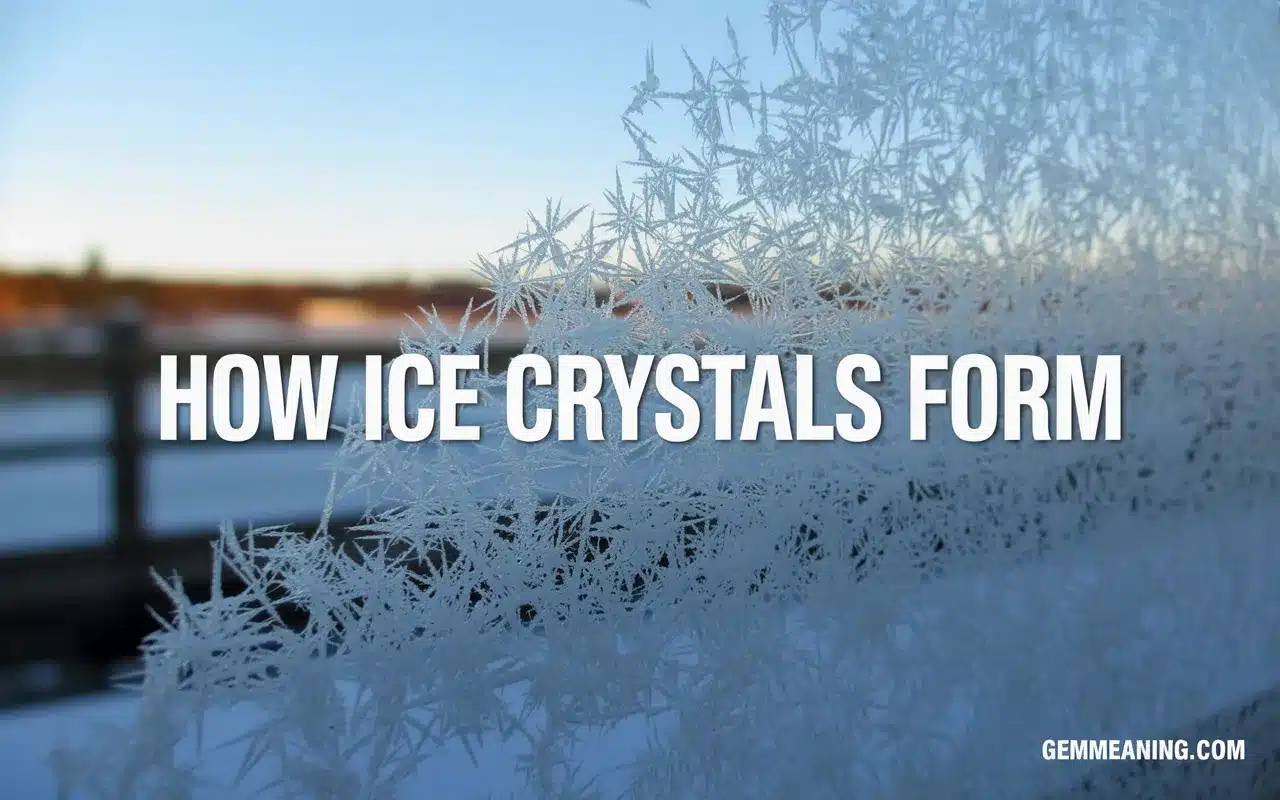
There are few sights in nature more enchanting than waking up to a world dusted in white. Whether it’s the delicate, fern-like patterns etched onto your bedroom window or the gentle silence of falling snow, frozen water has a way of turning the ordinary into the magical. We often catch ourselves staring at a snowflake on a dark mitten, marveling at its perfect symmetry before it melts away.
But have you ever stopped to wonder how that perfection happens? It seems impossible that nature, without any blueprints or tools, could construct such intricate, six-sided masterpieces. It feels like art, but it is actually a fascinating display of physics and chemistry happening right before our eyes.
The story of ice crystals is a journey of transformation. It is the story of water molecules dancing through the sky, locking arms in specific patterns, and responding to the slightest changes in the wind. Understanding this process turns a cold winter day into a live science experiment.
In this guide, we will explore the secret life of frozen water. We will uncover why snowflakes always have six sides, how temperature sculpts their shapes, and the remarkable journey a water molecule takes to become a crystal. Grab a warm cup of cocoa, and let’s dive into the microscopic winter wonderland.
The Magic Hidden in a Drop of Water
To understand how ice crystals form, we first have to look at the building blocks: the water molecules themselves. You likely know the chemical formula for water is $H_2O$. This means each unit of water is made of one oxygen atom and two hydrogen atoms.
While that sounds like a dry chemistry fact, it is actually the key to the entire mystery. The shape of a water molecule resembles a tiny Mickey Mouse head, with the oxygen as the face and the hydrogens as the ears. This shape makes water electrically “sticky.”
The oxygen side has a slight negative charge, while the hydrogen ears have a slight positive charge. Just like magnets, opposites attract. The hydrogen of one molecule wants to stick to the oxygen of its neighbor. This attraction is called “hydrogen bonding.”
In liquid water, these molecules are energetic and moving too fast to stay stuck. They slide past each other constantly, forming bonds and breaking them in a fraction of a second. But when the temperature drops, the molecules slow down. The “stickiness” starts to win, and they begin to lock into place.
The Starting Point: Nucleation
You might think that water freezes the moment it hits 32°F (0°C). Surprisingly, pure water can stay liquid well below freezing—sometimes down to -40°F! This state is called “supercooling.” For ice crystals to actually be born, they need a kickstart.
This kickstart is a process called nucleation. The water molecules need something to grab onto to start building their structure.
Dust: The Unsung Hero
In the atmosphere, this “something” is usually a microscopic speck of dust, pollen, or even bacteria floating in the air. This particle acts as a seed. A few supercooled water molecules latch onto the dust speck, freeze, and create a tiny ice nucleus.
Once this nucleus exists, it acts like a magnet. Other water molecules race to join the structure, and the crystal begins to grow outward. Without these tiny bits of dust in our atmosphere, we wouldn’t have snow as we know it!
The Journey of a Snowflake
When we talk about ice crystals, the snowflake is the most famous example. However, there is a common misconception about how snow forms. Many people believe a snowflake is just a frozen raindrop, but that is actually sleet.
From Vapor to Solid
True snowflakes form through a process called “deposition.” This happens when water vapor (gas) turns directly into ice (solid), skipping the liquid phase entirely.
Imagine a microscopic ice nucleus floating high in a cloud. It is surrounded by water vapor. These gas molecules bump into the ice nucleus and instantly freeze onto its surface. As more and more vapor deposits onto the seed, the crystal grows larger.
The Battle Between Faceting and Branching
As the crystal grows, two opposing forces sculpt its shape:
- Faceting: Water molecules love to arrange themselves in flat, smooth surfaces. This tends to create simple shapes like prisms or hexagons.
- Branching: As the crystal gets heavier and falls through the cloud, the corners stick out further into the humid air. These corners can “grab” water vapor faster than the flat centers. This causes arms to sprout from the corners, creating the complex, tree-like branches (dendrites) we associate with snowflakes.
Why Six Sides? The Hexagonal Secret
Look closely at any snowflake, or even the frost on your windshield, and you will notice a recurring theme: the number six. Snowflakes invariably have six arms. You never see a five-sided or eight-sided snow crystal in nature. Why is six the magic number?
The answer lies deep in that molecular geometry we mentioned earlier. Remember the Mickey Mouse shape of the water molecule? When water freezes, the molecules arrange themselves to maximize those attractive hydrogen bonds.
The Honeycomb Lattice
The most efficient way for water molecules to stack together is in a hexagonal lattice. Imagine a honeycomb. The molecules link up in six-sided rings. As the crystal grows, this internal hexagonal structure is projected outwards.
If you add bricks to a six-sided foundation, you end up with a six-sided building. Similarly, as new water molecules attach to the growing crystal, they follow the hexagonal blueprint laid down by the first few molecules.
While the complexity of the arms can vary wildly, the underlying symmetry is mathematically locked in by the atomic properties of water. It is nature’s way of finding the most stable, energy-efficient arrangement.
The Role of Temperature and Humidity
If all ice crystals follow the same six-sided blueprint, why do they look so different? Why do we get thin plates one day and fluffy stars the next? The answer was discovered by a Japanese physicist named Ukichiro Nakaya in the 1930s.
Nakaya found that the shape of an ice crystal is determined almost entirely by two factors:
- Temperature of the cloud.
- Humidity (how much water vapor is available).
The Crystal Morphology Diagram
Different temperatures produce vastly different shapes:
- Near 32°F (0°C): Simple hexagonal plates form.
- Around 23°F (-5°C): Long, thin needles or columns appear.
- Around 5°F (-15°C): This is the sweet spot for the classic “stellar dendrites”—the large, six-armed stars. This temperature encourages branching.
- Below -22°F (-30°C): The shapes return to simple plates and columns.
Humidity Adds Complexity
Humidity acts as the fuel for growth. Low humidity usually results in simple, blocky crystals because there isn’t enough material to build complex structures. High humidity leads to intricate, feathery branches because there is an abundance of vapor rushing to attach to the crystal corners.
Because a snowflake falls through different layers of the atmosphere, passing through warmer and cooler zones with varying humidity, its growth history is recorded in its shape. No two flakes follow the exact same path, which is why no two flakes are exactly alike.
Frost: Ice Crystals Down to Earth
Not all ice crystals fall from the sky. Some form right in our backyards, coating the grass, cars, and windows in a glittering layer of white. While the chemistry is the same, the formation process of frost is slightly different from snow.
Hoar Frost
On clear, cold nights, objects like blades of grass or car roofs radiate heat and cool down faster than the air around them. When the surface temperature drops below freezing, water vapor in the air comes into contact with the cold surface.
Just like inside a cloud, the vapor undergoes deposition, turning directly from gas to solid ice. This creates “hoar frost”—spiky, interlocking crystals that look like sugar or white hair. These crystals often grow into the wind, grabbing moisture from the breeze as it passes.
Window Ferns
One of the most beautiful forms of frost is the “fern frost” that appears on single-pane windows. Here, the glass acts as the cold surface. Dust or scratches on the glass provide the nucleation points.
As the ice crystals grow across the glass, they run into interference—microscopic bumps, dirt, or other crystals. This forces them to curve and branch, creating swirling patterns that look remarkably like fern leaves or feathers.
Rime Ice
Rime is different from hoar frost. It forms when supercooled liquid fog droplets hit a freezing surface. Instead of growing slowly from vapor, the droplets freeze instantly upon impact. This creates a chunky, white, icy coating often seen on trees on mountaintops or inside freezers that haven’t been defrosted.
Ice on the Lake: A Different Process
So far, we have talked about crystals forming from vapor. But what about a lake freezing over? This is freezing from a liquid, and the crystals behave differently.
Congelation Ice
When the surface of a lake cools, nucleation usually starts at the shoreline where the water is calm and touches cold rocks or soil. Needles of ice shoot out across the surface.
Unlike the free-floating freedom of a snowflake, these crystals are crowded. As they grow, they bump into each other, competing for space. They align vertically, forming long columns that point down into the dark water. This is called “congelation ice” or black ice (because it is clear and you can see the dark water beneath).
Why Ice Floats
This is a critical feature of ice crystals. In almost every other substance, the solid form is denser than the liquid form (a rock sinks in lava). But because water molecules lock into that spacious hexagonal honeycomb lattice, solid ice is actually about 9% less dense than liquid water.
This expansion is why ice cubes float in your drink and why ice forms on top of a lake, insulating the fish below, rather than sinking and freezing the lake solid from the bottom up.
Unusual Ice Forms You Might See
Nature loves to improvise. Under specific conditions, you might encounter some truly strange variations of ice crystals.
Diamond Dust
In extremely cold locations (like the Arctic or sometimes the northern USA during a polar vortex), tiny ice crystals can form in clear air near the ground. They are so small they hang suspended like fog. When sunlight hits them, they sparkle like floating glitter, creating a phenomenon called “diamond dust.” These crystals often create beautiful optical halos around the sun.
Needle Ice
If you walk in the woods on a cold morning, you might see dirt that looks like it has exploded. This is “needle ice.” It happens when the soil is moist and not yet frozen, but the air is freezing.
Water is drawn up from the soil through capillary action. As it hits the freezing air, it turns to ice. More water is pulled up underneath it and freezes, pushing the first crystal up. This creates long, fragile bundles of ice straws that push dirt and pebbles up off the ground.
Graupel
Sometimes, a falling snowflake encounters supercooled water droplets in a cloud. These droplets freeze instantly onto the snowflake, coating it in a layer of rime ice. The result is a soft, white pellet that looks like Styrofoam. This is called graupel, or “soft hail.” It crumbles easily in your hand, unlike hard sleet.
Capturing the Beauty
For centuries, the intricate detail of ice crystals was a secret kept by the cold. They melted too fast to be studied. It wasn’t until a farmer from Vermont named Wilson “Snowflake” Bentley attached a microscope to a bellows camera in 1885 that the world saw the true complexity of snow.
Bentley famously said, “Under the microscope, I found that snowflakes were miracles of beauty; and it seemed a shame that this beauty should not be seen and appreciated by others.” He took over 5,000 photomicrographs of snow crystals, proving that their variety is indeed endless.
Observing It Yourself
You don’t need fancy equipment to follow in Bentley’s footsteps. Next time it snows:
- Chill your gear: Put a piece of black construction paper or black velvet in the freezer (or leave it outside) so it’s cold.
- Catch a flake: Let snowflakes land gently on the cold, dark surface.
- Magnify: Use a simple magnifying glass or a cheap macro lens attachment for your smartphone.
- Look closely: You will be amazed at the sharp edges, the symmetry, and the imperfections that make each crystal unique.
Conclusion: A Winter Miracle
The formation of ice crystals is a reminder that the world is filled with hidden wonders. It is a process that relies on the precise alignment of invisible atoms, the whimsical changes of the wind, and the unique chemistry of our planet’s most vital resource—water.
Every time you scrape frost off your windshield or catch a snowflake on your tongue, you are interacting with a complex scientific masterpiece. These fleeting crystals are sculptures made of air and water, built by the cold, and destined to vanish with the warmth of the sun.
So, the next time the temperature drops, don’t just bundle up and rush inside. Take a moment to look closely. Find a patch of frost or a fresh drift of snow and appreciate the hexagonal magic at play. The more you know about how they form, the more beautiful the winter becomes.
Key Takeaways:
- It starts with a seed: Ice needs a dust particle (nucleus) to begin forming in the atmosphere.
- It’s all about hexagons: The molecular shape of water ($H_2O$) forces ice to grow in six-sided structures.
- Temperature tells the story: The temperature of the cloud determines if a snowflake becomes a plate, a column, or a star.
- Vapor to solid: Snow and frost form by deposition (gas directly to solid), not by freezing rain.
- Nature is diverse: From diamond dust to needle ice, frozen water takes many forms depending on the environment.
Stay warm, stay curious, and happy crystal hunting!