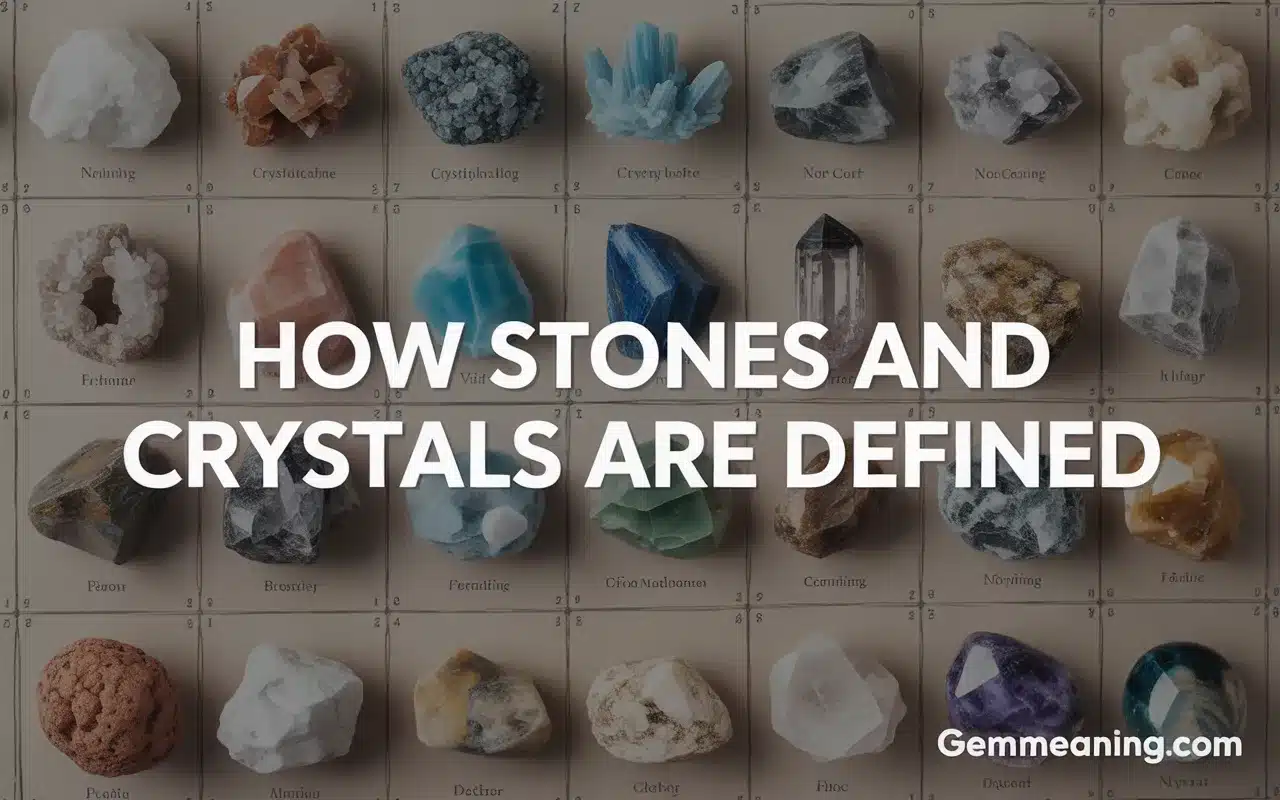
Have you ever walked along a beach or a hiking trail and picked up a particularly interesting rock? Maybe it had a unique color, a smooth texture, or a little bit of sparkle. We often use the words “stone,” “rock,” and “crystal” interchangeably in everyday conversation, but have you ever wondered what the actual difference is?
The world of geology can seem complex, but understanding the basics of stones and crystals is simpler than you think. Knowing how these natural objects are defined can deepen your appreciation for the beautiful treasures that come from the earth. It helps you understand why some are rough and opaque, while others are smooth, colorful, and translucent.
This guide is designed to be your friendly introduction to the definitions that separate these terms. We will explore what makes a rock a rock, what makes a stone a stone, and when something earns the special title of “crystal.” By the end, you’ll have a clear understanding of the language used to describe these natural wonders.
Let’s dig in and uncover the simple definitions behind the common stones and crystals you encounter every day, transforming the way you see the ground beneath your feet.
What Is a Rock? The Foundation of It All
Before we can talk about stones and crystals, we have to start with the biggest category: rocks. A rock is a naturally occurring solid mass or aggregate of minerals. Think of it like a cookie. A chocolate chip cookie is made of different ingredients—flour, sugar, butter, and chocolate chips—all mixed together.
In the same way, most rocks are made up of two or more different minerals. For example, granite, a very common rock, is typically composed of minerals like quartz, feldspar, and mica. If you look closely at a piece of granite, you can see the different specks of color and texture from these individual mineral components.
Rocks are the building blocks of our planet. They form the Earth’s crust, the mountains, and the ocean floor. Geologists classify rocks into three main types based on how they were formed.
1. Igneous Rocks
Igneous rocks are formed from the cooling and solidification of molten rock material (magma or lava). When a volcano erupts and the lava cools, it forms igneous rock. Granite and basalt are two common examples.
2. Sedimentary Rocks
These rocks are formed from the accumulation and cementation of small particles like sand, shells, and other organic matter. Over millions of years, layers of this sediment build up and pressure compacts them into solid rock. Sandstone, limestone, and shale are all sedimentary rocks.
3. Metamorphic Rocks
Metamorphic rocks are rocks that have been changed by intense heat or pressure. The original rock, which could be igneous, sedimentary, or even another metamorphic rock, gets “cooked” or squeezed deep within the Earth, causing its mineral composition and texture to change. For example, limestone can metamorphose into marble.
So, a rock is a composite material, a mixture of minerals. This is the starting point for understanding stones and crystals.
What Is a Stone? A Rock with a Purpose
This is where language gets a little less scientific and a bit more practical. The term “stone” is not a formal geological term like “rock” or “mineral.” Instead, “stone” is a word we use to describe a piece of rock that has been removed from its original source.
If a large rock formation is a mountain, a stone is a smaller piece that has broken off that mountain. Think of a riverbed filled with smooth, rounded pebbles. Each of those pebbles is a stone. The word often implies a certain size—something you can hold or at least move.
The definition of “stone” is largely based on human use and context. We use it to describe rocks that have a specific purpose or characteristic.
Stones in Construction and Landscaping
When we talk about building materials, we use the word “stone.” A “stone wall” is made of individual pieces of rock. “Gravel stones” are used for driveways, and “paving stones” are used for patios. In this context, “stone” simply means a piece of rock that is being used for a practical application.
The Connection to Gemology
The term “stone” is also used as a casual shorthand in the world of jewelry. People often refer to gems as “stones.” You might hear someone talk about a “precious stone” or an “emerald stone.” Here, “stone” is used to describe a mineral that has been cut and polished for use as a gemstone. This is a key area where the definitions of stones and crystals can start to overlap and cause confusion.
So, a simple way to think about it is that a stone is a piece of rock that has been separated from its parent formation. It’s a more tangible, human-scale term. All stones are derived from rock, but we call them stones when we interact with them as individual objects.
What Is a Crystal? Nature’s Perfect Geometry
Now we arrive at the most distinct category: crystals. Unlike rocks, which are mixtures of minerals, a crystal is a single, solid substance with a highly organized internal structure. It is made of one type of mineral (or sometimes a uniform combination).
The defining feature of a crystal is that its atoms, molecules, or ions are arranged in an ordered, repeating pattern. This internal geometric lattice extends in all directions. It’s this perfect, underlying structure that gives crystals their characteristic flat faces and sharp, symmetrical shapes.
Think back to our cookie analogy. If a rock is the whole cookie with all its ingredients mixed together, a crystal is like a single, perfectly formed sugar crystal you might sprinkle on top. It’s pure and has a defined structure.
How Do Crystals Form?
Crystals form when a liquid, like magma or water rich in dissolved minerals, cools and solidifies. As it cools, the atoms find each other and lock into their most stable, organized arrangement. The final size and quality of the crystal depend on the conditions during its growth.
- Slow Cooling: When magma cools very slowly deep within the Earth, it gives atoms plenty of time to arrange themselves perfectly. This can result in large, well-formed crystals.
- Fast Cooling: If lava cools quickly on the surface, the atoms don’t have time to form large structures, resulting in tiny crystals or even volcanic glass like obsidian, which has no crystalline structure.
Clear Quartz, Amethyst, Pyrite, and Halite (salt) are all classic examples of crystals. Each has a unique internal atomic pattern that dictates the shape it naturally grows into.
The Relationship Between Rocks, Stones, and Crystals
Let’s put it all together. The relationship between these terms is hierarchical.
- Rocks are the source. They are the composite masses of minerals that make up the Earth’s crust.
- Stones are pieces of rock. A stone is a general term for a detached piece of rock, often of a size that can be handled.
- Crystals are the pure ingredients. Crystals are the minerals with an ordered atomic structure. They can be found within rocks.
A single piece of granite is a rock. If you break off a small piece, you might call it a stone. If you look closely at that stone, you will see tiny, distinct crystals of quartz and feldspar that make it up.
Sometimes, a rock can be composed almost entirely of one type of mineral crystal. For example, a piece of marble is a rock, but it is made up of interlocking calcite crystals. A large Amethyst geode is a hollow rock, but its cavity is lined with beautiful Amethyst crystals.
The Overlap in Common Language
The main source of confusion comes from how we use these words every day. The term “stones and crystals” is often used as a catch-all phrase in spiritual and wellness communities to refer to a wide variety of minerals used for their perceived energetic properties.
In these contexts, “stone” is often used to describe minerals that are opaque and earthy, like Jasper or Turquoise. “Crystal” is often used to describe minerals that are transparent or translucent and have a more defined geometric shape, like Quartz or Fluorite.
While this is a helpful practical distinction for collectors, it is not a strict scientific one. Scientifically, both the opaque Jasper and the transparent Quartz are crystalline solids. They both have an ordered internal atomic structure, even if it’s not visible to the naked eye. Jasper is just made of micro-crystals packed tightly together.
A Practical Guide to Telling Them Apart
When you are out exploring or browsing a shop, here is a simple way to think about what you are looking at.
- Is it made of many different visible components? If you can see a jumble of different colors, grains, and textures all mixed together, you are most likely looking at a rock. A piece of granite or a river rock with various bands and spots fits this description.
- Is it a solid, uniform material? If the piece appears to be made of one consistent substance, even if it has different shades of the same color, you are likely looking at a mineral crystal. Now, you might call it a stone or a crystal.
- Does it have flat faces and a geometric shape? If you see defined, sharp edges and symmetrical faces, you are looking at a classic crystal. A Quartz point with its six sides is a perfect example.
- Is it opaque and earthy? If the material is solid in color and light does not pass through it, many collectors would call it a stone, even though it is scientifically a microcrystalline mineral. Examples include Bloodstone, Jasper, and Howlite.
- Is it translucent or transparent? If light can pass through the material, and it has some sparkle or clarity, people are more likely to call it a crystal. Rose Quartz, Amethyst, and Citrine fit this description.
Why This Matters for You
Understanding the basic definitions of stones and crystals does more than just satisfy your curiosity. It makes you a more knowledgeable and confident collector. You can better appreciate the natural processes that formed these objects, from the violent heat that creates igneous rocks to the slow, patient growth of a perfect crystal.
It also helps you communicate more clearly. When you know the difference, you can describe what you’re looking for more accurately, whether you’re talking to a geologist or a shop owner.
Most importantly, this knowledge connects you more deeply to the earth. The next time you hold a smooth stone in your hand, you can appreciate its long journey from a massive rock formation. The next time you admire a sparkling crystal, you can marvel at the perfect, hidden geometry that nature created deep underground.
The world of stones and crystals is vast and full of wonder. Don’t worry about getting every term right all the time. The goal is to simply start looking closer and appreciating the subtle but important differences. We encourage you to pick up a few different rocks, stones, and crystals and see if you can identify their defining characteristics for yourself.