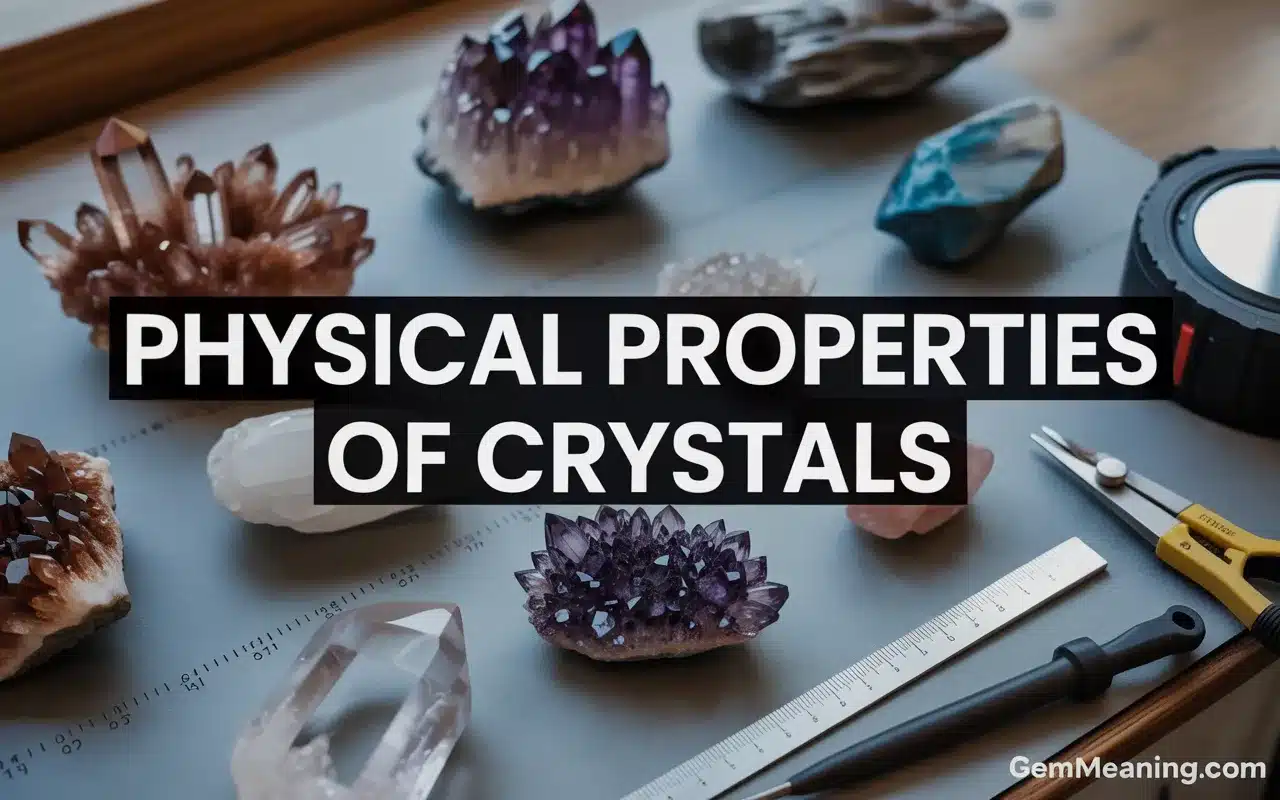
Have you ever held a piece of quartz and marveled at its perfectly flat sides and sharp point? Or maybe you’ve been captivated by the deep, inky black of obsidian versus the rainbow flash of labradorite. These unique characteristics aren’t random; they are the result of specific physical properties that define what a crystal is and how it behaves.
While many people are drawn to the metaphysical side of stones, understanding the science behind crystals and their properties can deepen your appreciation for them immeasurably. It transforms you from a casual admirer into a knowledgeable collector. Knowing why a crystal breaks a certain way, how it reflects light, or why it feels heavy can help you identify specimens, care for them properly, and even spot fakes.
This guide is designed to be your friendly introduction to the fascinating world of mineralogy. We are going to demystify the key physical properties that geologists use to identify minerals, but we will do it in a simple, easy-to-understand way. No geology degree required!
Let’s pull back the curtain and explore the science that makes each crystal in your collection a unique natural masterpiece.
What Makes a Mineral a Crystal?
Before we dive into the properties, let’s clarify one thing: all crystals are minerals, but not all minerals form visible crystals. The defining feature of a crystal is its internal structure.
A crystal is a solid material whose atoms are arranged in a highly ordered, repeating pattern. This microscopic blueprint is called the crystal lattice. This internal order is what gives crystals their distinct shapes and many of their unique physical characteristics. A rock, on the other hand, is typically made of multiple minerals jumbled together without a uniform structure.
Now, let’s explore the observable traits that arise from this amazing internal order.
1. Crystal Habit: The Natural Shape
One of the first things you notice about a mineral is its shape. “Crystal habit” is the term used to describe the characteristic shape a mineral takes when it has enough space to grow without obstruction. This shape is a direct outward expression of its internal atomic structure.
For example, the atoms in quartz are arranged in a way that naturally leads to a six-sided (hexagonal) prism with a pointed termination. Halite (salt) has a cubic structure, so it forms perfect little cubes.
Common Crystal Habits:
- Prismatic: Forms elongated, column-like crystals (e.g., Quartz, Tourmaline).
- Cubic: Forms cube shapes (e.g., Pyrite, Halite, Fluorite).
- Tabular: Forms flat, tablet-like shapes (e.g., Wulfenite, some Barite).
- Acicular: Forms slender, needle-like crystals (e.g., Scolecite, Rutile).
- Botryoidal: Forms grape-like, bubbly masses (e.g., Malachite, Smithsonite).
- Dendritic: Forms branching, tree-like or fern-like patterns (e.g., Dendritic Agate, Manganese oxides).
Understanding habit helps you appreciate why your crystals look the way they do. A perfect quartz point isn’t carved that way; it grew that way, atom by atom.
2. Luster: How a Crystal Plays with Light
Luster describes how light reflects off a mineral’s surface. It’s one of the most immediate and useful properties for identification. When you think about the difference between a shiny piece of metal and a dull rock, you are observing luster.
Main Categories of Luster:
- Metallic: Looks like polished metal. These are typically opaque and very reflective. Examples include Pyrite, Galena, and Hematite.
- Non-Metallic: This is a broad category with many sub-types. Most common collector crystals fall into this group.
Common Non-Metallic Lusters:
- Vitreous: Has the shine of glass. This is the most common luster. Examples: Quartz, Calcite, Fluorite.
- Resinous: Looks like resin or plastic. Examples: Amber, Sphalerite.
- Pearly: Has the iridescent sheen of a pearl. This is often seen on surfaces that have good cleavage. Examples: Muscovite Mica, some Talc.
- Greasy/Oily: Appears as if it’s coated in a thin layer of oil. Example: Some massive Quartz, Nepheline.
- Silky: Has a soft shine like silk fabric, caused by a fine, fibrous structure. Examples: Satin Spar Selenite, Tiger’s Eye.
- Dull/Earthy: Has no shine at all, like unglazed pottery. Examples: Kaolinite clay, some forms of Hematite.
Next time you pick up a stone, ask yourself: Does it shine like glass, metal, or silk? Answering this question is a key part of understanding crystals and their properties.
3. Hardness: A Test of Scratch Resistance
Hardness is a mineral’s ability to resist being scratched. This is one of the most reliable tests for mineral identification. Geologists use the Mohs Hardness Scale, which ranks ten common minerals from 1 (softest) to 10 (hardest).
It’s a relative scale, meaning it’s not linear. A diamond (10) is many times harder than a corundum (9), which is much harder than a quartz (7).
The Mohs Scale:
- Talc (softest mineral)
- Gypsum (Selenite is a form of gypsum)
- Calcite
- Fluorite
- Apatite
- Orthoclase Feldspar (Moonstone is a feldspar)
- Quartz
- Topaz
- Corundum (Sapphire and Ruby)
- Diamond (hardest mineral)
How to Use It:
You can test the hardness of your own crystals using common objects.
- A fingernail has a hardness of about 2.5.
- A copper penny is about 3.5.
- A steel knife or nail is about 5.5.
- A piece of glass is about 5.5.
- A streak plate (unglazed porcelain) is about 6.5.
- A steel file is about 6.5.
If a mineral can be scratched by your fingernail, its hardness is less than 2.5. If it can scratch glass, its hardness is greater than 5.5. This simple test is incredibly helpful. For example, if you have a clear crystal, it could be Quartz, Calcite, or even glass. If it easily scratches a steel knife, you know it’s likely Quartz (hardness 7).
4. Cleavage and Fracture: How a Crystal Breaks
Cleavage and fracture describe how a mineral breaks when put under stress. This property is directly related to the internal crystal lattice.
Cleavage
Cleavage is the tendency of a mineral to break along flat, planar surfaces. These breaks occur where the atomic bonds are weakest.
- Perfect Cleavage: Minerals with perfect cleavage break to produce smooth, shiny, flat surfaces. Mica is a great example—you can peel it into paper-thin sheets.
- Good Cleavage: Cleavage planes are visible but may not be perfectly smooth. Fluorite and Calcite have good cleavage in multiple directions, causing them to break into diamond or rhombohedral shapes.
The number of cleavage directions and the angles between them are important diagnostic tools.
Fracture
Fracture is how a mineral breaks when it does not have cleavage. The break is irregular and not along a flat plane.
- Conchoidal Fracture: The mineral breaks into smooth, curved surfaces, like the inside of a seashell. This is very characteristic of Quartz and Obsidian (volcanic glass).
- Fibrous Fracture: The mineral breaks into splinters or fibers. Examples: Kyanite, Satin Spar Selenite.
- Uneven Fracture: The surface is rough and irregular. This is a common type of fracture.
So, if you drop a piece of Fluorite, it will likely break into smaller, well-formed diamond shapes (cleavage). If you drop a piece of Rose Quartz, it will break into random, curved pieces (conchoidal fracture).
5. Color: Beautiful but Deceiving
Color is often the first property we notice, but it can be one of the least reliable for identification. Why? Because tiny impurities can cause dramatic color variations within the same mineral.
Quartz is the perfect example.
- Pure Quartz is clear (Rock Crystal).
- With iron impurities, it becomes purple (Amethyst).
- With aluminum impurities, it becomes grey-brown (Smoky Quartz).
- With fibrous inclusions, it can be pink (Rose Quartz).
However, some minerals have a very consistent and characteristic color. Malachite is always green, and Azurite is always blue. In these cases, color is a very helpful identifier. When examining crystals and their properties, think of color as a clue, not a conclusion.
6. Streak: The True Color
While the color of a mineral can vary, its “streak” is surprisingly consistent. Streak is the color of a mineral’s powder, which you can see by rubbing the mineral against a piece of unglazed porcelain (a streak plate).
This is a fantastic test for metallic minerals. For example:
- Pyrite (“Fool’s Gold”) is brassy yellow, but its streak is greenish-black.
- Gold is gold-yellow, and its streak is also gold-yellow.
- Hematite can be black, silver, or reddish-brown, but its streak is always a distinct blood-red or reddish-brown (its name comes from the Greek word for blood).
Streak is less useful for minerals harder than the streak plate (about 6.5) because they will scratch the plate instead of leaving a powder. It’s also less helpful for light-colored, non-metallic minerals whose streak is usually white.
7. Specific Gravity: How Heavy It Feels
Specific Gravity (SG) is essentially a measure of a mineral’s density. It compares the weight of the mineral to the weight of an equal volume of water. A mineral with an SG of 3.0 is three times heavier than the same amount of water.
You don’t need a lab to use this property. You can get a good feel for it just by holding minerals in your hand. This is often called “heft.”
For example, pick up a piece of Barite. For its size, it feels unusually heavy. That’s because it has a high SG of around 4.5. Now, pick up a similar-sized piece of quartz (SG 2.65). The quartz will feel significantly lighter. Metallic minerals like Galena (SG 7.5) feel incredibly heavy for their size.
Other Unique Properties
Some minerals have very unusual and distinctive characteristics that make them easy to identify.
- Magnetism: Magnetite is naturally magnetic and will attract a paperclip.
- Fluorescence: Some minerals, like Fluorite, will glow under ultraviolet (UV) light.
- Double Refraction: When you place a clear piece of Calcite (often called Optical Calcite) over text, you will see two images.
- Feel: Talc feels soapy, while Graphite (used in pencils) feels greasy.
- Taste: Halite tastes salty (because it is salt!). Note: Never taste a mineral unless you are 100% certain it is non-toxic!
- Reaction to Acid: Carbonate minerals like Calcite will bubble and fizz when a drop of weak acid (like vinegar) is applied.
Conclusion: Becoming a Confident Collector
Exploring the physical side of crystals and their properties opens up a whole new dimension of appreciation for your collection. It connects you to the deep geological history of each stone and empowers you with the language of science. Suddenly, you’re not just looking at a pretty rock; you’re observing its vitreous luster, its conchoidal fracture, and estimating its hardness.
You don’t need to memorize every detail. The key is to start observing. Next time you pick up a crystal, go through a mental checklist:
- What is its shape (habit)?
- How does it reflect light (luster)?
- Does it feel heavy or light for its size (heft)?
- Can you see any flat, reflective break surfaces (cleavage)?
By practicing this mindful observation, you’ll train your eye to see the subtle clues that tell the story of each mineral. This knowledge will not only make you a more confident collector but will also deepen your connection to these incredible treasures from the earth. We encourage you to grab a few stones from your collection right now and see what new details you can discover.