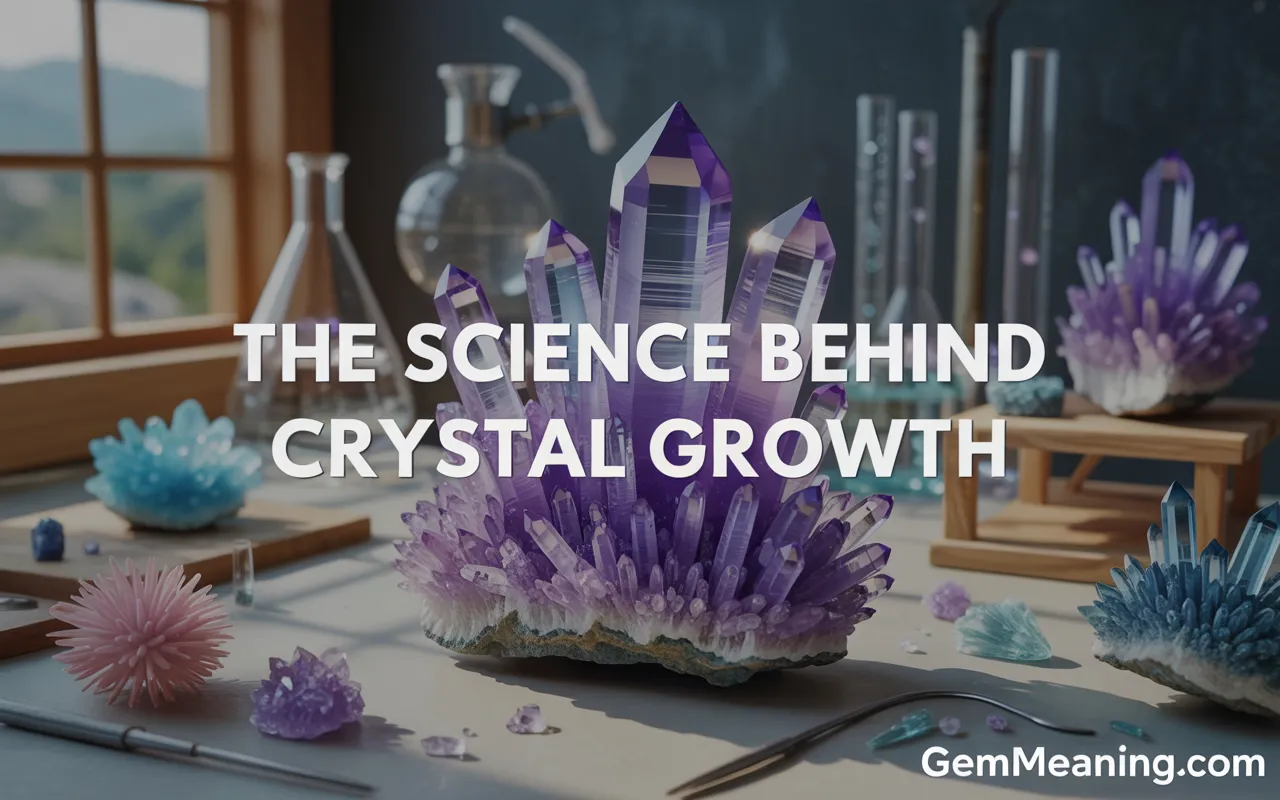
Have you ever held a six-sided quartz point, feeling its smooth faces and sharp termination, and wondered how nature could create such perfect geometry? It’s a marvel that the earth, without any conscious design, can produce objects that look like they were cut by a master jeweler. This natural artistry sparks a deep curiosity about how these treasures come to be.
The journey from a chaotic soup of atoms to a structured, sparkling gem is not magic, but a fascinating scientific process. Understanding the crystals growth process peels back a layer of mystery, replacing it with an even deeper sense of awe for the planet’s creative power. It connects you to the immense timescales and powerful forces that shape the world beneath our feet.
This guide will illuminate the science behind how crystals form. We will explore the essential ingredients, the different geological environments, and the step-by-step journey from a single atomic seed to a magnificent mineral specimen. By the end, you will have a new appreciation for the story every crystal has to tell.
The Universal Recipe: Four Pillars of Crystal Growth
Before a single crystal can form, four fundamental conditions must be met. Think of it as a precise geological recipe. If even one ingredient is missing or incorrect, the process fails, and you are left with just a plain rock.
- Ingredients: You must have the right chemical elements concentrated in one place. To grow halite (salt), you need sodium and chlorine. To grow quartz, you need silicon and oxygen.
- Temperature and Pressure: Every mineral has a “stability zone”—a specific range of heat and pressure. The atoms need enough energy to move into position but not so much that they fly apart.
- Space: To form the beautiful external shapes we love, a crystal needs an open cavity to grow into. Without this “elbow room,” it simply becomes an interlocking grain within a solid mass of rock.
- Time: This is the most profound ingredient. Most large, well-formed crystals grew at an incredibly slow pace, atom by atom, over thousands or even millions of years in a stable environment.
Nature has three primary “kitchens” where it combines these four ingredients to cook up crystals.
Kitchen #1: Igneous Formation (From a Molten State)
The most dramatic crystals growth process begins with fire and molten rock. Deep within the Earth, rock melts into magma, a chaotic liquid of free-floating atoms. As this magma cools, the atoms lose energy, slow down, and begin to bond in orderly, repeating patterns, forming solid crystals.
The Slow Cooling of Magma
When a large body of magma is trapped deep underground, it is insulated and cools over millions of years. This slow pace is critical for growing large crystals. Different minerals form at different temperatures, so as the magma cools, you get a sequence of crystallization. This is how rocks like granite are made, with their visible, interlocking grains of quartz, feldspar, and mica.
Pegmatites: Nature’s Treasure Chests
Sometimes, the last, watery fraction of this cooling magma, rich in rare elements like lithium and beryllium, is forced into cracks in the surrounding rock. This special fluid is called a pegmatite. Because it is trapped and cools very slowly, it becomes a factory for gigantic, gem-quality crystals. Some of the world’s largest specimens of tourmaline, aquamarine, and spodumene (kunzite) are found in these formations.
Lava and Gas Bubbles
When magma erupts as lava, it often contains dissolved gases that form bubbles. As the lava cools and hardens into rock like basalt, these bubbles become trapped, creating hollow pockets called “vugs.” These vugs provide the perfect open space for crystals to grow. Over time, mineral-rich groundwater flows into these pockets, depositing crystals layer by layer and forming the geodes we know and love.
Kitchen #2: Hydrothermal & Aqueous Growth (From a Liquid Solution)
Water is a master architect in the mineral kingdom. It can dissolve minerals in one place, carry them for miles, and then redeposit them as beautiful, sparkling crystals elsewhere. This process is generally much quieter and more patient than its igneous counterpart.
Precipitation from Solution
The basic principle is simple: water dissolves minerals, becoming a “solution.” When the conditions change—like a drop in temperature or pressure—the water can no longer hold all of its dissolved mineral load. The excess minerals “precipitate” out of the solution and form solid crystals.
Hydrothermal Veins
Deep in the crust, water heated by magma becomes a powerful solvent, dissolving metals and minerals. This hot, pressurized fluid shoots through fissures in the rock. As it moves into cooler areas, the minerals precipitate out, lining the walls of the cracks with crystals. This is the crystals growth process responsible for many quartz points and valuable gold veins.
Evaporation in Arid Environments
In places like deserts or enclosed sea basins, another process takes over. As water evaporates, the minerals left behind become increasingly concentrated. Eventually, the water is so saturated that the minerals begin to crystallize. This is how the vast salt flats of Utah form their fields of halite, and how deserts grow beautiful gypsum “roses.”
The Slow Drip of Caves
Caves offer a perfect, slow-motion view of growth from water. Rainwater becomes slightly acidic as it passes through soil. This acid dissolves limestone (calcite) as it seeps underground. When that water drips into an open cave, it releases carbon dioxide, causing the calcite to precipitate. Drop by drop, over millennia, these tiny deposits build massive stalactites and stalagmites.
Kitchen #3: Metamorphic Growth (From a Solid State)
This is perhaps the most fascinating crystals growth process, as it happens entirely in solid rock. Metamorphism occurs when an existing rock is subjected to immense heat and pressure, typically during mountain-building events when continents collide.
The atoms within the rock’s minerals are squeezed so intensely that they break their old bonds, migrate through the solid rock, and re-form into new, denser, more stable crystal structures—all without ever melting.
How Solid-State Growth Works
Imagine a simple mudstone being buried 10 miles deep and cooked at hundreds of degrees. The original clay minerals are no longer stable. Their atoms of aluminum, silicon, and iron will slowly rearrange themselves into entirely new minerals that can withstand these harsh conditions.
This is how some of our most beloved gems are born:
- Garnets: These iconic, soccer ball-shaped crystals often grow within a type of metamorphic rock called schist. They start as a microscopic seed and slowly expand, pushing the surrounding flaky mica minerals out of the way.
- Kyanite and Staurolite: Minerals like Kyanite (blue blades) and Staurolite (“fairy crosses”) are index minerals, meaning they only form under very specific pressures and temperatures. Their presence tells a geologist the life story of that mountain range.
The Step-by-Step Growth Sequence
Regardless of which “kitchen” a crystal is in, the fundamental steps of its growth are the same, proceeding from a tiny seed to a macroscopic specimen.
Step 1: Nucleation
Growth cannot start without a “seed,” or a point of nucleation. This is the initial moment when a handful of atoms or molecules in a liquid or solid happen to arrange themselves into the correct geometric pattern. This seed can be a microscopic impurity or simply a random fluke. It provides the template for all future growth.
Step 2: Accretion
Once the seed exists, it grows through accretion. Atoms from the surrounding fluid or solid matrix are attracted to the faces of the seed crystal and attach themselves, building up the structure layer by atomic layer. It is like building a perfect wall brick by brick, where each brick is a single molecule of the mineral.
Step 3: The Importance of Rate and Stability
The speed of the crystals growth process is a critical factor in determining the final quality.
- Slow Growth: A slow, stable process with a steady supply of ingredients allows each atom to find its perfect spot on the crystal lattice. This results in large, clear (euhedral) crystals with well-defined faces.
- Fast Growth: Rapid cooling or evaporation forces the atoms to solidify quickly and haphazardly. This leads to a mass of very small, imperfect crystals (anhedral) or prevents crystallization entirely, forming a natural glass like obsidian.
What Influences the Final Crystal?
The journey from seed to gem is rarely straightforward. Many environmental factors can influence a crystal’s final appearance, leading to the unique characteristics we cherish as collectors.
Impurities and Inclusions
The environment where a crystal grows is rarely pure. Other minerals, drops of water, or bubbles of gas can become trapped inside the growing crystal. These are called inclusions. The needles of rutile in Rutilated Quartz or the phantom layers in Garden Quartz are beautiful examples of this.
Color and Zoning
A crystal’s color is often caused by trace amounts of other elements substituting into the crystal lattice. If the chemistry of the surrounding solution changes during growth, the crystal’s color can change, too. This creates “zoning.” Ametrine is a perfect example, where a change in iron oxidation state creates distinct zones of purple Amethyst and yellow Citrine within a single quartz crystal.
Twinning
Sometimes, two or more separate crystals grow together in a specific, non-random alignment. This is called twinning. The famous cross-shapes of Staurolite and the “fishtail” shape of some Selenite crystals are classic examples. Twinning occurs when a new crystal begins to grow on the face of an existing one but in a mirrored or rotated orientation.
Conclusion: A Story of Time and Transformation
The crystals growth process is a testament to the patient, organizing power of nature. It is a story told over millions of years, written in the language of chemistry and physics. From the fiery heart of a volcano to the quiet drip of water in a dark cave, the earth is constantly, slowly, creating these beautiful geometric forms.
Understanding this science does not diminish the wonder of holding a crystal. Instead, it enriches it. You are not just holding a rock; you are holding a physical record of geological history. That quartz point is an artifact of ancient hydrothermal systems. That garnet is a souvenir from the birth of a mountain range.
We encourage you to look at the minerals in your collection or in a local shop with this new perspective. Try to imagine the incredible journey each one took, from a random collection of atoms to the structured, sparkling treasure you see today. The science is just as beautiful as the sparkle.