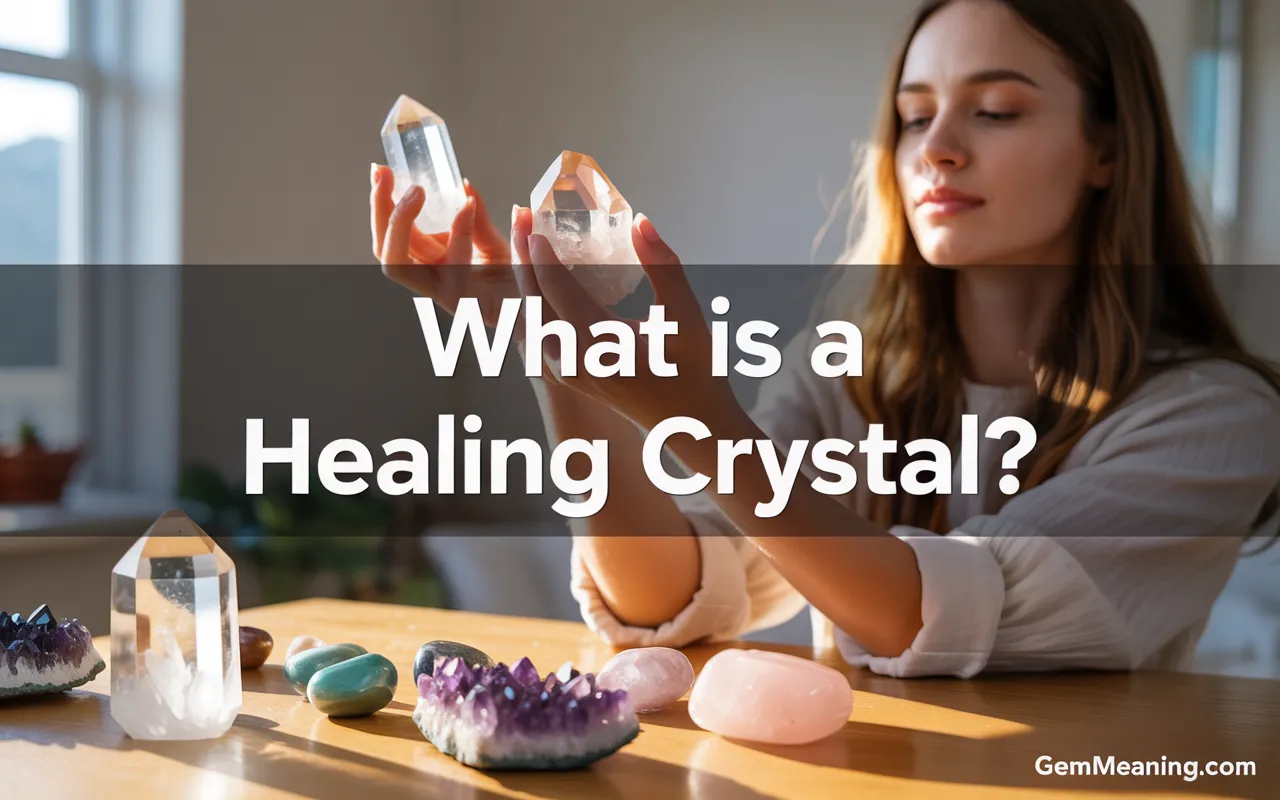
You see them everywhere these days. They are on celebrities’ Instagram feeds, sitting on your coworker’s desk, and maybe even lining the shelves of your local home goods store. Beautiful, sparkling stones in every color of the rainbow. But beyond their aesthetic appeal, there is a buzzing curiosity about their function. You might find yourself wondering: what is a healing crystal, exactly?
Is it just a pretty rock? Is it a magical talisman? Or is it something in between? If you have felt skeptical, curious, or simply confused by the sudden surge in crystal popularity, you are in the right place.
The world of crystal healing can feel overwhelming at first glance. There are hundreds of stones, ancient traditions, and modern wellness trends all mixed together. But at its core, the concept is quite simple and deeply rooted in our connection to the earth.
In this guide, we are going to strip away the mystery. We will explore the definition of a healing crystal, how they are believed to work, and why people have been fascinated by them for thousands of years. We will also give you the practical knowledge you need to decide if they are right for you. Let’s dig in.
Defining the Basics: What Is a Healing Crystal?
So, let’s answer the big question first. When we ask “what is a healing crystal,” we are talking about a mineral or fossilized resin that is believed to possess specific energetic properties.
Scientifically speaking, a crystal is a solid material whose atoms are arranged in a highly ordered, microscopic structure. This structure forms a crystal lattice that extends in all directions. It is this perfect internal order that makes crystals unique in the natural world.
However, in the context of wellness and spirituality, a healing crystal is more than just geology. It is viewed as a tool for restoration and balance.
Practitioners believe that these stones can:
- Interact with your body’s energy field (often called the aura).
- Help move stagnant or blocked energy.
- Amplify your thoughts and intentions.
- Promote a sense of physical and emotional well-being.
Essentially, a healing crystal is a conduit. It is a stable, unchanging source of frequency that you can use to help stabilize your own often chaotic human energy.
The Science of Vibration
To understand what is a healing crystal doing, we have to talk about physics. Everything in the universe is made of energy. You, your chair, your phone, and the stones in the ground are all vibrating at different frequencies.
Humans are complex beings. Our vibration changes constantly based on our emotions, health, and environment. When we are stressed or sick, our vibration can become erratic or “out of tune.”
Crystals, on the other hand, are incredibly stable. Because of their fixed geometric atomic structure, they vibrate at a very precise, constant frequency. This is not just spiritual theory; it is scientific fact.
This stability is known as the piezoelectric effect. Quartz crystals, for example, can generate an electrical charge when pressure is applied. This ability to hold a precise frequency is why quartz is used in:
- Watches (to keep time).
- Radios (to transmit signals).
- Computers (to store memory).
- Medical ultrasound equipment.
Crystal healing applies this same principle to the human body. The theory is that when you bring a stable, high-vibration crystal near your body, your unstable energy naturally tries to sync up with it. This process is called entrainment. It is like a tuning fork correcting a sour note.
A Brief History of Crystal Use
Asking “what is a healing crystal” isn’t a new question. In fact, humans have been using stones for healing and protection for as long as history has been recorded. This isn’t a fleeting TikTok trend; it is an ancient practice.
Ancient Egypt
The Egyptians were famous for their love of Lapis Lazuli, Turquoise, and Carnelian. They didn’t just wear them as jewelry; they buried their dead with Quartz to help guide them in the afterlife and used ground-up Malachite as eye makeup for protection against evil spirits.
Ancient Greece
The word “crystal” actually comes from the Greek word krystallos, meaning “ice.” They believed clear quartz was water that had frozen so deeply it would never melt. Greek soldiers rubbed crushed Hematite on their bodies before battle, believing it would make them invincible.
Traditional Chinese Medicine
For thousands of years, Chinese medicine has used jade needles for acupuncture and healing. They believe that certain stones carry life-force energy, or Qi, and can help balance the body’s yin and yang.
Ayurveda
In India, the ancient Vedic texts describe specific stones for healing different ailments. This system is closely tied to the concept of chakras (energy centers), which is still the primary way most people use crystals today.
Understanding this history helps ground the practice. It reminds us that our ancestors, across different continents and eras, all intuitively felt that stones held power.
How Crystals Interact with Chakras
You cannot fully explain what is a healing crystal without mentioning chakras. In many spiritual traditions, the body has seven main energy centers aligned down the spine. These are called chakras.
Each chakra governs a different aspect of our physical and emotional life, and each is associated with a specific color. Crystal healing often involves matching a stone’s color to the chakra that needs help.
Here is a quick breakdown of how this works:
1. Root Chakra (Red/Black)
- Location: Base of the spine.
- Function: Safety, survival, grounding.
- Healing Crystals: Red Jasper, Black Tourmaline, Hematite.
- How they help: These stones help you feel safe, secure, and present in your body.
2. Sacral Chakra (Orange)
- Location: Below the belly button.
- Function: Creativity, passion, emotion.
- Healing Crystals: Carnelian, Sunstone.
- How they help: These stones ignite inspiration and help you process feelings.
3. Solar Plexus Chakra (Yellow)
- Location: Stomach area.
- Function: Confidence, will, personal power.
- Healing Crystals: Citrine, Tiger’s Eye.
- How they help: These stones boost self-esteem and motivation.
4. Heart Chakra (Green/Pink)
- Location: Center of the chest.
- Function: Love, compassion, forgiveness.
- Healing Crystals: Rose Quartz, Jade, Green Aventurine.
- How they help: These stones heal emotional wounds and open you to love.
5. Throat Chakra (Light Blue)
- Location: Throat.
- Function: Communication, truth.
- Healing Crystals: Blue Lace Agate, Aquamarine.
- How they help: These stones help you speak your truth clearly and kindly.
6. Third Eye Chakra (Indigo)
- Location: Between the eyebrows.
- Function: Intuition, wisdom.
- Healing Crystals: Amethyst, Lapis Lazuli.
- How they help: These stones quiet the mind and deepen your insight.
7. Crown Chakra (Violet/White)
- Location: Top of the head.
- Function: Spirituality, connection.
- Healing Crystals: Clear Quartz, Selenite.
- How they help: These stones connect you to higher consciousness and clarity.
So, when you ask what is a healing crystal for anxiety, you might look for a Third Eye stone like Amethyst. If you need courage, you might look for a Solar Plexus stone like Citrine.
The Psychological Aspect: The Placebo Effect
Skeptics often ask: is it the crystal working, or is it all in your head? The honest answer is that it might be a bit of both—and that is okay.
The placebo effect is a powerful, documented scientific phenomenon. It proves that the mind has an incredible ability to influence the body. If you firmly believe that holding a piece of Rose Quartz will make you feel more loved, your brain releases neurochemicals that actually create that feeling.
In this sense, a healing crystal acts as a “psychological anchor” or a talisman. It is a physical object that represents an intention.
- When you put a crystal on your desk for focus, it serves as a visual reminder to stay on task.
- When you hold a worry stone in your pocket, the physical sensation interrupts your anxiety loop.
Whether the change comes from the stone’s vibration or your own powerful mind, the result is the same: you feel better. For many users, the “how” matters less than the “result.”
Common Types of Healing Crystals
If you walk into a shop, you will see crystals in many forms. Understanding the different shapes helps answer the question what is a healing crystal used for in practice.
Raw or Rough Stones
These are unpolished chunks of rock, exactly as they came out of the earth.
- Vibe: Earthy, intense, diffuse energy.
- Best for: Placing in a garden or a large room to shift the energy.
Tumbled Stones
These are smooth, shiny, and rounded pebbles. They have been put in a rock tumbler to polish them.
- Vibe: Gentle, easy to handle.
- Best for: Carrying in your pocket, placing in a bra, or using for meditation.
Points and Towers
These are cut or naturally formed to have a sharp point at one end.
- Vibe: Directed, focused energy.
- Best for: Manifesting (directing energy out) or drawing energy in.
Spheres
These are perfectly round crystal balls.
- Vibe: Even, harmonious energy that radiates in all directions.
- Best for: Massage or bringing harmony to a chaotic room.
Clusters
These are groups of many crystal points growing together on a base.
- Vibe: Collaborative, amplifying.
- Best for: Cleansing other crystals or energizing a living space.
How Do You Choose a Healing Crystal?
Now that we have defined what is a healing crystal, how do you pick one? With so many options, it can feel paralyzing.
The golden rule of crystal healing is: trust your intuition.
You do not need to memorize a textbook. Often, your body knows what it needs before your mind does. Here is a simple way to choose:
- The Visual Test: Look at a display of stones. Which one do your eyes keep going back to? Is there a color that seems to “pop” for you?
- The Physical Test: Pick up the stone. Does it feel good in your hand? Some people feel a warmth, a tingle, or just a sense of comfort.
- The Emotional Test: How does looking at it make you feel? If a stone makes you feel happy or calm, that is the right one for you.
Sometimes you might be drawn to a blue stone, only to look it up later and realize it is for communication—exactly what you have been struggling with at work. Trust that instinct.
Caring for Your Crystals
If we accept the definition that what is a healing crystal is an energetic tool, then like any tool, it needs maintenance. Crystals are believed to absorb and store energy. Over time, they can get “clogged” with old or negative vibrations.
To keep them working well, you need to cleanse them. Here are a few easy ways:
- Smoke: Pass the stone through the smoke of sage, palo santo, or incense.
- Moonlight: Leave the stone on a windowsill overnight during a full moon.
- Sound: Ring a bell or play a singing bowl near the crystals.
- Selenite: Place your stones on a slab of Selenite (a self-cleansing crystal) to recharge them.
- Water: Rinse them under cool water (but be careful—some soft stones like Selenite or Halite will dissolve!).
Think of cleansing like washing your hands. It removes the residue of the day so you can start fresh.
Safety and Ethics
As the popularity of crystals grows, it is important to talk about where they come from. Crystals are natural resources mined from the earth.
When asking what is a healing crystal, we should also ask: what is an ethical crystal?
Unfortunately, some mining practices can be harmful to the environment or involve unfair labor practices.
- Ask questions: When buying, ask the shop owner where they source their stones.
- Look for transparency: Reputable sellers will often list the country of origin.
- Buy less, buy better: You don’t need a thousand stones. One high-quality, ethically sourced crystal is better than a bucket of questionable ones.
Also, a safety note: healing crystals are a complementary therapy. They are not a replacement for medical treatment. If you are sick, please see a doctor. Use crystals to support your emotional and spiritual wellness alongside professional medical care.
Incorporating Crystals into Daily Life
You don’t have to be a monk or a mystic to use crystals. They fit easily into a modern lifestyle. Here are three simple ways to start.
1. The Pocket Rock
This is the easiest method. Put a tumbled stone in your pocket in the morning. Every time you touch it, remind yourself of your intention.
- Example: Carry Black Tourmaline when you know you have to deal with a difficult person.
2. Desk Decor
Place a crystal on your desk at work. It looks beautiful and can help set a mood.
- Example: Place Fluorite near your computer to help with focus and mental clutter.
3. The Bedside Guardian
Keep a stone on your nightstand to influence your sleep energy.
- Example: Keep Amethyst or Celestite nearby to promote peaceful dreams and deep rest.
Final Thoughts: Your Journey Begins
So, what is a healing crystal? It is a piece of the earth’s history. It is a scientific marvel of order and frequency. It is a psychological tool for focus. And for many, it is a spiritual ally in a chaotic world.
Whether you see them as powerful energetic batteries or simply as beautiful reminders to breathe, there is no wrong way to appreciate them. The magic lies not just in the stone, but in what you bring to it.
If you are curious, don’t overthink it. Go find a stone that calls to you. Hold it in your hand. Take a deep breath. You might just find that this ancient practice offers exactly the kind of grounding modern life is missing.
The world of crystals is vast, colorful, and waiting for you to explore it. Enjoy the journey.