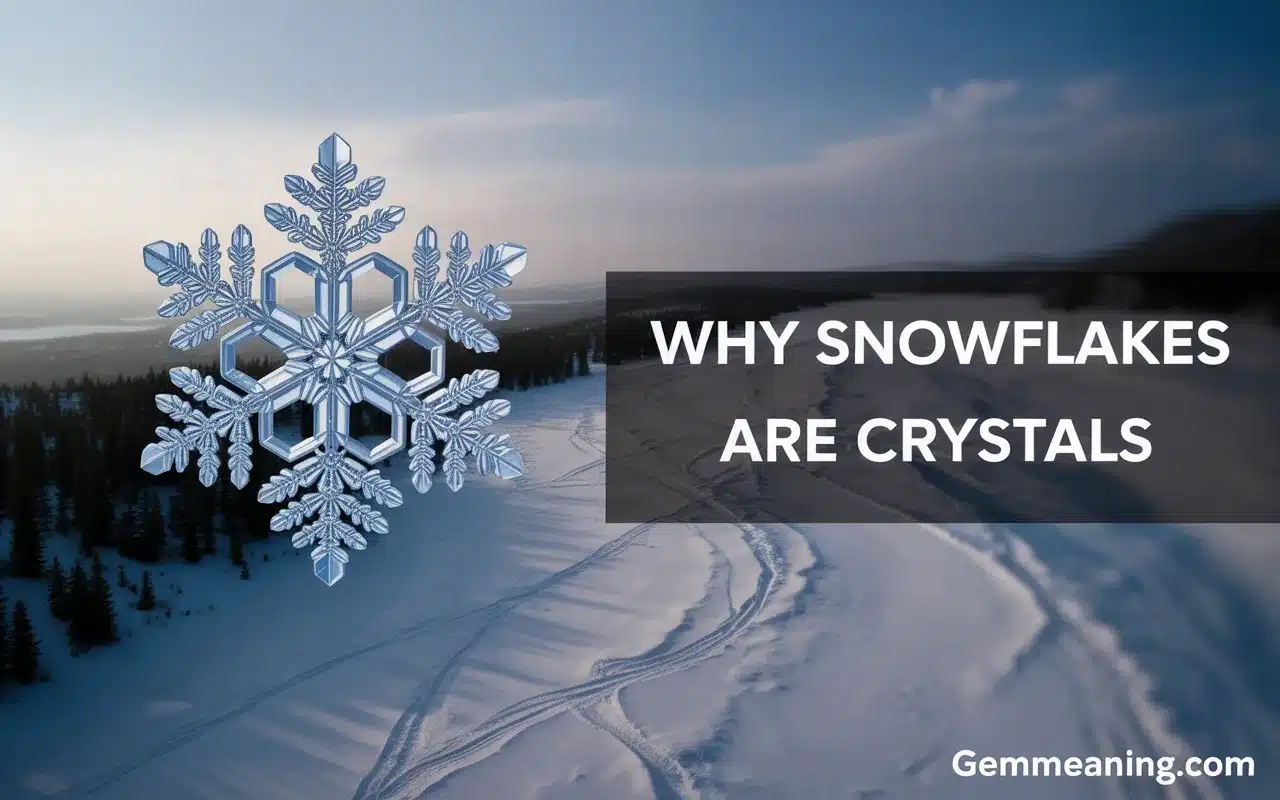
There is a moment of pure magic when you catch a falling snowflake on your dark winter coat. For a fleeting instant, before it melts away forever, you can see an impossibly intricate and symmetrical masterpiece. It looks like a tiny, ornate jewel that has fallen from the sky. It’s so perfect, it’s hard to believe it wasn’t carved by a master artist.
This observation is more accurate than you might think. A snowflake is not just a frozen droplet of water. It is a genuine, fully-formed mineral crystal. The same natural laws that create a six-sided quartz point in the earth or a perfect salt cube from the sea are responsible for the beautiful geometry of a snowflake.
Understanding that snowflake crystals are true crystals transforms how you see a snowstorm. It’s no longer just weather; it’s a large-scale geological event happening in the clouds. This guide will explore the fascinating science behind why snowflakes are crystals, how they get their unique shapes, and what makes them one of nature’s most beautiful creations.
Let’s shrink down to the molecular level and uncover the secrets hidden in a flurry of snow.
What Defines a Crystal?
To understand why snowflakes qualify as crystals, we first need to define what a crystal actually is. In science, the word “crystal” has a very specific meaning that goes beyond just being shiny or transparent.
A crystal is a solid material whose atoms, molecules, or ions are arranged in a highly ordered, repeating pattern that extends in all three spatial dimensions. Think of it like a perfectly organized brick wall, where every brick is laid in exactly the same way. This internal, microscopic order is what gives a crystal its characteristic flat faces and sharp, geometric angles on the outside.
Key characteristics of a crystal include:
- Ordered Structure: The internal arrangement of its atoms is not random. It follows a predictable, repeating pattern called a crystal lattice.
- Formation Process: Crystals form when a substance transitions from a less-ordered state (like a liquid or gas) to a more-ordered solid state.
- Geometric Shape: The visible, external shape of a crystal often reflects its internal atomic symmetry.
Quartz, diamonds, and salt are all classic examples of minerals that form crystals. As we will see, snowflakes check every one of these boxes.
The Molecular Blueprint of Ice
The entire reason snowflake crystals have their iconic shape comes down to the simple water molecule: $H_2O$. This molecule consists of one oxygen atom bonded to two hydrogen atoms. But the way they are bonded is what matters.
The “Mickey Mouse” Shape
A water molecule is not linear. The two hydrogen atoms are attached to the oxygen atom at an angle of about 104.5 degrees, giving it a shape that looks like a tiny Mickey Mouse head. This bent shape creates a slight electrical imbalance. The oxygen side becomes slightly negative, and the hydrogen side becomes slightly positive.
Hydrogen Bonds: Nature’s Velcro
This imbalance makes water molecules “polar,” or sticky. The positive hydrogen “ears” of one molecule are strongly attracted to the negative oxygen “face” of a neighboring molecule. This attraction is called a hydrogen bond.
In liquid water, the molecules are moving too fast to stay locked together. They are constantly forming and breaking these bonds. But as water cools down, the molecules slow down, and these hydrogen bonds start to take over, forcing the molecules to arrange themselves in the most energy-efficient way possible.
The Birth of Snowflake Crystals: From Vapor to Solid
A common misconception is that a snowflake is just a frozen raindrop. In reality, a frozen raindrop is sleet. True snowflake crystals form through a much more elegant process called deposition.
Step 1: Nucleation
High up in a cold cloud, the air is full of water vapor (a gas) and microscopic, supercooled water droplets that are still liquid even though the temperature is below freezing (32°F or 0°C).
For a snowflake to be born, the water vapor needs a “seed” to start growing on. This seed, or nucleus, is usually a microscopic speck of dust, pollen, or even bacteria floating in the air. The first few water vapor molecules will attach to this speck and freeze, forming a tiny, nascent ice crystal.
Step 2: Deposition and Growth
Once this ice nucleus exists, it becomes a magnet for the surrounding water vapor. Gaseous water molecules from the cloud bump into the ice seed and instantly freeze onto its surface, skipping the liquid phase entirely. This direct gas-to-solid transformation is deposition.
As more and more water vapor molecules deposit onto the seed, the snowflake crystals grow larger, layer by atomic layer.
The Six-Sided Secret: Why Hexagons?
This brings us to the most iconic feature of a snowflake: its six-sided symmetry. You will never find a natural snowflake with five or eight sides. This hexagonal shape is a direct result of the water molecule’s geometry.
When water molecules lock together via their hydrogen bonds, the most stable and energy-efficient pattern they can form is a hexagonal (six-sided) lattice. Think of it like a honeycomb. Each molecule connects to others to form interlocking six-sided rings.
This internal, microscopic hexagonal arrangement dictates the macroscopic shape of the growing crystal. As new water vapor molecules attach to the surface, they follow the hexagonal blueprint laid down by the very first molecules. The crystal can only grow in a way that preserves this six-sided symmetry.
So, while the final snowflake might be a complex star with intricate arms, its fundamental symmetry is locked in from the very beginning by the laws of chemistry.
Sculpting the Crystal: Temperature and Humidity
If all snowflake crystals are based on the same hexagonal pattern, why do they look so different from one another? We see everything from simple plates to long columns to elaborate, feathery stars.
This incredible diversity is primarily controlled by two environmental factors inside the cloud:
- Temperature
- Humidity (the amount of available water vapor)
The Nakaya Diagram
The relationship between these factors was famously mapped by Japanese scientist Ukichiro Nakaya. He discovered that different temperature ranges produce dramatically different crystal shapes.
- Near 32°F (0°C): The crystals tend to grow as thin, simple hexagonal plates.
- Around 23°F (-5°C): The growth switches to long, slender needles or hollow columns.
- Around 5°F (-15°C): This is the sweet spot for the classic, large, star-shaped “stellar dendrites.” The conditions are perfect for arms to sprout from the six corners.
- Below -22°F (-30°C): Growth returns to forming small, simple plates and columns.
The Role of Humidity
Humidity acts as the fuel for crystal growth.
- Low Humidity: In drier conditions, there isn’t much water vapor available. Growth is slow and steady, usually resulting in simple, solid shapes like prisms and plates.
- High Humidity: In a moisture-rich environment, there is an abundance of water vapor. This encourages rapid growth, especially at the corners of the crystal, which stick out further into the moist air. This rapid corner growth is what creates the beautiful, branching arms of dendritic snowflakes.
No Two Snowflakes Are Alike: A Journey Through the Clouds
The old saying that “no two snowflakes are alike” is, for all practical purposes, true. The reason for this near-infinite variety is the journey each crystal takes on its way to the ground.
A growing snowflake is tossed about by winds inside a cloud, falling through different layers of the atmosphere. On its journey, it might pass through a zone at 5°F with high humidity, causing it to grow stellar arms. A minute later, it might fall into a warmer layer around 23°F, where the tips of those arms might start growing needles.
Each snowflake crystal records its unique life history in its final shape. The chances of two separate crystals following the exact same path through the same sequence of temperatures and humidities for the same amount of time are astronomically small. It is this individual journey that ensures each one is a unique work of art.
Snowflakes vs. Snow Crystals vs. Snow
You might hear these terms used interchangeably, but in meteorology, they have slightly different meanings.
- Snow Crystal: This refers to a single, individual crystal of ice. A stellar dendrite or a hexagonal plate is a snow crystal.
- Snowflake: This term can mean a single snow crystal, but it more often refers to a clump of multiple snow crystals that have collided and stuck together as they fell. Those big, fluffy flakes you see in a gentle snowfall are usually aggregates of many smaller crystals.
- Snow: This is the general term for precipitation in the form of ice crystals.
So, while all snowflakes are made of snowflake crystals, not every snowflake is a single, perfect crystal.
Observing Snowflake Crystals Yourself
You don’t need a high-tech lab to appreciate the crystalline nature of snow. With a little preparation, you can become a backyard scientist and see this beauty for yourself.
Here’s how:
- Get Ready for the Cold: When it starts to snow, place a piece of black cardboard, construction paper, or velvet outside for a few minutes to let it get as cold as the air. If you try to catch a flake on a warm surface, it will melt instantly.
- Catch Some Flakes: Hold the cold surface out flat and let some snowflakes land on it. Try to catch individual flakes rather than big clumps.
- Use Magnification: Use a simple magnifying glass to get a closer look. A macro lens attachment for your smartphone camera works even better.
- Observe the Details: Look for the six-sided symmetry. Can you see the arms branching? Are they simple plates or complex stars? You will be amazed at the intricate details you can see.
This simple activity is a powerful way to connect with the science of mineralogy and meteorology in a hands-on way.
Conclusion: Nature’s Fleeting Minerals
The delicate snowflake that lands on your sleeve is more than just frozen water—it is a true mineral crystal, just as much as a quartz point or a diamond. Its existence is a perfect demonstration of how fundamental laws of physics and chemistry create order and beauty out of chaos.
The journey of snowflake crystals from a speck of dust in a cloud to a complex, six-armed star is a story of transformation. It is shaped by the unique molecular structure of water and sculpted by the ever-changing conditions of the atmosphere. Each flake is a tiny, frozen record of its journey through the sky.
Next time a winter storm rolls in, we encourage you to think of it not just as a weather event, but as a crystal-forming factory. Take a moment to step outside, catch a few of these fleeting gems, and marvel at the fact that nature is producing billions of unique, intricate mineral specimens, just for them to melt in a matter of seconds.
Key Takeaways:
- Snowflakes are true crystals: They have a highly ordered, repeating internal structure of water molecules.
- Hexagonal symmetry is key: The bent shape of the water molecule causes it to form a six-sided lattice when it freezes.
- Shape is determined by environment: The temperature and humidity of the cloud dictate whether a crystal grows into a plate, column, or star.
- No two are alike: Each snowflake’s unique journey through the atmosphere gives it a one-of-a-kind shape.
- They form from vapor, not liquid: Snowflakes grow directly from water vapor in a process called deposition.
Stay curious, and enjoy the wonder of the next snowfall