Have you ever faced a decision where logic just couldn’t give you the answer? Maybe you were torn between two job offers, unsure about a relationship, or just trying to figure out what your gut was trying to tell you. In moments like these, we often wish for a direct line to our intuition. This is where a gemstone pendulum comes in.
A pendulum is one of the oldest and simplest tools for divination and guidance. It acts as a receiver and transmitter of information, moving in different ways in response to questions. When you combine this ancient tool with the unique energetic properties of crystals, you get a powerful instrument for clarity, healing, and self-discovery.
If you have been curious about dowsing or simply drawn to the beauty of a crystal swinging on a chain, you are in the right place. Working with a pendulum isn’t about magic tricks; it’s about learning to trust yourself. It is a way to bypass the noisy, analytical mind and access the quiet wisdom of your subconscious.
In this guide, we will explore the fascinating world of the gemstone pendulum. We will cover everything from how it works and what the different stones mean, to a step-by-step guide on how to program and use your pendulum for the first time.
What is a Gemstone Pendulum?
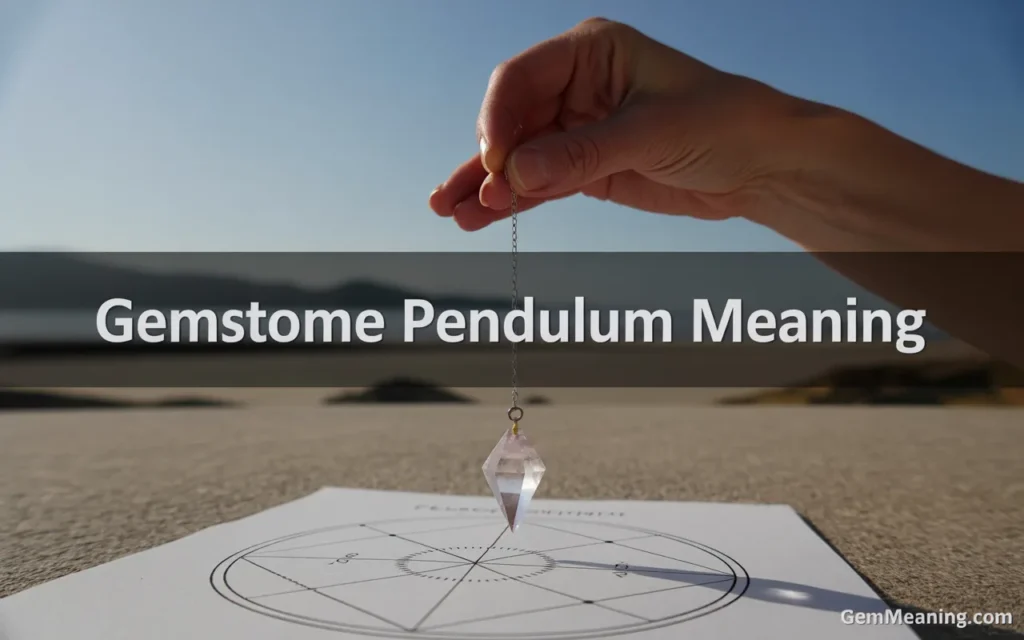
At its most basic level, a pendulum is a weighted object suspended from a stationary point so that it can swing freely. A gemstone pendulum specifically uses a crystal or mineral as the weight.
While pendulums can be made of wood, metal, or glass, gemstone versions are favored by many because the crystal itself adds a layer of energetic support. The stone acts as an amplifier.
How Does It Work?
The science behind pendulums is often attributed to the ideomotor effect. This suggests that the pendulum is moved by tiny, involuntary muscle movements in your hand. These micro-movements are controlled by your subconscious mind.
So, the pendulum isn’t being moved by spirits or ghosts; it is being moved by you. It is an extension of your own intuition, making visible what you already know deep down but might not be consciously aware of.
Why Use a Gemstone?
Using a crystal adds a specific vibration to the process. Just as you might choose chamomile tea for sleep or coffee for energy, you can choose a specific gemstone pendulum to support the type of questions you are asking.
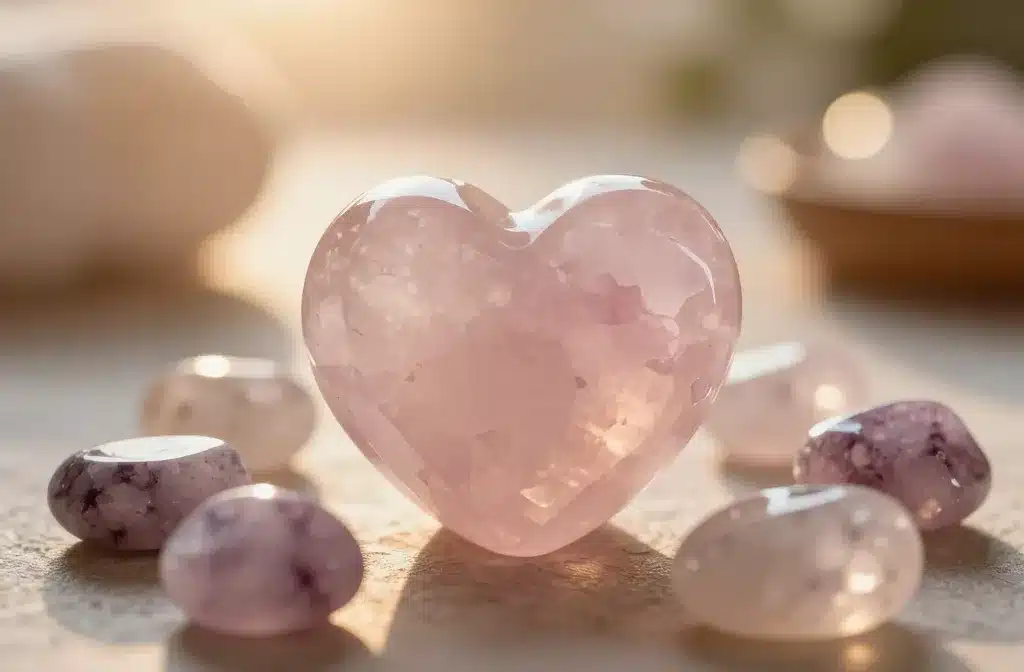
- Rose Quartz: Great for questions about love and relationships.
- Amethyst: Excellent for spiritual questions and clarity.
- Clear Quartz: An all-purpose amplifier that ensures clear answers.
Choosing the Right Gemstone Pendulum for You
Walking into a metaphysical shop or browsing online for a pendulum can be overwhelming. There are hundreds of stones to choose from. How do you know which one is right?
The best advice is usually to trust your gut. Which stone catches your eye? Which one do you keep going back to? That is usually the one you need. However, if you are looking for a pendulum for a specific purpose, here are some common gemstone pendulum meanings to guide you.
Amethyst: The Spiritual Connector
Amethyst is a high-vibration stone connected to the Third Eye and Crown Chakras.
- Best For: Spiritual guidance, connecting with spirit guides, and questions about your life path.
- Energy: Calming, protective, and clarifying. It helps cut through confusion and anxiety.
Rose Quartz: The Heart Healer
This soft pink stone is the ultimate symbol of unconditional love.
- Best For: Questions about relationships, self-love, family matters, and emotional healing.
- Energy: Gentle, nurturing, and compassionate. It ensures that the answers you receive are filtered through the lens of love.
Clear Quartz: The Master Clarifier
Clear Quartz is known as the “Master Healer” because it amplifies energy and thought.
- Best For: General dowsing, “yes/no” questions, and cleansing other crystals. It is the “blank slate” of pendulums.
- Energy: Pure, high-frequency, and programmable. It is excellent if you want one pendulum to do it all.
Black Tourmaline: The Protector
This is a powerful grounding stone that absorbs negative energy.
- Best For: Identifying negative energy, dowsing for harmful lines (like geopathic stress), and protection work.
- Energy: Grounding, shielding, and heavy. It helps keep you tethered to the earth while you work.
Lapis Lazuli: The Stone of Truth
With its deep blue color and gold flecks, Lapis Lazuli has been revered for centuries as a stone of wisdom.
- Best For: Uncovering deep truths, past-life work, and enhancing intellectual ability.
- Energy: Honest, direct, and royal. It encourages self-awareness and speaking one’s truth.
Citrine: The Success Stone
Citrine carries the energy of the sun and is associated with the Solar Plexus Chakra.
- Best For: Career questions, financial decisions, and boosting confidence.
- Energy: Joyful, abundant, and energizing. It helps you make decisions that align with your personal power.
Preparing Your Pendulum for Use
Once you have chosen your gemstone pendulum, you shouldn’t just take it out of the box and start asking questions. It is important to cleanse and bond with your tool first.
Cleansing the Energy
Crystals absorb energy from their environment. Your new pendulum has likely traveled a long way and been handled by many people before reaching you. You want to clear that “static” so you can get clear answers.
- Smoke: Pass the pendulum through the smoke of sage, palo santo, or incense.
- Moonlight: Leave it on a windowsill overnight during a full moon.
- Sound: Use a singing bowl or bell near the stone.
- Breath: Hold the stone, take a deep breath, and blow sharply on it with the intention of clearing away old energy.
Bonding with Your Pendulum
Carry your pendulum with you for a few days. Keep it in your pocket or wear it (if it’s on a chain). Sleep with it on your nightstand. The goal is to attune the crystal’s vibration to your own unique energy signature.
How to Program Your Gemstone Pendulum
Before you can ask questions, you need to establish a common language with your pendulum. You need to know what “Yes,” “No,” and “Maybe” look like. This process is called programming or calibrating.
Step-by-Step Calibration Guide
- Find a Quiet Space: Sit comfortably at a table where you can rest your elbow. Take a few deep breaths to center yourself. Grounding is key.
- Hold the Pendulum: Hold the end of the chain or the fob between your thumb and index finger. Let the gemstone dangle freely. There should be about 3-4 inches of chain between your fingers and the stone.
- Steady Your Hand: Rest your elbow on the table to stabilize your arm. Your hand should be relaxed.
- Ask for “YES”: Say out loud or in your head, “Show me a YES.” Watch the pendulum. It might swing front-to-back, side-to-side, or in a circle (clockwise or counter-clockwise). Be patient; it might take a moment to start moving. Note the direction.
- Ask for “NO”: Stop the pendulum with your other hand to steady it. Then say, “Show me a NO.” Wait for the movement. It should be different from the “YES” movement.
- Ask for “MAYBE”: Stop the pendulum again. Say, “Show me MAYBE” or “I don’t know.” This is often a diagonal swing or a wobble, but it can be anything distinct.
Once you have established these three movements, you are ready to start dowsing!
How to Ask Questions Effectively
The quality of your answers depends entirely on the quality of your questions. A gemstone pendulum works best with straightforward, binary questions (Yes/No).
Be Specific
Vague questions get vague answers.
- Bad: “Will I be happy?” (Happy is subjective and changes daily).
- Good: “Is taking this new job in my best interest right now?”
One Thing at a Time
Don’t stack questions.
- Bad: “Should I move to New York and become a writer?”
- Good: “Is it aligned for me to move to New York?” (Followed by) “Is it aligned for me to pursue writing?”
Check Your Emotional State
If you are highly emotional or desperate for a specific answer, your conscious mind can override the subtle muscle movements, forcing the pendulum to give you the answer you want rather than the truth.
- If you are too invested in the outcome, ask a friend to dowse for you.
- Always approach the session with a feeling of “neutral curiosity.”
The “Can I? May I? Should I?” Rule
Before asking a serious question, it is often helpful to ask these three pre-check questions:
- Can I? (Do I have the ability/skill to ask this?)
- May I? (Do I have permission from my higher self/spirit guides?)
- Should I? (Is it appropriate to ask this right now?)
If you get a “No” to any of these, put the pendulum away and try again later.
Using Charts with Your Gemstone Pendulum
While Yes/No questions are great, sometimes you need more detail. This is where pendulum charts come in. A chart is simply a piece of paper with a semi-circle or circle divided into wedges (like a pie).
Creating a Chart
You can draw your own chart easily.
- Draw a semi-circle.
- Divide it into wedges.
- Write different options in each wedge.
Examples of Chart Uses
- Choosing Crystals: Write the names of different crystals (Amethyst, Citrine, Jasper, etc.) in the wedges. Hold your gemstone pendulum over the center (the “hub”) and ask, “Which crystal do I need today?” Watch which wedge it swings toward.
- Chakra Checks: Write the names of the seven chakras. Ask, “Which chakra needs balancing right now?”
- Decision Making: Write your options (e.g., Dinner A, Dinner B, Dinner C) and ask the pendulum to pick.
Troubleshooting: Why Isn’t It Moving?
It is common for beginners to struggle with getting the pendulum to move. Don’t worry; you aren’t “doing it wrong.”
Relax Your Grip
If you are holding the chain too tightly, you are blocking the micro-movements. Hold it lightly, as if you are holding a butterfly wing.
Shorten the Chain
Sometimes a long chain creates too much drag. Try inching your fingers down the chain closer to the stone to see if that helps it swing more easily.
Ground Yourself
If you are feeling “spacey” or ungrounded, the connection can be weak. Stomp your feet on the floor, visualize roots growing into the earth, or hold a piece of Black Tourmaline for a moment before trying again.
Ask “Is This the Right Time?”
Sometimes, for whatever reason, the energy just isn’t right. If you are getting static or no movement, respect that. Put the tool away and come back to it tomorrow.
Caring for Your Gemstone Pendulum
Your gemstone pendulum is a sacred tool, and treating it with respect ensures it continues to work well for you.
Storage
Don’t just toss it in the bottom of your bag. The crystal point can chip, and the chain can get tangled.
- Pouch: Keep it in a small velvet or silk pouch.
- Box: A small wooden box is also a great home for it.
- Safety: If your pendulum is made of a softer stone like Selenite or Fluorite, keep it away from harder stones that might scratch it.
Regular Cleansing
Just like your other crystals, your pendulum needs regular energetic hygiene. If you have done a heavy session—for example, asking about a traumatic event or doing healing work for someone else—cleanse the stone immediately afterward.
If you haven’t used it in a while, give it a quick cleanse before starting up again to wake up the energy.
The Ethics of Dowsing
When using a gemstone pendulum, it is important to observe some basic spiritual ethics.
Privacy
Generally, it is considered unethical to dowse about other people without their permission. Avoid asking questions like, “Does John have a crush on Sarah?” or “What is my sister’s secret?” Stick to questions about your own life and path.
Medical and Legal Questions
Never use a pendulum as a substitute for professional advice. Do not use it to diagnose illnesses (“Do I have the flu?”) or make major legal decisions (“Should I sue my neighbor?”). Use common sense and professional resources for these matters.
Reliance vs. Guidance
A pendulum is a tool for guidance, not a ruler of your life. It shouldn’t replace your own critical thinking or free will. Use it to gain insight, but always make the final decision yourself. If the pendulum says “quit your job” but you have no savings and no backup plan, use your logic!
Final Thoughts: Trusting Your Inner Wisdom
The true magic of a gemstone pendulum doesn’t lie in the rock or the chain; it lies in you. The pendulum is simply a mirror, reflecting the deep knowing that already exists within your soul.
In a world that constantly demands we look outside ourselves for answers—to experts, to the internet, to social media—dowsing is a radical act of looking inward. It is a practice of self-trust.
Whether you choose a soothing Rose Quartz to heal your heart or a sharp Clear Quartz to sharpen your mind, your pendulum can become a faithful companion on your journey of self-discovery. It invites you to pause, to breathe, and to listen to the quiet voice of your intuition.
So, pick up that chain. Take a deep breath. Ask your question. And trust that you already have the answer.
Ready to Start?
Why not start small today? Find a quiet moment, cleanse your new pendulum, and ask a simple question. “Is it in my best interest to go for a walk today?” See what your inner wisdom has to say. You might be surprised at how loud that quiet voice can be.

Christian Grey is the creator of GemMeaning, where he shares simple insights about crystals, gemstone meanings, and spiritual guidance. His focus is on making complex ideas easy to understand and practical for everyday life.