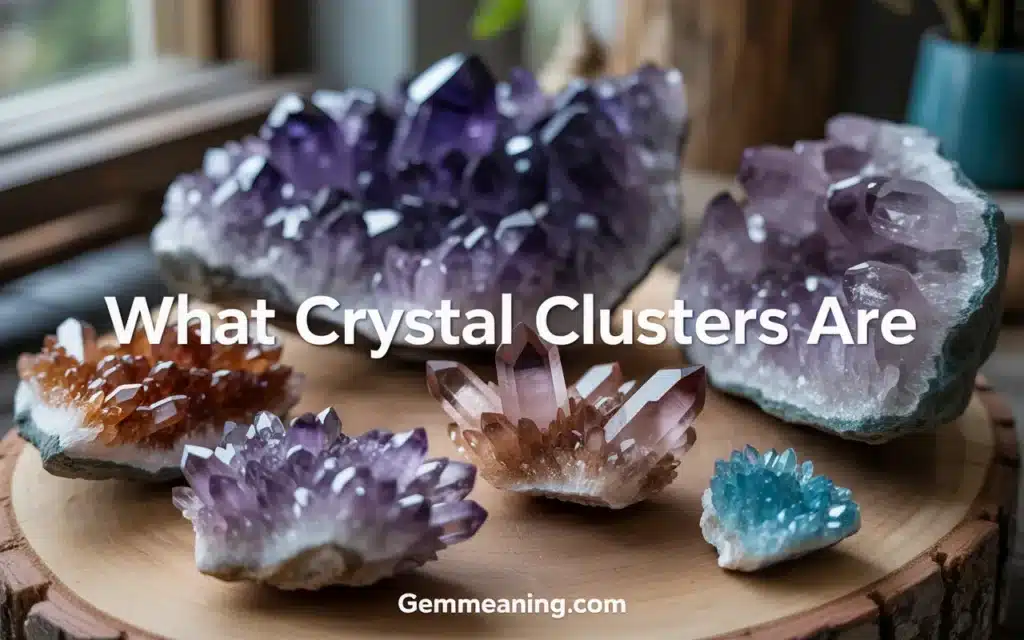
If you’ve ever walked into a crystal shop, your eyes were likely drawn to the spectacular, sparkling formations known as clusters. These pieces, with their dozens or even hundreds of individual crystal points growing together from a common base, are often the stunning centerpieces of any collection. They look like miniature, magical cities, each point a skyscraper of shimmering light.
While single tumbled stones and polished points are beautiful, there is a unique and powerful energy to a raw crystal cluster. But what exactly are they? How do they form, and what makes them different from a single crystal? Understanding the nature of these incredible specimens can deepen your appreciation and help you connect with their energy on a whole new level.
This guide will explore the fascinating world of the crystals cluster. We will cover how they are born deep within the earth, the different types you might encounter, and how their unique structure gives them a special purpose in the world of energy work. Let’s delve into the magic of these communal crystals.
What Defines a Crystal Cluster?
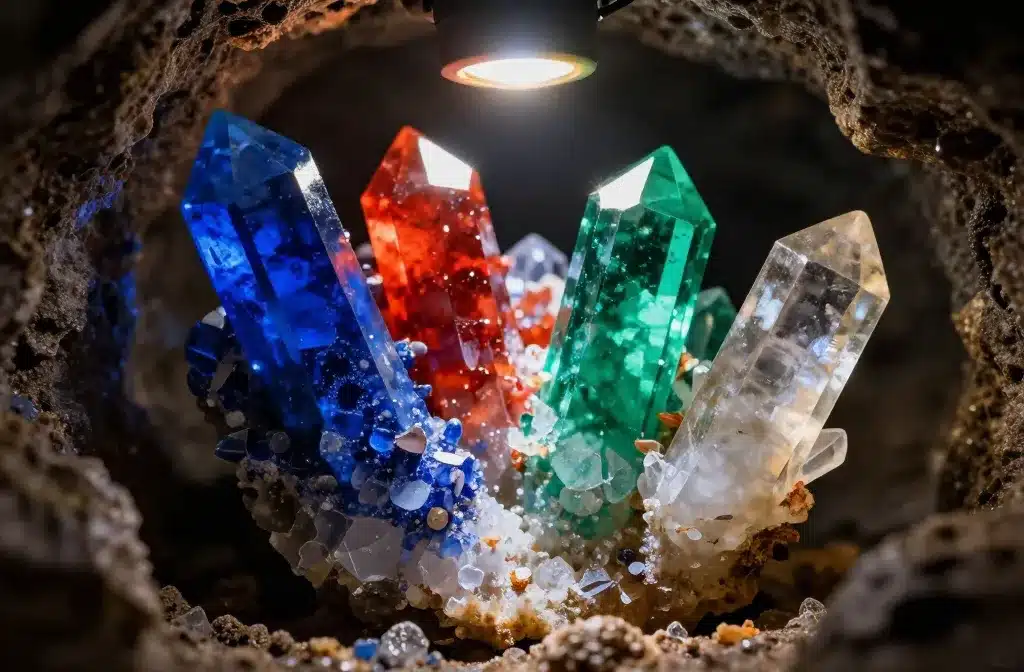
A crystal cluster is a group of individual crystal points that have all grown together on a shared foundation, called the matrix. The matrix is the host rock or mineral bed from which the crystals first began to form. You can think of it like a family of crystals, all connected at the root and growing outward in the same general direction.
Unlike a single crystal point, which represents a solitary growth, a cluster is a community. Each point in the cluster is a distinct individual with its own termination (the pointed end), but they all share the same source. This structure is key to understanding both their formation and their metaphysical properties.
These formations can range in size from a small, palm-sized piece with a few points to massive, museum-quality geodes weighing several hundred pounds and containing thousands of individual crystals.
How Do Crystal Clusters Form?
The creation of a crystals cluster is a slow, magical process that takes place over millions of years deep within the Earth’s crust. It requires a specific set of geological conditions, which can be broken down into three main ingredients.
1. An Open Cavity
First, there needs to be an empty space within the rock. These cavities, or “vugs,” are often formed by gas bubbles trapped in cooling volcanic rock (like in basalt) or by cracks and fissures created by geological activity. This empty pocket provides the protected “womb” where the crystals can grow without being constricted.
2. Super-Saturated Mineral-Rich Water
Next, water that is super-saturated with dissolved minerals must seep into this cavity. For a quartz cluster to form, this water needs to be rich in silicon dioxide (SiO₂). For a calcite cluster, it needs to be rich in calcium carbonate. This mineral-rich hydrothermal fluid is the “nutrient soup” that will feed the growing crystals.
3. Time and Stability
Finally, the conditions inside the cavity need to remain stable for a very long time—thousands or millions of years. As the mineral-rich water slowly cools or evaporates, the dissolved minerals begin to precipitate out of the solution. The atoms start to lock together in their unique, repeating geometric pattern (the crystal lattice).
The first tiny seed crystals form on the walls of the cavity (the matrix). From these initial seeds, the crystals begin to grow inward, point by point, layer by layer, into the open space. Because many seed crystals form at once, they grow alongside each other, creating the beautiful community we recognize as a cluster. The size and perfection of the points depend on the stability and purity of the solution during this incredibly long growth period.
Common Types of Crystal Clusters
While many different minerals can grow in cluster formations, some are far more common and popular in the collector’s market. Here are a few of the most beloved types of crystals cluster you are likely to encounter.
Amethyst Clusters
Amethyst is arguably the most famous and sought-after type of crystal cluster. These are typically found as sections of geodes, which are hollow rocks lined with crystals. Their stunning purple points can range from pale lilac to a deep, royal purple. Brazil and Uruguay are famous for producing massive, high-quality Amethyst geodes.
Clear Quartz Clusters
Clear Quartz clusters are prized for their clarity and beautiful, ice-like formations. They can range from having tiny, sparkling “druzy” points to large, perfectly formed individual points. Arkansas and Brazil are world-renowned sources for high-quality Clear Quartz clusters. They are often seen as master healers and amplifiers of energy.
Citrine Clusters
Natural Citrine clusters are quite rare. Most of the bright yellow or burnt-orange Citrine clusters on the market are actually heat-treated Amethyst clusters. The heating process alters the iron impurities in the Amethyst, changing the color from purple to golden. While man-altered, these clusters are still beautiful and carry a vibrant, joyful energy.
Smoky Quartz Clusters
These clusters feature points that range from a light, translucent grey to a deep, nearly opaque brown or black. The smoky color comes from natural irradiation within the earth. Smoky Quartz clusters are powerful grounding and protective tools.
Spirit Quartz (Cactus Quartz)
This is a truly unique type of crystals cluster. Spirit Quartz is characterized by a main, larger crystal point that is encrusted with hundreds of smaller, sparkling crystal points. It’s a cluster on top of a crystal. Found almost exclusively in South Africa, it can come in Amethyst, Citrine, and Smoky varieties. It is said to have a very high, harmonious vibration.
Apophyllite Clusters
Apophyllite is known for its beautiful, water-clear or white cubic and pyramidal crystals. It often forms in clusters with a brilliant, pearly luster. It is frequently found growing alongside other minerals, most notably the peachy-pink zeolite mineral Stilbite, creating stunning combination specimens.
The Metaphysical Power of a Crystal Cluster
In the world of energy work, the structure of a crystal determines its function. While a single point is excellent for directing energy in a focused beam, a crystals cluster has a very different role due to its unique communal formation.
Radiating Energy Outward
Instead of focusing energy, a cluster radiates it outward in all directions. The multiple points work together to send energy flowing throughout a room or space. This makes clusters excellent tools for cleansing a space, raising its vibration, and creating a positive, harmonious atmosphere. Placing a cluster in a living room, office, or meditation space can have a profound effect on the environment.
A Community of Harmony
A cluster is a symbol of community and harmonious co-existence. Each point is an individual, yet they are all rooted in a shared foundation. This teaches a lesson of peaceful group dynamics and connection. Meditating with a cluster can be beneficial for those working on family relationships, teamwork, or community projects.
Cleansing and Charging Other Crystals
One of the most popular uses for a crystal cluster is as an energetic “charging station” for other stones. The powerful, radiating field of a large Quartz or Amethyst cluster can effectively cleanse and recharge smaller tumbled stones, crystal jewelry, or single points.
How to use it: Simply place your smaller stones directly on top of the cluster and leave them there for several hours or overnight. The cluster will absorb any stagnant energy from the smaller stones and fill them with fresh, vibrant energy.
A Self-Cleansing Tool
Because of their many points and strong vibrational output, many believe that crystal clusters are self-cleansing. The constant flow of energy prevents stagnation from building up within the cluster itself. While it never hurts to give them an occasional sound bath or moonlight cleanse, they require far less maintenance than single “working” stones.
How to Choose a Crystal Cluster
Choosing a crystals cluster is a very personal and intuitive process. There is no right or wrong choice, but here are a few factors to consider as you browse.
- Go with Your Gut: The most important rule is to choose the one you are drawn to. Walk around the shop and see which one catches your eye. Which one makes you feel happy, calm, or energized when you look at it? That’s the one that is meant for you.
- Consider the Energy You Need: Think about your intention. Are you looking to create a more peaceful and spiritual atmosphere? An Amethyst cluster might be perfect. Do you want to amplify positive energy and bring clarity to a space? A Clear Quartz cluster would be an excellent choice. Need more joy and abundance? A Citrine cluster could be the answer.
- Examine the Points: Look at the individual crystals. Are they well-formed? Are they damaged? While some minor dings are inevitable from the extraction process, you’ll want a piece that is mostly intact. The size of the points also creates a different feel—large, distinct points have a different energy than a carpet of tiny, sparkling druzy points.
- Check the Matrix: Look at the base the crystals are growing on. Is it solid and stable? The ratio of crystal to matrix is also a matter of personal preference. Some people love a piece that is almost entirely covered in crystals, while others appreciate seeing the contrast with the host rock.
Caring for Your Crystal Cluster
Caring for your crystals cluster is relatively simple, but there are a few things to keep in mind to preserve its beauty and energy.
Cleaning
Clusters are dust magnets! The best way to clean them physically is with a can of compressed air (the kind used for keyboards). This will blow the dust out of the tiny crevices without risking damage. For a deeper clean on water-safe clusters like Quartz and Amethyst, you can use a soft toothbrush and lukewarm water with a tiny drop of mild soap, followed by a thorough rinse. Always avoid this method for fragile or water-soluble clusters.
Placement
Place your cluster in a central location where its energy can radiate freely. A living room coffee table, a bookshelf, or an entryway console are all great spots. Be mindful of direct sunlight, as it can cause the color of Amethyst, Citrine, and Smoky Quartz to fade over time.
Energetic Cleansing
As mentioned, clusters are largely self-cleansing. However, if your cluster is in a high-traffic area or has been around a lot of heavy energy, you can give it a refresh. The safest methods for all clusters are sound cleansing (using a singing bowl or chimes) or smoke cleansing (with sage or palo santo).
Conclusion: A Universe in Your Hands
A crystals cluster is more than just a beautiful object. It is a snapshot of geological history, a perfect expression of atomic order, and a powerful symbol of community. Each one is a tiny universe of individual points working together in harmony, radiating a powerful and uplifting energy into the world around it.
Whether you use them to cleanse your space, charge your other stones, or simply as a stunning piece of natural art, bringing a cluster into your home is like opening a window to the ancient, magical world of minerals.
Key Takeaways:
- A crystal cluster is a group of crystal points that grow together on a common base or matrix.
- They form over millions of years in cavities within rocks from mineral-rich water.
- Common types include Amethyst, Clear Quartz, and Spirit Quartz clusters.
- Metaphysically, clusters radiate energy outward, making them ideal for cleansing a room and charging other crystals.
- Their structure symbolizes community, harmony, and interconnectedness.
We encourage you to explore the world of crystal clusters. Find one that speaks to you, bring it into your space, and experience for yourself the vibrant, harmonious energy that these incredible natural formations have to offer.

Christian Grey is the creator of GemMeaning, where he shares simple insights about crystals, gemstone meanings, and spiritual guidance. His focus is on making complex ideas easy to understand and practical for everyday life.