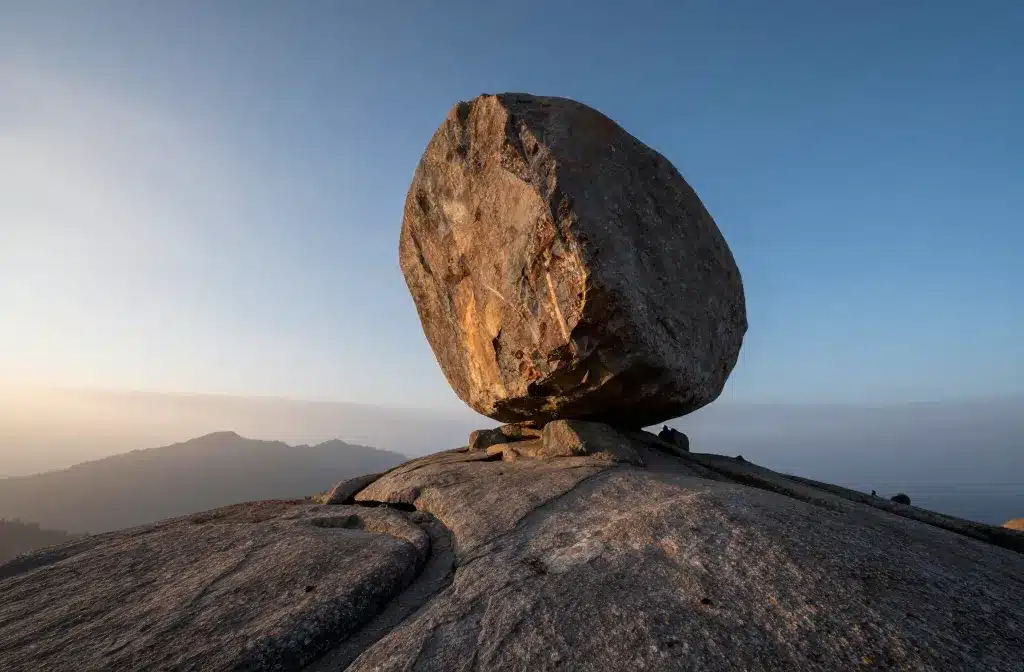
Stand beneath a massive boulder perched on a sliver of stone, and your instincts whisper that nature bent the rules. These perched monuments rouse the same awe we feel under a cathedral dome—except the architect here is time, ice, and wind. They look impossible, yet they have stood for centuries.
If you love gems, minerals, and the stories stones can tell, these “impossible” rocks offer a grand-scale lesson in geology. You’ll learn how they form, why they’re stable, what minerals build their structure, and how the same forces shape the crystals we set into rings. We’ll compare famed balancing stones around the world, peek into their mineral makeup, and connect their drama to the quiet sparkle of faceted gemstones.
We’ll also talk about care: not of the rocks (nature handles that), but of gemstone jewelry inspired by them, plus buying and collecting tips for mineral specimens that echo their look. Consider this a field guide written by someone who has as much respect for a precise pavilion cut as for a wind-sanded granite giant.
Why “Defying Gravity” Isn’t Magic at All
Giant rocks that appear to defy gravity are usually called balanced rocks, perched boulders, or glacial erratics. Their stance may seem uncanny, but physics is on their side. A rock stays put when its center of gravity falls within its base of support. What’s deceptive is the silhouette: a swollen caprock resting on a pinched pedestal or thin contact point creates visual tension.
Weathering sculpts the contrast. Softer layers erode faster, leaving behind a resistant cap. Add frost-wedging, differential wind abrasion, and occasional seismic nudges, and you have an outdoor gallery of improbable poise. The same principles explain why some gemstones resist abrasion better than others—durable minerals outlast their surroundings, whether in a desert spire or a gravel bar rich in almandine garnet.
Great Balancers of the World: A Geology-Focused Tour
Across continents, balanced rocks tell regional stories. Each landmark’s stance comes from local bedrock, climate, and erosional timeline—think of them as chapters written in granite, sandstone, or basalt.
- Devils Marbles (Karlu Karlu), Australia: Hemispherical granite boulders cleaved along orthogonal joints and rounded by spheroidal weathering. The feldspar-rich granite weathers to a coarse, gritty rind; fresh breaks gleam with quartz and pinkish microcline. Mohs hardness: roughly 6–7 for the constituent minerals—tough enough to keep their shape under desert wind.
- Balanced Rock, Arches National Park, USA: A resistant Entrada Sandstone head atop the softer Dewey Bridge Member. The iron-oxide staining creates warm russets and terra-cotta tones, a familiar palette to anyone who’s admired jasper cabochons. Sandstone’s cement varies; silica-cemented beds resist better than clay-cemented layers, explaining the mushroom profile.
- Idol Rock, Brimham Moor, England: Millstone Grit sculpted by periglacial processes and wind. Its undercut forms dramatic shelves and “stilts.” Angular quartz grains in gritstone catch light in a sugary sparkle, reminiscent of drusy quartz surfaces in mineral cabinets.
- Krishna’s Butter Ball, Mahabalipuram, India: A granite sphere seemingly frozen mid-roll. Its feldspar laths and smoky quartz veins show under strong sunlight. The sphere’s stability is a puzzle until you trace its contact points and micro-undulations—small friction ridges and a low center of mass lock it in place.
- Pedra do Baú Region, Brazil: Weathered granitic gneiss forms dramatic stacks and perched blocks. Banding in gneiss—alternating light feldspar-quartz and darker biotite-rich layers—adds a striped elegance you also see in banded agates, albeit on a monumental scale.
These aren’t carnival tricks. They’re the summary of millions of years, written with abrasion, uplift, and patient collapse of everything less durable.
From Boulder to Birthstone: Mineralogy Behind the Spectacle
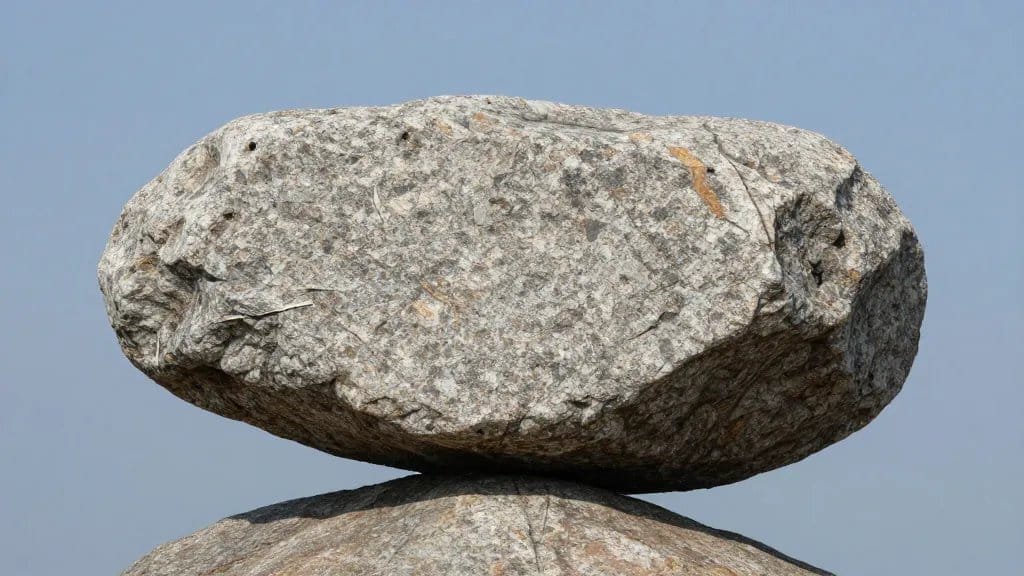
Balanced rocks wear their mineralogy openly. Hard, silica-rich rocks like granite and quartzite often shape distinct capstones because quartz (Mohs 7) and feldspar (around 6) shrug off weathering longer than surrounding material. In sandstone, silica cement and iron-oxide coatings can grant surprising tenacity, just as a fine ruby resists scratches thanks to corundum’s 9 on the Mohs Scale.
Look closely at a sunlit granite balancer: you’ll see glittering quartz patches, pearly feldspar cleavage planes, and dark mica flecks—an uncut mineral buffet. In gem terms, these boulders are outsize aggregates of the same minerals cut into popular jewelry—think rock crystal, orthoclase sunstone, or schorl-tourmaline needles along fracture lines. Their colors—rust, umber, cream, and smoke—mirror the earthy spectrum collectors admire in rutilated quartz, jasper, and garnet schists.
Crystalline architecture matters. Massive rocks erode along joints and planes, just as a lapidary anticipates cleavage when planning a gemstone cut. A pedestal may exist because a joint set limited erosion at the base while spherical weathering rounded the top. Swap scale, and it’s the same foresight that keeps a gem cutter from cleaving a topaz along its perfect basal plane.
How They Balance: The Subtle Geometry of Stability
Three simple ideas keep these giants perched:
- Center of Gravity: If the weight vector lands inside the footprint, the rock stays. Even an acorn-sized contact point can support a large mass if its placement is right—much like a well-proportioned gem sits safely in a minimalist tension setting.
- Friction and Micro-Topography: Minute ridges, quartz-rich asperities, and weathered crusts increase friction. Over geologic time, dust and mineral crusts can act like natural rosin.
- Load Distribution: Internal strength and a low center of mass reduce torque. In layered rocks, toughness and grain interlock distribute stress, similar to how a well-cut cabochon withstands knocks better than an overly thin edge.
Despite their poise, they do fall—eventually. Freeze-thaw cycles, earthquakes, or the slow undermining of a pedestal can topple them, the way a chipped girdle can propagate a crack in a faceted stone. Yet most failures are patient, not dramatic; they whisper with a shift, then settle into a new, more stable form.
Symbolism, Stories, and the Human Eye for Balance
Across cultures, balanced rocks are anchors for myth. Some are offerings to deities; others, talismans of luck. Many people read balance as a sign of endurance and harmony—ideas that cross into personal adornment. In gemstone jewelry, we favor stones that “sit right” on the body and in life: stable, resilient, aligned with meaning.
Collectors often mirror nature’s physics in displays. A slender metal prong lifting a weighty mineral specimen echoes a pedestal of gritstone beneath a granite cap. The message is the same: beauty arises at the edge of risk—supported by knowledge and a few hidden mechanics.
From Monuments to Micros: What Balancing Boulders Teach Gem Lovers
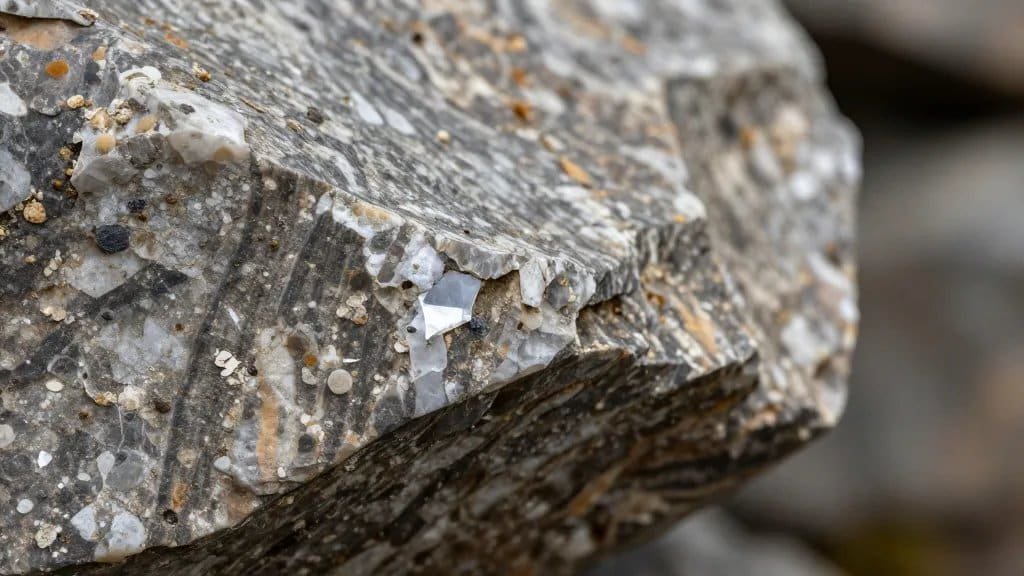
If you enjoy studying Gemstone Hardness and durability, balanced rocks are large-format textbooks. Their survival highlights minerals that resist abrasion, pressure, and thermal shock. A quartzite balancer signals intense metamorphism and interlocked grains—great clues when selecting durable quartz varieties for Gemstone Rings exposed to daily wear.
You can translate landscape to lapidary:
- Resistance Equals Longevity: Quartz-rich stones (amethyst, citrine, rock crystal) make practical everyday pieces. Softer gems like malachite (Mohs ~3.5–4) still captivate but suit earrings or pendants.
- Textures Tell a Story: Desert varnish on boulders—thin manganese and iron films—mirrors patina on copper-bearing minerals and the warm tones in chalcedony. Seek that same earthy richness in Gemstone Colors when curating pieces for autumn wardrobes.
- Structure Dictates Setting: Cleavage in feldspar or topaz means protective settings, just as joints and bedding planes determine a rock’s break lines. A bezel can be your miniature buttress.
The landscape becomes a classroom for Gemstone Identification basics: notice luster, fracture, and grain—habits that translate directly to spotting natural vs. treated surfaces on polished stones.
Collecting at Human Scale: Specimens That Echo the Look
Not everyone can bring home a glacial erratic, but you can collect minerals that echo the character of balancing rocks. Look for:
- Granite and Pegmatite Slices: Beautiful cross-sections showing quartz, feldspar, and mica. In polished slabs, quartz sparkles while feldspar shows silky sheen; black tourmaline needles add drama.
- Sandstone with Desert Varnish: Thin polished tiles reveal iron and manganese blushes. They read like landscape paintings and pair well beside red jasper or iron-stained agates.
- Quartzite and Jasper: Dense, fine-grained pieces that withstand handling. Their compact texture recalls the strength of natural pedestals.
- Gneiss and Schist: Banding and mica sheen mimic the layered complexity carved into many balancing formations. Under good light, muscovite flashes like a row of tiny mirrors.
When buying, use a light and a loupe. Watch for dyed stones posing as iron-rich jaspers; edges and drill holes often betray overly bright colors. A magnet won’t help with non-magnetic minerals, but a cotton swab and acetone can reveal surface dyes on some porous stones. If building a themed shelf, position a rounded “cap” on a smaller “base” of a different rock—your own safe, miniature homage to gravity’s dance.
Designing Jewelry Inspired by Balancing Giants
There’s poetry in a heavy gemstone held by the lightest touch. Designers translate the silhouette of a perched boulder into tension settings, architectural bezels, and asymmetric drop earrings.
- Stones That Wear the Concept Well: Spinel and sapphire (Mohs 8–9) handle exposure in tension-inspired rings. A sleek, high-polish metal band acts like a rock pedestal—slim yet strong.
- Surface Play: Pair matte-finished metals with glossy cabochons to echo the contrast between weathered pedestals and polished quartz faces in nature.
- Shape Matters: Ovals and domed cabochons deliver a “caprock” feel; slender baguettes or knife-edge shanks provide the visual pedestal. Explore Gemstone Shapes and Gemstone Cuts that create a sense of poised mass.
- Earring Balance: Keep weight low; a small top element with a larger bottom stone can feel inverted. Reverse the order—larger stone above, tiny kinetic drop below—for a steady profile that nods to natural balance.
If you’re curating a set, a rugged jasper cuff with a smooth rock crystal ring makes a lovely “boulder and sky” pairing. For gift ideas that carry symbolic weight, browse Gemstone Gifts focused on resilience and harmony.
Durability, Care, and the Quiet Work of Time
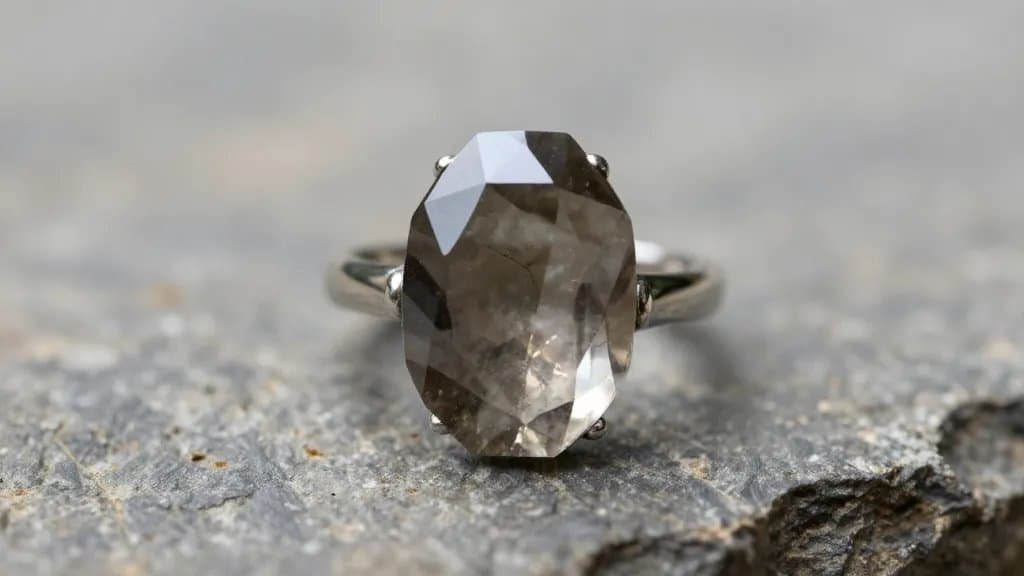
Balanced rocks endure because their materials suit their environment. Translate that to jewelry care: choose the right stone for the right use, then maintain it.
- Daily Wear: Favor corundum, spinel, chrysoberyl, and well-cut quartz for rings. Softer stones—opal, turquoise, malachite—excel in Gemstone Necklaces and Gemstone Earrings where impact risk is low.
- Cleaning: Mild soap, soft brush, and lukewarm water suit most pieces. Avoid ultrasonic or steam on stones with inclusions, cleavage, or treatments. Think of it as preventing micro-erosion at your own scale.
- Storage: Separate gems by hardness to prevent scratching, much as nature separated quartz-rich caprocks from easily abraded bases over time.
If a setting loosens, fix it quickly. A small shift compromises stability—what topples a boulder over centuries can chip a gemstone in weeks if ignored.
Real vs. Fake: The Lure of the Impossible
Some tourist shops sell “balancing stones” glued into photogenic stacks. They’re fun decor, but if you want authenticity, look for unaltered rocks with a natural contact interface. In the specimen world, fakes show up as dyed agates or stabilized “sandstone” composites. Study fracture, pore structure, and weight. Natural pieces feel integral—composites often reveal a uniform binder and identical pore texture across “different” layers.
For wearable stones, consult a trusted Gemstone Buying Guide and ask for treatment disclosures. Glass-filled rubies and dyed jaspers can be lovely, but price and care should match reality. Think of integrity the way you admire a boulder’s true balance: honest structure, gracefully revealed.
Field Etiquette and Conservation
Balanced rocks are fragile in a slow-motion way. Avoid climbing on them or chiseling souvenirs. Surface crusts protect underlying stone from rapid weathering. If you’re photographing or sketching, appreciate from a respectful distance, as you would with a rare crystal cluster at a mineral show.
Local guides and interpretive signs are worth heeding; beyond safety, you’ll often learn tidbits about mineral composition, joint patterns, and erosional timing that turn a pretty view into a geology lesson you can carry into your gemstone hobby.
FAQs
Are balanced rocks stable enough to withstand earthquakes?
Some survive moderate quakes thanks to low centers of gravity and frictional contact. Strong shaking can topple them, and in some regions, fallen caprocks lie nearby as evidence of past events.
What minerals most commonly form balanced rocks?
Quartz-rich rocks—granite, quartzite, and silica-cemented sandstones—dominate, with feldspar, quartz, and mica in granite; pure quartz grains in quartzite; and quartz grains bonded by silica in sandstone.
Can I find gemstones near balanced rock sites?
Sometimes. Granite terrains may host pegmatites with tourmaline or beryl, while sandstone regions yield agates downstream. Check local regulations before collecting.
Do balanced rocks erode faster at the base?
Often yes; softer or more fractured material at the pedestal weathers first, undercutting the cap until collapse resets the profile.
How does Mohs hardness relate to these formations?
Harder minerals resist abrasion, helping a caprock endure longer. The same scale guides jewelry durability—sapphire outlasts daily wear better than calcite.
What jewelry best reflects the “balancing” aesthetic?
Tension-style rings, asymmetric pendants, and cabochon-on-slim-band designs. Choose durable stones like sapphire or spinel for rings to keep the look practical.
How can I tell if a sandstone specimen is dyed?
Check pores and fractures under magnification. Dye concentrates in voids, and a swab with acetone on an inconspicuous area may lift color if it’s surface-applied.
Final Thoughts
Giant rocks that defy gravity aren’t illusions; they’re honest outcomes of mineral strength, structure, and time. See them as oversized mentors for gemstone lovers: they teach stability, respect for material, and the beauty that emerges when mass and balance meet. Carry that lesson into your collection, your choice of stones for daily wear, and the way you set and care for the pieces you love.

Christian Grey is the creator of GemMeaning, where he shares simple insights about crystals, gemstone meanings, and spiritual guidance. His focus is on making complex ideas easy to understand and practical for everyday life.