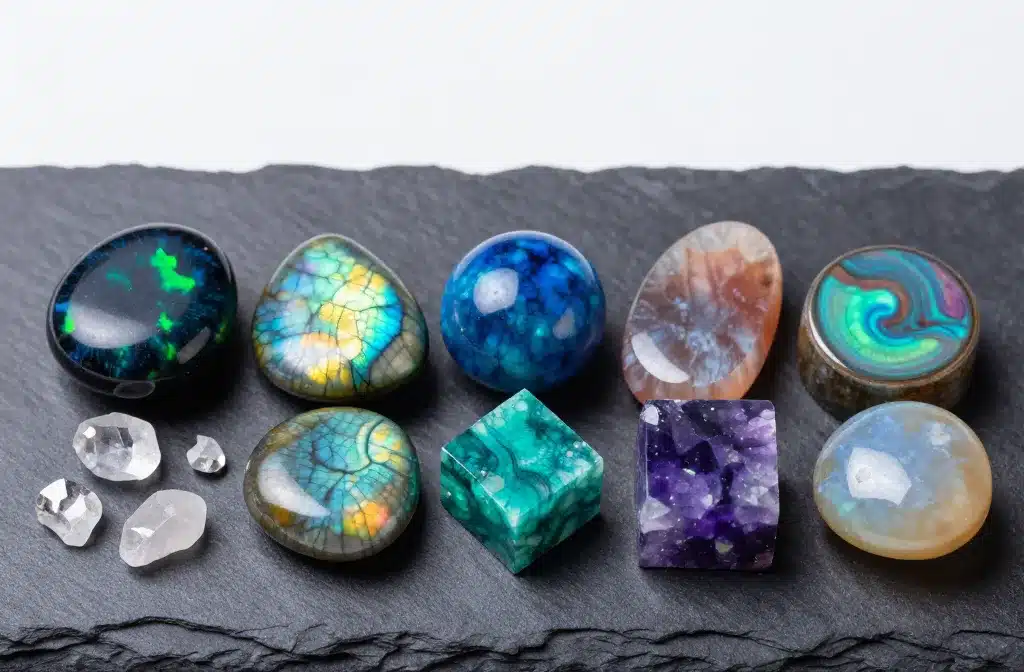
Every so often a stone stops you in your tracks. Not because it’s big or expensive, but because its colors look like they came from an artist’s palette rather than a pocket of the Earth. Those are the specimens that turn casual admirers into forever rockhounds.
In this guide, you’ll meet natural wonders that regularly get accused of being dyed, CGI, or “too perfect to be real.” You’ll learn how their colors form, how durable they are, what they’re used for, which ones belong in jewelry and which ones should stay in cabinets, and how to tell genuine material from treatments and imitations.
Along the way, I’ll share field tips, value clues, and care advice you won’t find on a sales card. If a name piques your curiosity, make a note to explore topics like Gemstone Colors, Gemstone Identification, or a Gemstone Value Guide for deeper dives.
Ready to meet the rocks that look unreal—and are entirely real?
Opal: Lightning Trapped in Stone
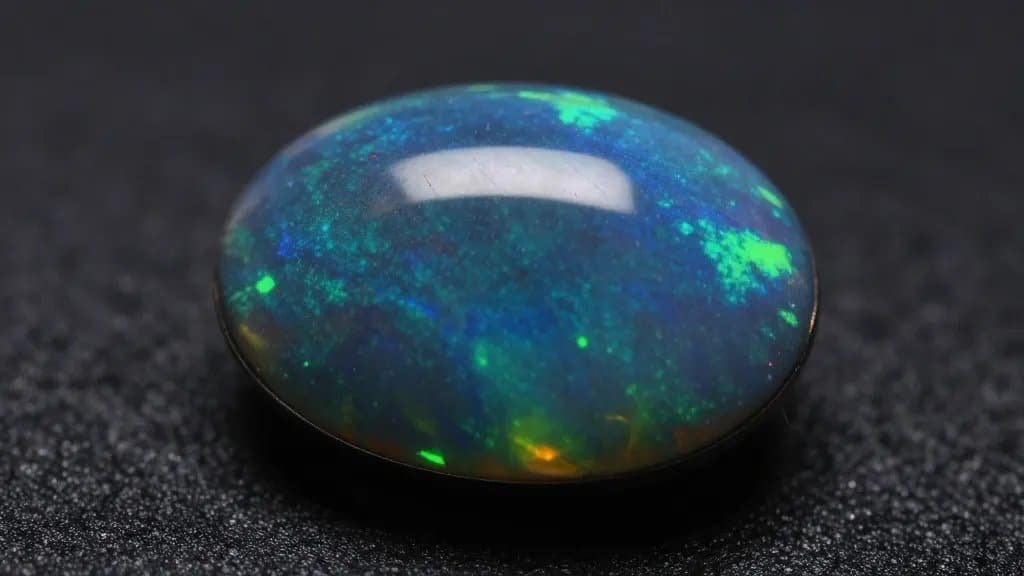
Precious opal can look like electrified confetti: neon greens, tropical blues, flaming oranges, and violet streaks that shift with the slightest tilt. The magic—called play-of-color—comes from microscopic silica spheres stacked like billiard balls; light diffracts through them, splitting into spectral colors.
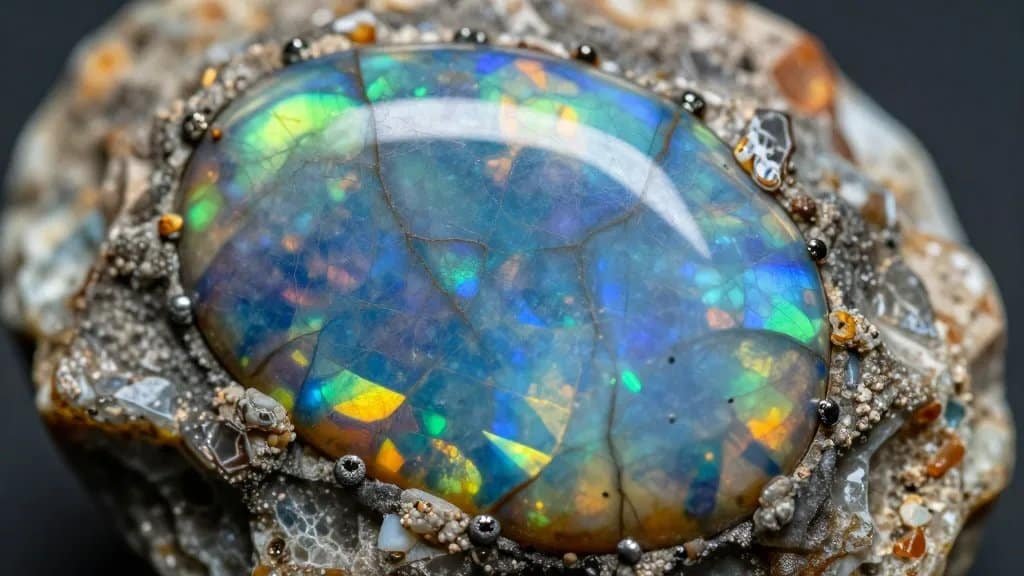
Appearance varies wildly. Black opal from Lightning Ridge shows vivid play-of-color on a dark body, making colors look saturated and dramatic. White and crystal opals have paler bodies but can still flash like a peacock. Boulder opal leaves ironstone attached, adding chocolate-brown contrast to electric veins.
Hardness is 5.5–6.5 on the Mohs scale, and opal contains water, so it’s sensitive to heat, rapid temperature changes, and dehydration. Jewelers often set opals in protective bezels, and earrings or pendants are safer than rings for daily wear.
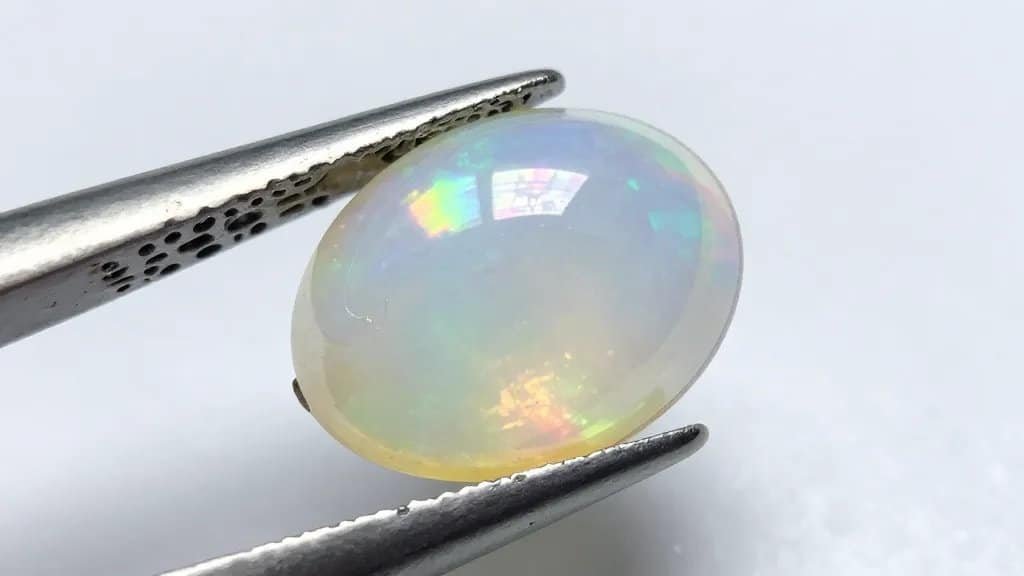
Value climbs with bright, broad color patches, multiple hues (especially red), and a pattern that stays visible across the face. Common treatments include sugar/acid or smoke to darken Ethiopian hydrophane material. To check for hydrophane opal, touch a drop of water—if it absorbs and turns slightly transparent, it’s likely Ethiopian, not Australian. That’s not a flaw, just a different personality with specific care needs: avoid prolonged soaking.
Rainbow Fluorite: Pastel Strata and Northern-Light Bands
Fluorite often forms in bands of mint, purple, teal, and smoky gray, like weather maps stacked in glass. In good light, transparent pieces show a velvety glow; opaque ones read like layered candy. The cubic crystal habit sometimes gives sharp, clean edges that reflect light in geometric glints.
Fluorite is soft—Mohs 4—so it scratches easily and cleaves with little provocation. It’s perfect for display, beads that won’t take daily abuse, or rings you wear only on “museum days.”
Geologically, it forms in hydrothermal veins, often with galena and sphalerite, and can show fluorescence under UV light (from bluish-white to vivid colors depending on trace elements). Untreated material is the norm; if you see colors that look unnaturally uniform, question the source. Look for crisp banding rather than smeary transitions—nature usually leaves a rhythm.
Ammolite: Fossilized Fire
Ammolite is the iridescent outer shell of fossil ammonites, mostly from Alberta, Canada. Under light it can blaze with sheets of emerald, ruby, and sunburst orange, sometimes all at once. The surface shows a mosaic of “dragon skin” fractures that break color into living tiles.
Its color arises from thin-film interference within aragonite layers. Because those layers are delicate, ammolite is typically stabilized with a clear resin and often capped with quartz or spinel in a triplet construction for jewelry. On the Mohs scale, think of the cap, not the ammolite, when considering wearability.
Pricing depends on color range (more hues command more), brightness, and how far the color holds at different angles—“chromatic shift.” Greens and reds are common; blues and violets are rare and priced accordingly. For care, avoid ultrasonic cleaners and extremes of temperature. In a Gemstone Jewelry context, pendants and brooches let ammolite shine safely.
Azurite and Malachite: Earth’s Turquoise and Forest in One Stone
Azurite’s blue is the saturated heart of the sky; malachite’s green is fern-deep and banded. Often, they grow together, painting copper deposits with swirling blue-green patterns that look hand-marbleized. In polished cabochons, malachite reveals rhythmic rings; azurite offers a velvet luster that borders on inky.
Formed by weathering of copper ores in the oxidized zone, these minerals are relatively soft—malachite at Mohs 3.5–4 and azurite about 3.5–4. Cabochons and beads do fine in earrings and necklaces; rings need protective settings and mindful wear. Avoid harsh chemicals; malachite can react due to its copper content.
Natural malachite shows tight, undulating banding and subtle variation. Fake or reconstituted material can look too perfect, with evenly spaced, cartoonish rings and a plastic feel. Check heft (natural feels dense), look for variability in pattern, and view the polish: natural malachite takes a warm, satin polish rather than a mirrored plastic gloss.
Labradorite and Spectrolite: Aurora Borealis in a Slab
Turn a plain gray feldspar and it erupts into electric blue, copper gold, or neon green. That flash—labradorescence—comes from light bouncing between layers inside the mineral, an optical trick born of exsolution lamellae in plagioclase feldspar.
Labradorite from Madagascar typically shows blue-green flashes, while Finnish spectrolite can display near-full rainbows with saturated, high-contrast color. Watch for the “angle of fire”: not all surfaces flash at all angles, which is part of the dance.
At Mohs 6–6.5, labradorite is fine for pendants and earrings; for rings, choose low-profile cabochons and avoid hard knocks. A good polish reveals crisp color windows; a poor one leaves a gray, sleepy face. I like to rotate a slab slowly under a bright, white LED—high-grade stones switch on like neon signs.
Tourmaline: Watermelon Slices and Electric Neon
Tourmaline’s palette stretches beyond believable. The most famous head-turners: pink-and-green “watermelon” slices that show a rind, pulp, and seeds; and Paraíba-type tourmalines, which blaze with copper-induced neon turquoise that looks battery powered.
Tourmaline forms in pegmatites, with color zoning common. Hardness is 7–7.5, making it a robust jewelry choice. Clean with warm, soapy water and a soft brush; avoid ultrasonic cleaners for heavily included stones.
Value cues: for watermelon slices, look for a crisp color boundary and bright saturation without brownish bleed. For Paraíba-type, neon intensity matters more than size; smaller stones can outprice larger greens if they glow vividly. Many pink tourmalines are heat-treated to remove brown tones; reputable sellers will disclose. If you’re comparing Gemstone Cuts, tourmaline often rewards elongated shapes—emerald and pear cuts show off its pleochroism and depth.
Aurora Quartz and Titanium-Coated Dazzlers: Beauty with a Boost
Not every “unreal” color is born that way. Some quartz varieties are vacuum-coated with metals like titanium or niobium to create oil-slick rainbows called aura quartz. The resulting colors are dramatic—think mermaid tails and cosmic sunsets—but they’re a treatment, not a natural optical effect.
Coatings are thin but reasonably durable; still, abrasion can wear them. Mohs hardness defaults to quartz (7), but treat coated stones gently. Identification is easy: look for uniform surface sheen that sits on top of facets rather than arising from within, and check edges for slight color thinning.
These are fun for fashion-forward Gemstone Earrings and festival jewelry. Just buy with awareness: you’re paying for artistry, not rarity. If you want untouched rainbows, opal, ammolite, and labradorite give you nature’s version.
Chrysocolla in Quartz: Tropical Shorelines Solidified
Chrysocolla by itself can be soft and crumbly, but when it permeates quartz, it transforms into a durable gem with beaches-and-lagoons color zones: powdery sky blues against milky white and mossy green. Sometimes it’s sold as “gem silica” when the chalcedony content is high and translucency is striking.
Quality gem silica is one of the most delicious blues in the trade—clean, saturated, and slightly glowing—and it commands strong prices. On the Mohs scale, quartz backing gives you around 6.5–7, suitable for rings and daily-wear pendants. Be wary of dyed magnesite or howlite masquerading as chrysocolla; they often show spiderweb veining and overly uniform blue. Under magnification, dyed stones display color concentrated in surface cracks.
Rainbow Lattice Sunstone: Confetti Under Glass
From Australia’s Harts Range comes a feldspar with geometric iridescent inclusions that line up like holographic confetti. The “lattice” is actually hematite or ilmenite platelets aligned in a crisscross pattern, throwing metallic rainbows.
The body color ranges from pale to amber, with a vitreous polish. At Mohs ~6–6.5, it’s workable for carefully worn rings and standout pendants. Because supply is limited and the effect is distinctive, prices can be strong; always request provenance or an identification report. In a Gemstone Comparisons mindset, it’s unlike Oregon sunstone (which glitters with copper platelets) and more like opalized glitter frozen inside feldspar.
Bismuth Crystals: Staircases from a Sci-Fi City
Though technically a metal rather than a mineral specimen in the traditional sense, lab-grown bismuth crystals develop rainbow oxide patinas and fantastical hopper structures—stepped, Escher-like terraces. The hues shift from lemon-yellow to magenta and sea-green as light plays across the oxide film.
These are created by controlled cooling of molten bismuth; the color is natural to the oxide but human-directed. Mohs hardness is low (~2–2.5), and the crystals are brittle. They’re excellent display pieces and conversation starters but unsuitable for high-wear jewelry. If you see perfect geometric rainbows at rock shows for friendly prices, that’s likely bismuth—not a synthetic gemstone trying to fool you, just honest, delightful alchemy.
Peacock Ore (Bornite and Chalcopyrite): Rainbow Tarnish on Rough Rock
Peacock ore is copper mineralization that breaks into rough chunks with a metallic peacock sheen—purples, blues, and golds. Natural tarnish can look painterly; heated or chemically treated pieces show stronger, more uniform colors.
Bornite is softer (Mohs 3) and often darker; chalcopyrite is around 3.5–4 and brassy beneath the patina. These are display specimens. If you handle them, expect a little metallic rub-off, and don’t wash with cleaners that can strip the color. The charm lies in their raw, sparkling skins.
Benitoite: California’s Electric Star
Benitoite, California’s state gem, flashes a piercing sapphire-to-cornflower blue with a crisp, high refractive brilliance. Under shortwave UV, it fluoresces a fiery blue-white, almost shocking. Well-cut stones look like drops of night sky lit from within.
It’s rare—most fine material came from the San Benito County mine—and sizes above a carat are prized. Mohs hardness is about 6.5, with good toughness for careful jewelry. Expect premium pricing for unclouded, vivid stones with expert cutting. This belongs on any short list of Collector Gemstones, and its scarcity means fakes are more often mislabels than true synthetics; sapphire or spinel might be substituted. Distinguish by dispersion (benitoite shows more fire) and UV behavior.
Real vs. Treated: Quick Identification Habits
- Color uniformity: Nature loves gradients and zoning. Perfectly even neon may signal dye or coating.
- Surface vs. internal color: Rotate under a strong light. If color skates over the surface, think coating; if it blooms from within, likely natural phenomena like diffraction or internal inclusions.
- Magnification: A 10x loupe reveals dye concentrations in fractures, gas bubbles in glass imitations, and platelets or spheres responsible for optical effects.
- Weight and temperature: Plastics and resins feel warm and light; quartz and copper minerals feel cool and dense.
- Provenance and paperwork: For scarce beauties—Paraíba tourmaline, benitoite, rainbow lattice sunstone—ask for origin notes or lab reports.
Buying Advice: Bring Your Eyes, Not Just Your Wallet
For stones that look unreal, brightness is the north star. Opal, ammolite, and labradorite should light up under diffused daylight and still hold color indoors. Tilt them; do the colors hang on, or do they vanish at a narrow angle? Persistent play adds value.
Match the stone to its use. Fluorite and malachite deserve gentle wear or display. Tourmaline, quartz-backed chrysocolla, and labradorite can handle more. If you’re exploring Gemstone Rings or Gemstone Necklaces, pick settings that shield softer gems—bezels, halos, or protective galleries.
Budget for cutting quality. A sleepy labradorite can become electric with the right orientation; an opal with a thick, opaque base won’t gain life from polishing alone. Skilled cutting is an invisible upgrade that changes everything.
Lastly, collect with joy. A vividly banded malachite cab can be as satisfying as a neon tourmaline if it sings to you. Keep notes: source, seller, and any lab remarks. Over time, your cabinet becomes a personal Gemstone History you can trace stone by stone.
Care and Cleaning: Keeping the Magic Bright
- Opal and ammolite: Avoid ultrasonic and steam. Use a soft damp cloth and mild soap. No extreme heat.
- Fluorite and malachite/azurite: Lukewarm water, very mild soap, soft cloth. No acids, no prolonged soaking.
- Labradorite and tourmaline: Warm soapy water, soft brush, rinse well. Ultrasonic only if the stone is clean and inclusion-free.
- Coated quartz and bismuth: Wipe gently; avoid abrasion and chemicals.
- Storage: Keep softer minerals in padded boxes, away from harder neighbors. Opal likes stable humidity; don’t bake it on a windowsill.
Who Should Wear These Colors?
If you love mood-shifting stones, opal and labradorite read as introspective and changeable—great for creatives and night owls. Tourmaline and chrysocolla feel vibrant and steady, perfect for daily color. Ammolite and benitoite are statement-makers for special pieces where the stone does the talking.
Symbolically, malachite is tied to transformation, azurite to insight, and tourmaline to protection. Believe as you like; meaning adds a personal layer to the visual pleasure. For gift ideas, check Gemstone Gifts and Birthstone Jewelry if you want to align color with tradition.
FAQ
Is the neon color in Paraíba tourmaline natural?
Yes. Copper and manganese in the crystal lattice produce the electric blue-green. Heat may enhance clarity or adjust tone, but the glow is elemental.
How do I tell Ethiopian opal from Australian opal at home?
Ethiopian hydrophane opal often absorbs water, temporarily changing transparency. Australian black opal won’t. Also, Ethiopian pieces can show honeycomb-like patch patterns distinct from Australian styles.
Can I wear fluorite in a ring every day?
Not ideal. At Mohs 4 with perfect cleavage, it chips and scratches easily. Reserve for occasional wear or choose a protective setting and mindful habits.
Are aura quartz crystals considered “fake”?
No. They’re natural quartz enhanced with a metallic coating. They’re treated, not counterfeit—just buy them as what they are.
What makes labradorite flash more in some stones than others?
Orientation and quality of internal lamellae. cutters must find the plane that turns the light on; misalignment yields a dull face.
Does malachite need special care?
Yes. Avoid acids and harsh cleaners, and store separately to prevent scratches. Wipe with a soft, slightly damp cloth.
Why is benitoite so expensive for its size?
Limited source, true rarity, and exceptional optical properties. Fine stones above one carat are scarce, driving value.
Final Thoughts
The Earth doesn’t just make stones—it paints with them. From opal’s living fire to tourmaline’s neon and labradorite’s auroras, these colorful rocks and minerals look unreal because their chemistry and structure bend light in extraordinary ways. Learn what each stone can handle, choose settings that respect their quirks, and let your eyes guide your collection. The most rewarding pieces are the ones that still surprise you when you turn them in your hand.

Christian Grey is the creator of GemMeaning, where he shares simple insights about crystals, gemstone meanings, and spiritual guidance. His focus is on making complex ideas easy to understand and practical for everyday life.