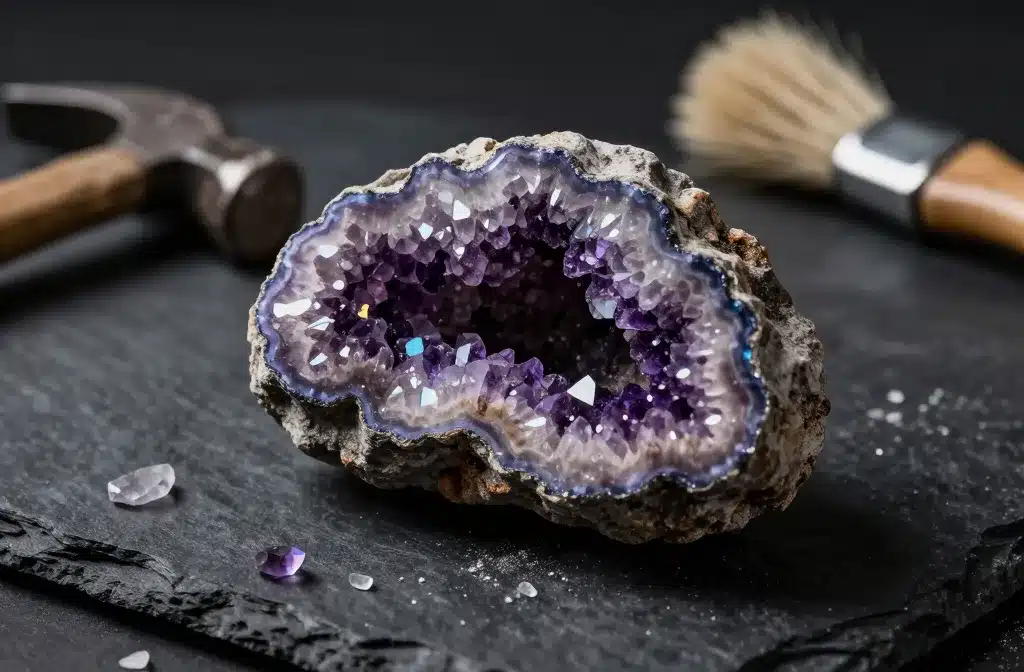
Pick up a plain-looking stone and you might be holding a miniature vault. Nature often hides its brightest colors, clearest crystals, and strangest patterns behind dusty skins. The real thrill isn’t just the sparkle—it’s the surprise.
This article shows you what gems and minerals can lurk inside unremarkable rocks, how they form, what they look like on the outside, and how to reveal them without ruining the prize. You’ll also learn simple identification tips, value clues, and practical care once you’ve made a discovery.
We’ll explore geodes that crack open like candy, opal that flashes fire from a drab host, and agates that sketch landscapes in banded stone. Along the way, you’ll pick up field-smart advice from a gem enthusiast who has cracked, cut, and polished more than a few “ordinary” rocks into keepsakes.
Ready to see what’s hiding in plain sight? Let’s go hunting.
Why Ordinary Rocks Hide Extraordinary Interiors
Many gemstones form in cavities, fractures, or porous zones inside other rocks. Mineral-rich fluids slip into these spaces, then cool or evaporate, leaving behind crystals or silica gels that harden over time. What you see outside is the original host—often weathered, chalky, or bland—while the interior holds the magic.
Hard outer “rinds” can protect delicate formations like quartz crystals or opal from decades of erosion. That’s why a lumpy geode or a crusty piece of petrified wood can split to reveal vivid crystals, silky chalcedony, or fiery play-of-color. The drab disguise isn’t the exception—it’s the rule.
Geodes: Sparkle Sealed in Stone
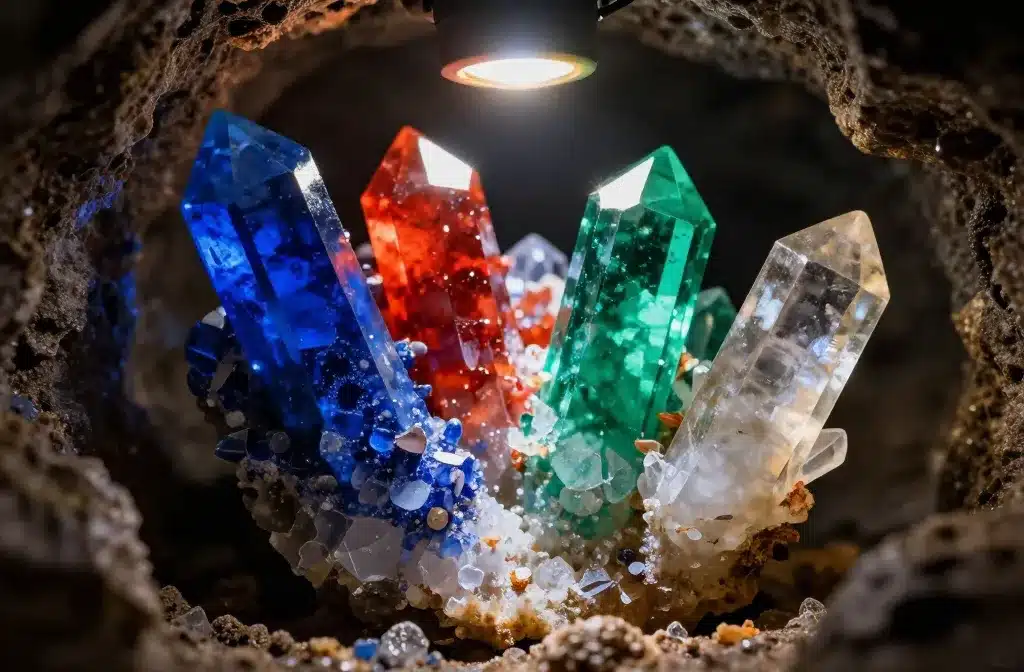
Geodes are nature’s lockboxes—rounded nodules with hollow centers lined by crystals. On the outside, they look like potato-shaped gray or tan lumps. Inside, they can be starry with rock crystal quartz, frosting-white with calcite, or saturated purple with amethyst.
Appearance and colors: The inner sparkle depends on chemistry and temperature during formation. Clear quartz is common; amethyst appears when trace iron and radiation meld just right. Less common interiors include blue chalcedony, agate bands, and even rare citrine or smoky quartz. Look for tiny druses that glitter like sugar or larger crystal points that catch light like a chandelier.
Formation and origins: Geodes often form in volcanic ash beds and basalt flows, or in sedimentary limestones where bubbles and cavities later infill. Notable sources include Brazil, Uruguay, Mexico, Morocco, and the American Midwest and Southwest.
Hardness and durability: Quartz-lined geodes rate 7 on the Mohs Scale and can be quite durable, though the thin crystal points inside chip easily.
Identification tips: True geodes feel lighter than a solid stone of the same size due to the hollow center. Tap gently—some give a soft echo. Exteriors often show a bumpy “warted” surface. To open, use a specialized geode cracker or a pipe cutter for a clean split rather than a hammer, which can shatter the interior.
Value notes: Larger, symmetrical crystals with vivid color fetch more. Undamaged crystal terminations, even growth, and attractive matrix contrast raise desirability. Amethyst centers typically bring higher prices than plain quartz.
Agates and Thunder Eggs: Banding, Eyes, and Scenes in Stone
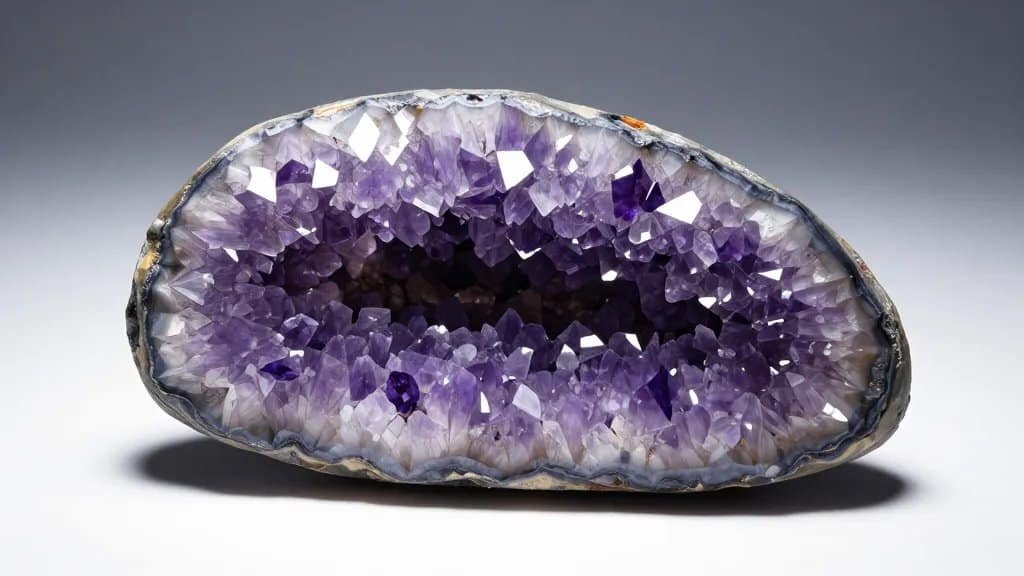
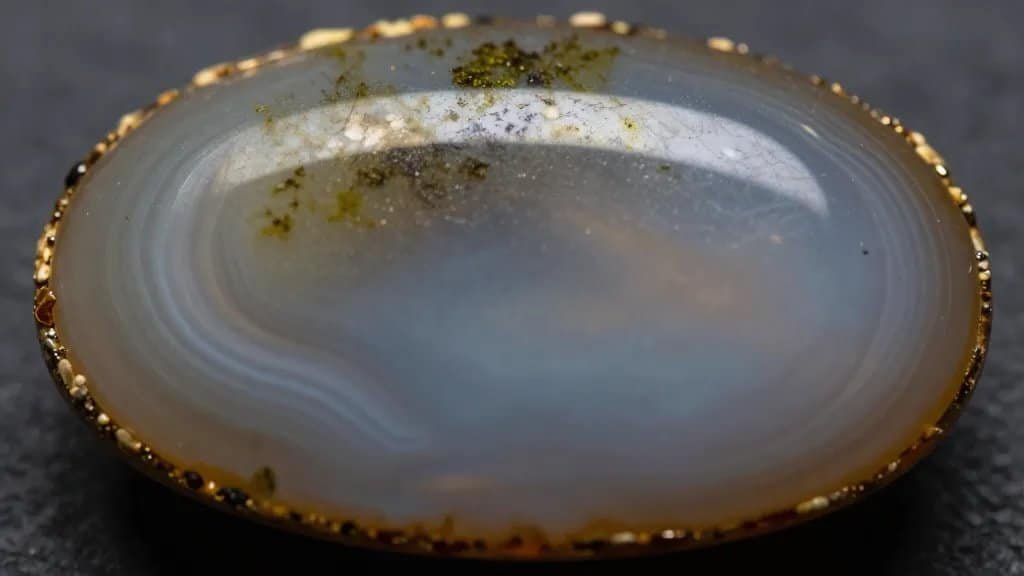
Agate is chalcedony that forms in layers, often inside cavities where silica-rich fluids deposit successive bands. A “thunder egg” is a specific agate-bearing nodule formed in rhyolite or tuff. From the outside, these nodules can be lumpy, gray-brown, or angular—not exactly jewelry material. Cut and polish them, though, and you’ll find banded cathedrals, fortification patterns, orbs, or scenic landscapes.
Appearance and colors: Agates show translucent to opaque bands in whites, grays, blues, reds, and browns, often with intricate fortification lines resembling topographic maps. Eye agates feature round, concentric orbs. Moss agate looks like botanical sketches—green or black inclusions resembling ferns or algae suspended in clear chalcedony.
Hardness and durability: Typically Mohs 6.5–7. Agate takes a fine polish and is tough enough for rings, pendants, and bracelets.
Identification tips: Look for subtle lines or color hints on chipped edges. When wet, even a rough exterior may reveal faint banding or a waxy luster—a classic chalcedony clue. Thunder eggs often show radial cracks, a starry pattern, or a subtle seam hinting at an agate core.
Value factors: Unusual color contrasts, strong translucency, crisp banding, and eye or landscape patterns raise value. Large, unfractured halves suitable for display are sought by collectors.
Opal Hiding in Common Host Rock
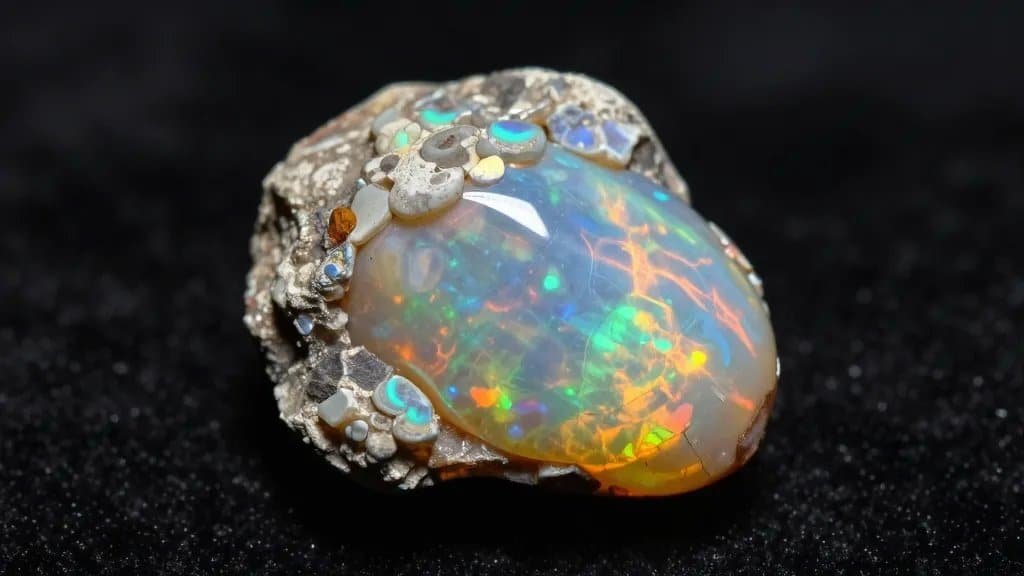
Few surprises match opal—silica spheres stacked so neatly that they diffract light into fire. But precious opal often grows in nondescript ironstone, basalt, or sandstone, especially in fields like Australia’s Queensland boulder opal. Without cutting, you might see only a soft sheen or a smudge of color at a fracture.
Appearance and colors: The prize is play-of-color—flashes of red, green, blue, and orange that shift as you move the stone. Boulder opal shows veins and patches of opal peeking through brown ironstone. Common opal (potch) lacks play-of-color but can display pleasing pastels—pinks, blues, and minty greens.
Formation: Opal forms from silica-rich water that seeps into cavities and hardens as a gel. Over time, ordered silica spheres produce precious opal; disordered spheres form common opal.
Hardness and durability: Opal sits at 5–6.5 Mohs and contains water, making it more delicate. Boulder opal gains strength from its ironstone backing; seam and crystal opal require gentler handling.
Identification tips: Look for a soft, waxy luster and “jelly” translucency. Tilt the stone under bright light to catch fleeting color. A small window of fire near a crack may signal a larger vein inside. Avoid soaking suspect pieces; sudden drying can craze opal.
Value notes: Brightness, range of colors (especially red), pattern distinctness (harlequin, pinfire, broadflash), and size all matter. Natural opal carries more value than assembled doublets or triplets. For more context, see topics like Gemstone Value Guide and Gemstone Identification.
Geological Time Capsules: Petrified Wood and Fossil-Filled Stones
Not all hidden treasures are sparkly. Petrified wood forms when silica replaces woody tissue cell by cell, preserving bark textures and growth rings in stone. Exteriors can look dusty or earthy; a cut face reveals silky chalcedony grains in browns, reds, yellows, and sometimes vivid blues or greens if trace elements are present.
Appearance and colors: Expect wood-like banding and pore structures locked in quartz. Rainbow petrified wood from Arizona shows iron, manganese, and chromium coloring. Polish brings a warm, glassy sheen that highlights the grain.
Hardness and durability: Usually around Mohs 7. It polishes beautifully and holds up well in decor and jewelry, though larger pieces can be heavy.
Fossil stones: Limestone nodules can conceal fossil shells; flint and chert may host fossilized sea life—brachiopods, crinoids, or trilobite impressions. Split nodules in fossil-rich strata can be unexpectedly ornate, with delicate chamber patterns or pyritized details that gleam brassy gold.
Value factors: Complete, well-preserved structures, attractive color, and polish quality increase desirability. Rare species or dramatic cross-sections command premiums among Collector Gemstones enthusiasts.
Nodules and Concretions: Unassuming Shapes with Bold Interiors
Concretions are mineral cements that grow around a nucleus—sometimes a leaf, shell, or even a small fossil fragment. They can trap mineral-laden fluids and develop colorful interiors of calcite, aragonite, siderite, or chalcedony. Septarian nodules are a standout: brown limestone shells intersected by yellow calcite “lightning-bolt” veins and gray chalcedony infills.
Appearance and colors: From the outside, concretions look like smooth, eggy stones. Inside, septarian reveals crackle patterns in warm neutrals—honey, chocolate, slate gray. Polish turns those veins glossy against a matte matrix.
Hardness and durability: Varies by mineral; calcite is 3 Mohs and scratches easily, while chalcedony is much harder. Mixed-mineral nodules need gentle handling during cutting to prevent undercutting of softer zones.
Identification tips: Weight can be deceptive—some concretions are dense. A small test window with a lapidary wheel can reveal interior color before committing to a full cut. Avoid hammering; internal fractures can radiate and ruin the pattern.
Less-Expected Finds: Garnet, Tourmaline, and Hidden Quartz Varieties
Not all treasures come in hollow pockets. Metamorphic rocks—schists and gneisses—often hide garnet crystals. A plain, flaky schist may show dodecahedral garnet “knots” that appear as dark, rounded bumps. Split the rock, and crimson to wine-red crystals might emerge, sometimes translucent when backlit.
Appearance and colors: Almandine garnet tends toward deep red to burgundy; grossular can be green or honey-brown. Crystals may be embedded and incomplete but can still look striking sliced and polished.
Hardness and durability: Garnet is 6.5–7.5 Mohs, tough enough for rings and bracelets. Fractures can occur where the crystal meets softer matrix.
Tourmaline and beryl: In pegmatites, drab granite boulders can hide slender tourmaline pencils (black schorl common; green and pink less so) or pale beryl (aquamarine hints). On a broken face, look for prismatic shapes with striations running lengthwise.
Quartz surprises: Even a dull quartzite may hide smoky zones or rose quartz pockets. Chalcedony nodules can encase carnelian—orange to red from iron—only revealed after heat or sunlight deepens the hue.
Value clues: Sharp crystal form, transparency, and vivid color raise value. Matrix specimens with attractive display aesthetics are popular with collectors even when individual crystals are too included for faceting.
How to Read the Outside to Predict the Inside
Field identification is a mix of experience and informed guesses. These checks help without special gear:
- Surface texture: Warty or cauliflower skin often hints at a geode; smooth, rounded “eggs” can be concretions or thunder eggs.
- Weight and sound: Hollow geodes feel light and may echo. Dense, metallic heft could indicate iron-rich nodules or pyritized fossils.
- Fracture hints: Look at natural chips or breaks. Any waxy or glassy sheen? Faint banding? Tiny quartz points? Those are green lights.
- Color bleed: Rusty oranges and reds on the outside can signal iron staining—and possibly colorful interiors like carnelian or boulder opal.
- Environment: Volcanic areas favor geodes, agates, and thunder eggs; sedimentary limestones yield calcite geodes and fossils; metamorphic belts can hide garnet and kyanite.
If you’re building skills, explore related topics such as Gemstone Identification, Gemstone Hardness, and Gemstone Comparisons to understand how different minerals behave and break.
Opening, Cutting, and Polishing Without Breaking Your Find
Gentle methods protect your prize. For suspected geodes, a chain-style geode cracker or pipe cutter provides even pressure and cleaner halves. Avoid a direct hammer blow unless you accept the gamble.
For nodules and thunder eggs, use a slab saw with plenty of coolant. Plan your cut by studying external lines or seams to frame the most interesting pattern. Mark a cut line with a wax pencil. On mixed materials like septarian, use a slower feed rate to prevent spalling of softer calcite against harder chalcedony.
Polishing tips: Agates and quartz respond well to progressive grits and cerium or tin oxide finish. Calcite and aragonite polish differently—use lighter pressure and keep the stone cool to avoid “orange peel” texture. A final buff should feel like silk under your finger.
Safety always: Wear eye protection, gloves when appropriate, and a mask when cutting silica-rich stones. Silica dust is dangerous. Wet cutting and good ventilation are non-negotiable.
Real vs. Fake: What’s Natural, What’s Enhanced
Most “hidden treasures” are natural, but enhancements are common once a piece hits the market. Know the norms:
- Agate dyes: Bright neon blues, greens, or purples in slabs or bookends often mean dyeing. Natural agate colors are typically earthy, though they can be vivid.
- Crackled quartz and aura coatings: Heat-and-dye or metallic vapor coatings can produce unreal colors. Look for unnatural surface iridescence or color concentrated along cracks.
- Assembled opal: Doublets and triplets sandwich thin opal between a base and a cap. Side view reveals layered construction. Still beautiful, just priced accordingly.
- Reconstructed stones: Some “turquoise” or “malachite” products are reconstituted powders in resin. Uniform patterns and too-perfect coloring are clues.
If you’re shopping, consult a Gemstone Buying Guide and Gemstone Value Guide for typical enhancements and fair pricing expectations.
Caring for Your Finds and Turning Them into Jewelry
Care depends on hardness and structure. Quartz-family pieces (agate, geode quartz) handle daily wear well. Opal, calcite, and aragonite are sensitive to heat, chemicals, and sudden blows.
- Cleaning: Warm, soapy water and a soft brush suit most stones. Avoid ultrasonic cleaners for opal, dyed stones, or heavily fractured pieces.
- Storage: Keep softer stones separate. Opal benefits from moderate humidity; avoid sealed, arid environments.
- Jewelry suggestions: Agate slices make bold pendants and earrings. Boulder opal shines in rings with protective bezels. Geode halves become statement necklaces or home accents. For durability insights, explore Gemstone Jewelry and Gemstone Rings.
- Settings: Protect edges and tips with bezels or halo designs, especially for brittle interiors like drusy surfaces that can snag.
What Makes a Hidden Treasure Valuable?
Value isn’t just about sparkle. Collectors and jewelers look for:
- Visual drama: Strong color, striking patterns, or arresting crystal form.
- Integrity: Few fractures, solid polish, and stable structure.
- Rarity: Unique patterns (harlequin opal), unusual locales, or large, undamaged interiors.
- Craft potential: Good orientation for cutting, slab potential, or display-friendly symmetry.
Don’t overlook sentiment. A geode you cracked with your child or an agate you cut on your first saw session has value no auction can measure.
Common Mistakes to Avoid in the Hunt
- Smashing instead of planning: A single hammer blow can turn a museum-worthy interior into gravel. Use proper tools.
- Ignoring location: Scouting the right geology saves time. Ask local clubs or landowners, and follow regulations.
- Overheating while cutting: Heat causes fractures and burned polish, especially in calcite, opal, and mixed nodules.
- Assuming every nodule is a geode: Many are solid all the way through—still beautiful if they’re agate, but not hollow.
- Skipping documentation: Note where you found it. Provenance can add interest and value for Collector Gemstones.
FAQs
How can I tell if a rock might be a geode without breaking it?
Check weight (often lighter), surface texture (bumpy rind), and sound (a soft echo when tapped). A strong flashlight may reveal internal crystal glints at small natural openings.
What basic tools do I need to start cutting nodules and geodes?
A geode cracker or pipe cutter for opening, a slab or trim saw with coolant, a marker, and polishing equipment with progressively finer grits. Safety glasses and a respirator are essential.
Is dyed agate worth buying?
Yes, if priced as dyed material and you like the look. It’s common in decor items. For serious collecting, natural coloration holds more long-term appeal.
Can I wear opal jewelry every day?
With care. Choose protective settings, avoid impacts and harsh chemicals, and remove opal rings during exercise, cleaning, or dishwashing.
What’s the difference between a thunder egg and a geode?
Thunder eggs are usually solid or partially filled with agate or chalcedony in rhyolite hosts. Geodes are typically hollow cavities lined with crystals, often in volcanic or sedimentary rocks.
Why did my opal craze after I cleaned it?
Rapid drying or heat can cause fine cracks. Avoid hot water, steam, or prolonged low humidity. Use mild soap, cool water, and gentle drying.
Where are the best places to search for hidden treasures?
Volcanic fields, old basalt flows, limestone quarries for calcite geodes, and known agate beds. Join a local rock club for site access and guidance.
Final Thoughts
The plain stones at your feet can hold color, light, and history that only reveal themselves with patience and the right touch. Learn to read the clues, open them carefully, and you’ll find that “ordinary” rocks often carry extraordinary stories—perfect for your collection, your jewelry bench, or the shelf where you keep your favorite wonders.

Christian Grey is the creator of GemMeaning, where he shares simple insights about crystals, gemstone meanings, and spiritual guidance. His focus is on making complex ideas easy to understand and practical for everyday life.